


Photo: Panel on End-of-Life care. From left: Dr Asif Raza, Dr Zujaj Quadri and Sooaad Dahoud. Photos courtesy of One Studio.
Nearly 200 healthcare professionals and students attended the sold-out inaugural Australian Islamic Medical Association (AIMA) NSW State Conference on Saturday 29 August at Western Sydney University’s Bankstown City Campus.
AIMA national leaders from across Australia joined NSW members, expert speakers, government and university representatives, sponsors and community partners for a full day of professional education, networking and reflection.

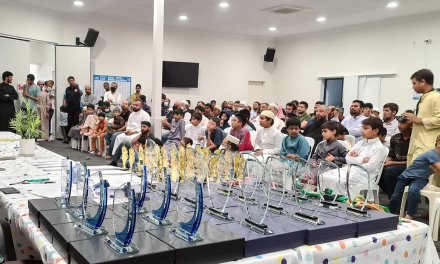
Group photo of speakers, delegates, sponsors and volunteers at the AIMA NSW State Conference on Saturday 29 August 2026 at Western Sydney University Bankstown. Photos courtesy of One Studio.
Held under the theme “Caring Together: Advancing Health Across Communities and Professions”, the conference combined clinical education with Islamic perspectives on compassionate service, cultural safety and professional responsibility.
The program was accredited for six hours of RACGP educational activities and covered women’s health, cancer care, cardiometabolic disease, neurodiversity, end-of-life care, clinician burnout and the legal challenges facing Muslim healthcare professionals.
The conference opened with Quran recitation and reflections on Surah Al-Balad by Liverpool Hospital junior medical officer and AIMA NSW JMO and Student Co-President Dr Omar Hamed.
He compared the demanding path of medical training and clinical practice with the Quranic concept of undertaking the difficult, upward path in service of others.
“May you all learn something useful today that allows you to leverage your skills and expertise in a way that serves our community,” he told delegates.
NSW Chief Health Officer Dr Kerry Chant, AO, PSM said collaboration across professions, services and communities was essential to achieving better health outcomes.
“More than 2.2 million people in New South Wales speak a language other than English at home,” Dr Chant said, noting the state’s extraordinary cultural and linguistic diversity.
“Building trust requires ongoing relationships, sustained engagement, and a willingness to understand the needs and experiences of different communities.”

Western Sydney University Executive Dean of Health Professor Sarah Lewis welcomed delegates to the Bankstown campus and highlighted the university’s commitment to equitable and compassionate healthcare education.
“Healthcare excellence is not simply about clinical knowledge and technological advancement,” Professor Lewis said.
“It’s about understanding people, respecting culture, embracing diversity, and ensuring that every individual can access safe, compassionate and responsive care.”
NSW Minister for Industrial Relations and Work Health and Safety Sophie Cotsis MP praised AIMA for supporting Muslim healthcare professionals while serving the wider Australian community through education, advocacy, leadership and practical health initiatives.
Addressing inequality in healthcare
A women’s health panel featuring physiotherapist Nora Salem, obstetrics and gynaecology registrar Dr Marrwah Ahmadzai, therapist Abeda Iqbal and public health lecturer Dr Sadia Hossain examined barriers affecting women’s access to healthcare.

Panel on womens health. From left: Dr Sadia Hossain, Dr Marrwah Ahmadzai, Nora Salem and Abeda Iqbal.
Ms Salem discussed how modesty, physical contact and gender preferences could become barriers for Muslim patients when clinicians lacked cultural understanding.
“Cultural safety is not so much about what we believe,” she said. “It’s about whether the patient in front of us feels safe and respected.”
Dr Ahmadzai highlighted poorer obstetric outcomes experienced by Muslim and culturally and linguistically diverse women, while Ms Iqbal addressed domestic and family violence and the importance of recognising warning signs and maintaining careful clinical documentation.
Medical oncologist Dr Alina Mahmood explored cancer inequalities in culturally diverse communities, where delayed diagnosis and barriers to treatment can contribute to poorer outcomes.

Dr Alina Mahmood
She said the Islamic understanding of the body as an amanah, or trust, could encourage Muslims to pursue screening and treatment while maintaining trust in Allah’s decree.
Cardiologist Dr Faraz Pathan challenged conventional approaches to cardiometabolic disease, noting that commonly used cardiovascular risk assessment tools may underestimate risk among some culturally diverse populations.
He highlighted evidence showing South Asians experience heart attacks at a younger age on average, reinforcing the need for tailored prevention and management strategies.
Faith-informed compassionate care
One of the conference’s key sessions examined end-of-life care through an Islamic lens.
Palliative medicine specialist Dr Zujaj Quadri, intensivist and anaesthetist Dr Asif Raza and paramedic Sooaad Dahoud discussed advance-care planning, symptom management, brain death, organ donation and the communication challenges faced by families during critical illness.
Dr Raza outlined contemporary Islamic scholarly perspectives on brain death and organ donation, including circumstances in which organ donation may help save human life.
Senior clinical and forensic psychologist Hanan Dover presented a strengths-based approach to neurodivergence among Muslims.
Sharing her experience of receiving autism and ADHD diagnoses later in life, she encouraged clinicians and communities to move away from seeing difference as a deficit.
“Difference is not deficit,” she said, calling for supportive environments grounded in dignity rather than stigma.
Protecting Muslim healthcare workers
A medico-legal session led by lawyer Nick Hanna and employment and discrimination lawyer Nikolai Haddad examined professional complaints, workplace disciplinary processes, social-media conduct and the rights of healthcare professionals.

Nick Hanna (left) and Nikolai Haddad.
The speakers discussed professional and regulatory issues faced by healthcare workers engaging in public advocacy, including matters relating to Palestine, and offered practical advice for practitioners navigating employer or regulatory processes.
AIMA Board Chair Dr Yousuf Ahmad said the organisation opposed anti-Semitism, Islamophobia and all forms of religious discrimination while defending freedom of expression for healthcare professionals.
He outlined five AIMA work streams involving engagement with regulators, governments, community organisations, professional bodies and legal services.
Resilience through faith
In the closing keynote, AIMA National President and consultant neuropsychiatrist Dr Omer Shareef examined the growing problem of burnout across the medical profession.

Dr Omer Shareef.
He said burnout was frequently a systemic problem rather than a failure of individual willpower and called for organisational reform alongside personal strategies for resilience.
Dr Shareef also explored the role of sleep, dhikr, salah and emotional regulation in protecting clinician wellbeing.
“Islam doesn’t ask us to suppress our emotions,” he said. “Islam is asking us to regulate our emotions.”
Service beyond the conference
AIMA founding president and urologist Dr Muhammad Afzal Kahloon presented the work of HEAL International, AIMA’s humanitarian medical initiative.
He highlighted support for evacuated medical graduates from Gaza, cataract and paediatric screening programs in Fiji and Sri Lanka, and a micro-donation campaign encouraging supporters to contribute the value of a daily cup of coffee.
Sponsors and partners
Sponsors supporting the conference included Diamond Sponsor Crystal Radiology Group; Gold Sponsors Mecca Property Group, Novartis and MIPS; and Silver Sponsors Douglass Hanly Moir Pathology, Nestlé Australia, Precision Circumcision Clinic, Carers NSW and One Studio.
Western Sydney University supported the event as a venue partner, with AMUST serving as Media Partner.

Mr Shahid Iqbal, founder of Crystal Radiology Group, shared his journey from arriving in Australia as an international student in 2000 and completing an MBA at UNSW to building a diagnostic imaging network of 25 practices across Australia.
He also discussed opportunities to improve access to healthcare services and highlighted the role of collaboration in supporting underserved communities.
During her conference address, Mehar Ahmad, President of Seena Inc, publishers of AMUST, invited health professionals to share their expertise through accessible health-awareness articles on AMUST multimedia platforms and in AMUST Monthly Print and Digital, helping families better understand prevention, early intervention and important medical issues.
MC for the event, Dr Sarah Yusuf performed an excellent job, coordinating the program in a timely manner and guiding the conference throughout the day.

From left: Prof Habib Bhurawala, Dr Elhassan Elabbas, Dr Kerry Chant, Dr Fouzia Khan, Dr Sara Yusuf, Dr Asif Raza and Dr Faraz Pathan.
The program ended with recognition of the AIMA NSW conference organising team and all the volunteers who worked behind the scenes to make the event such a success including Ms Rubinah Ahmed, AIMA Office Manager, whose efforts in coordinating the conference were highly acknowledged.
The sold-out event highlighted growing interest in professional education that integrates clinical excellence, cultural understanding and faith-informed service.
AIMA’s national mission is to unite and inspire Muslim healthcare professionals in the service of humanity.
AIMA National Conference 2027
AIMA’s next National Conference will be held at Sea World Resort on the Gold Coast from Sat 12 – Sun 13 June 2027, over the King’s Birthday long weekend, bringing together Muslim healthcare professionals and students from across Australia.
Early bird registrations are now open at aimaconference.com, with early bird pricing available until 31 October 2026. Discounted accommodation rates are also available for conference delegates at tinyurl.com/aimaseaworld. Rooms at the special rate are limited, so early booking is recommended. Each room booking includes two complimentary Sea World tickets, with unlimited entry for the duration of the stay at Sea World Resort.





Comments