


There are moments in history when politics seeks to turn back the clock, even though society has already moved forward. Australia is experiencing one such moment.
Recent remarks by One Nation leader Pauline Hanson questioning whether there are “good Muslims”, her continued attacks on multiculturalism, and rhetoric that echoes nostalgia for a bygone era have once again reminded Muslim Australians that some politicians still see us not as fellow citizens but as perpetual outsiders.
Her comments have drawn widespread condemnation across the political spectrum and reignited debate about race, belonging and the future of multicultural Australia.
Yet history tells a very different story.
Muslims are not newcomers passing through. We are doctors, engineers, teachers, academics, business owners, journalists, tradies, public servants and community volunteers.
We are raising children, caring for elderly parents, paying taxes, serving in our armed forces and contributing to every aspect of Australian life.
Simply put, we are here to stay.
This reality was captured powerfully by Greens Senator Mehreen Faruqi after the Federal Court dismissed Pauline Hanson’s appeal in the racial discrimination case arising from her infamous “go back to Pakistan” remarks.
Senator Faruqi declared that the decision was a victory for every Australian who had ever been told they did not belong and had been made to feel their place in this country was conditional.
She is right.
Belonging should never depend upon the colour of one’s skin, the country of one’s birth or the faith one professes.
Our own family history illustrates what modern migration has achieved.
More than sixty years ago, two young Muslim men from India embarked on remarkably similar journeys that ultimately took them to opposite sides of the world.
One was Dr Asim Hussain, a graduate of the prestigious King George’s Medical College in Lucknow. In 1965, he turned westward and migrated to the United States, eventually settling in Detroit.
Like countless immigrant physicians of his generation, he devoted himself to medicine, raised a family, help build community institutions and embraced America as home.
Today, four generations of his descendants and extended family are spread across the United States. They are proud of their Indian Muslim heritage, but they are unmistakably American.
Their children know no other homeland. They have become an integral part of the social, professional and civic fabric of the nation.
The other was Professor Qazi Ashfaq Ahmad who moved Eastwards, down under moving to Australia in 1971.
A self educated Islamic scholar, distinguished mechanical engineer and academic, he helped pioneer Muslim community organisation in Australia at a time when Muslims represented only a tiny fraction of the national population.
Over the next five decades, he contributed not only to engineering and academia but also to building mosques, Islamic schools, community organisations and interfaith relationships that strengthened Australia’s multicultural landscape.
His service was recognised nationally with the Medal of the Order of Australia (OAM).
Today, his family extends across four generations, numbering more than 85 members. They are academics, engineers, teachers, doctors, entrepreneurs and professionals who proudly call Australia home.
Last weekend, these two remarkable family stories intersected once again.
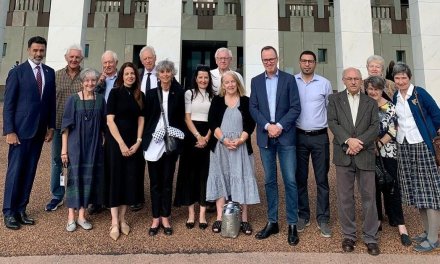
Three generations of Dr Asim Hussain’s eldest son, Rafe Hussain’s family stayed with the family of Dr Qazi Ashfaq Ahmad’s OAM eldest son, Ziaul Islam Ahmad OAM at Dar-ul-Islam in Bonnyrigg.
The formal gathering on Sunday 2 August 2026 was far more than a family reunion. It became a celebration of migration, opportunity and gratitude.
Children and grandchildren who had never lived anywhere except America or Australia shared stories of careers, education, friendships and family life. While they cherish their Indian Muslim heritage, their identities are firmly rooted in the countries of their birth.
They are Americans.
They are Australians.
They are Muslims.
There is no contradiction between these identities.
Indeed, they enrich one another.
This is precisely what critics of multiculturalism often fail to understand.
Migration is not about replacing one nation with another. It is about building new lives while contributing to the common good.
Australia’s Muslim story is filled with thousands of similar examples.
These are not isolated success stories. They are everyday realities repeated in every Australian city and regional town.
The overwhelming majority of Muslim Australians seek exactly what every other Australian family seeks: safety, opportunity, education for their children, meaningful work and the freedom to practise their faith peacefully.
When politicians portray an entire faith community through the actions of some extremists, they do more than distort reality. They weaken social cohesion and undermine the very multicultural values that have helped make Australia one of the world’s most successful immigrant societies.
This is not to deny that societies face genuine challenges relating to extremism, integration or social harmony. Every community has responsibilities, including Muslims themselves.
The Australia of 2026 bears little resemblance to the Australia imagined by advocates of the White Australia Policy a century ago.
Modern Australia is proudly multicultural. Its diversity is one of its greatest strengths. It has been built not despite migration but because of migration.
Muslims have contributed to that success, just as migrants from Europe, Asia, Africa, the Middle East and the Pacific have done.
The children and grandchildren of migrants are no longer guests.
They are citizens.
They are voters.
They are taxpayers.
They are community leaders.
They are parliamentarians.
They are neighbours.
And increasingly, they are shaping Australia’s future.
Attempts to divide Australians according to religion or ethnicity belong to yesterday’s politics.
The future belongs to those who build bridges rather than walls.
As our family reunion in Bonnyrigg demonstrated, migration stories do not end when a ship docks or an aeroplane lands.
They continue through children, grandchildren and great-grandchildren who flourish in societies that give them opportunity.
Their success is America’s success.
Their success is Australia’s success.
That is the enduring promise of multicultural democracy.
Muslims in the West are not temporary visitors.
We are citizens.
We are contributors.
We are stakeholders.
And, Insha’Allah, we are here to stay.




Comments