

For centuries, Muslim communities have sustained themselves through a powerful yet often forgotten institution: waqf,
A waqf is a form of ongoing charity in Islam, where an asset or fund is dedicated (lit. confined/frozen) for the public good. It can no longer be sold or traded.
Instead, it must benefit a specified set of beneficiaries in perpetuity. A waqf is a form of sadaqah jariyah (a charity with ongoing rewards) that has no expectation of an end.
Historically, awqaf (plural of waqf) were the backbone of Islamic civilisation. Hospitals, schools, universities, libraries, roads, and care for vulnerable people and even animals were funded through awqaf.
The University of Al-Qarawiyyin in Morocco, founded in 859 CE as the first degree-awarding university in the world and still operates today, was established as a waqf by the exceptional Fatima al-Fihri.
Her legacy includes facilitating the scholarship of such intellectual giants as:
- Al-Biruni (973-1048), a polymath who made major contributions to mathematics, physics, astronomy, and geography;
- Al-Idrisi (1100-1165) the cartographer whose maps were eagerly studied by Renaissance geographers;
- Ibn Tufayl (d. 1185) who wrote the world’s first science fiction novel;
- Ibn Rushd (1126-1198) the great jurist, translator and commentator of Aristotle, known in Europe as Averroes;
- Jewish scholar Maimonides (1138-1204) who would have a profound influence on Jewish philosophy and theology;
- Astronomer Al-Bitruji (d.1204) known in Europe as Alpetragius;
- Ibn Al-Arabi (1165-1240) the philosopher and poet;
- Historian Ibn Khaldun (1332-1406) whose work laid the foundations for modern sociology, history and political economy.

Courtyard of Al-Qarawiyyin University, Fes, Morocco.
Across the Muslim world, awqaf enabled communities to thrive independently, without constant fundraising appeals or reliance on rulers.
It inspired foresight in compassion and encouraged the dignity of beneficiaries. Awqaf was also a gift for philanthropists by granting them endless reward, peace and contentment in the hereafter, knowing that their legacy is forever.
As Ramadan approaches, we often reflect on how to give in a way that lasts beyond the blessed month. In Australia today, reviving the incredible tradition of waqf offers a powerful pathway to build family legacy, community strength, and long-term impact.
Rather than one-off donations, when we establish a Family Waqf, it allows our family members to plant a seed of capital which grows into perpetual support for the causes we care deeply about — education, media advocacy, social services for the vulnerable, da‘wah, or emergency relief — and to pass down that legacy generation after generation.
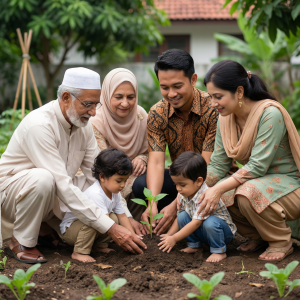
A family planting their legacy.
Awqaf Australia, established in 2014 as Australia’s first organisation operating in accordance with the principles of Islamic endowment, now makes establishing a Family Waqf affordable and accessible through its cash waqf program.
Using a transparent digital portal and independent wealth management firms that invest cash into low-risk Shari’ah-compliant asset classes, families or community groups can establish a waqf via tax-deductible online donations.
As a Public Ancillary Fund with a Shari’ah Advisory Board including the esteemed Shaykh Shabir Moosa, Awqaf Australia operates with strong governance, regulatory oversight and accountability, and regular reporting, to give donors confidence that their waqf assets are managed responsibly.
In the past year, Family Waqfs managed by Awqaf Australia have provided grants for homelessness feeding, Palestinian refugee support services, and women’s crisis services in two states of Australia, as well as medical missions in Gaza and micro-finance support in Myanmar.
One family has established a waqf to establish an Islamic hospital while many families have established waqfs to support scholarships.

A Family Waqf to support medical facilities.
If recent events in the world have taught us anything, it is that we must rise above positions of helplessness and dependence on leaders to save us. It is time that we harnessed our collective resources for long-term strength and security to save ourselves.
By determining what our family legacy is and establishing a waqf for that purpose, we can honour a timeless Islamic tradition while shaping a stronger future for Australia’s Muslim community and beyond.

For more information, go to: awqaf.org.au






Comments