

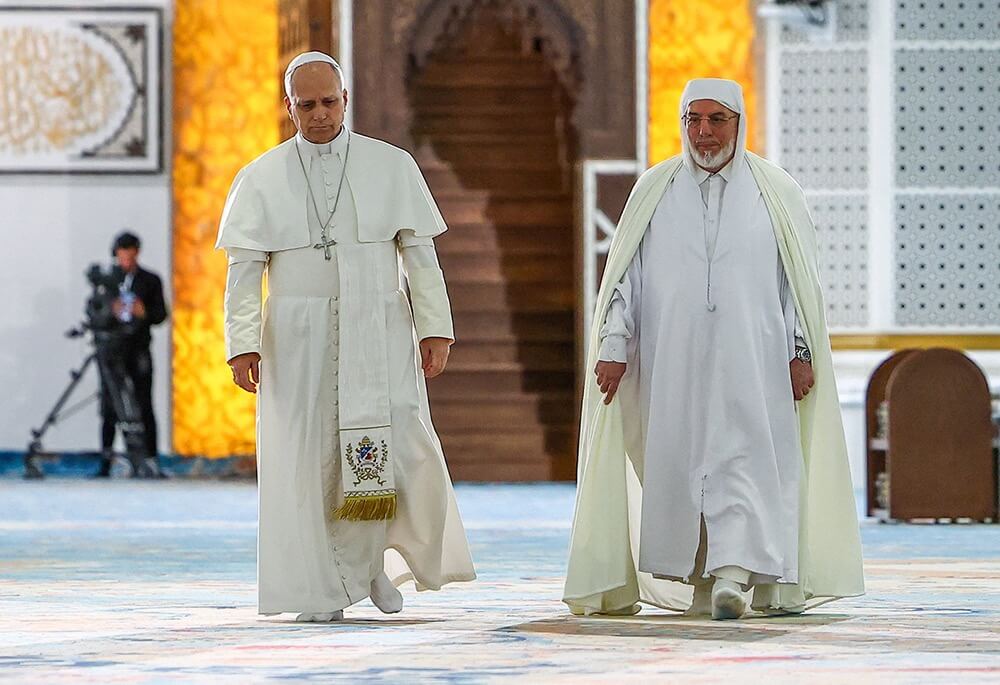
When Donald Trump attacked Pope Leo XIV in April 2026 by calling him “terrible on Foreign Policy,” “WEAK on crime,” and demanding he “stop catering to the Radical Left,” most commentary in our compromised and sensationalist media like Sky News Australia treated it as political theatre in the shallow way they approach most issues today. In fact, this exchange exposed a collision between two entirely different understandings of the purpose of religion.
In Bamenda, Cameroon at the epicentre of a conflict the world has largely forgotten. Pope Leo had addressed a peace meeting with words that were immediately seized upon by the media as a salvo against Trump. The Pope condemned global leaders “ravaging the world” by spending billions on weapons and sharply criticised those who use religion to justify military action.
The media framed it as another round of the feud between the Pope and Trump on the Israeli-US attacks on Iran. Speaking aboard the papal plane, the Pope pointed out that the Cameroon speech had been written two weeks earlier, long before Trump’s threat. He also clarified that the speech had been prepared for a conflict described as “one of the forgotten crises on the planet earth.” The Pope clarified “As it happens, it was looked at as if I was trying to debate again the president, which is not in my interest at all,” he said.
JD Vance immediately claimed Leo had backtracked, but Pope Leo had retracted nothing. His message had not been written with Trump in mind; it had been written with global focus. What Trump found intolerable was not any specific criticism but the principle: that a moral authority independent of electoral power exists at all. In Maga’s framework, the vote sanctifies the bomb but in Leo’s Chrisitan framework as is also the case with Islam’s, it does not.
The intellect as sacred trust
To understand why this matters profoundly for Muslims requires a theological lens ably put forward by Sheikh Khaled Abou El Fadl in his recent sermon (Iran: The War Between Muslims and the Epstein Class) He said that God did not simply give human beings the capacity to reason. He entrusted us with something that participates in the qualities of divinity: the power to comprehend, choose, create, and shape reality. This is the basis of the covenant between the created and the Creator. To receive this intellect and surrender it blindly is a betrayal of the most fundamental trust.
Idols, Abou El Fadl argues, were never about stones. They were in Mecca, as they are in every age, symbolic constructs for the will of the powerful. When you bow to an idol, you surrender your intellect to the human will standing behind it. Idolatry is the abdication of reason in favour of power. Today’s idols are financial systems, politicians who function as proxies for invisible elites that Abou El Fadl calls the Epstein class: the corporate, financial, and military-industrial complex whose power operates through systems the public votes on, while the deeper structures remain beyond democratic reach. The modern idolator surrenders moral reasoning out of compliance, or the internalised belief that resistance is futile.
Just war, both traditions, one standard
Both Islam and Christianity impose binding constraints on force. Augustine and Aquinas demanded just cause, proportionality, and protection of civilians. The Quran is equally clear: Fight in the way of Allah those who fight you, but do not transgress (2:190) as is the Hadith that categorically forbids harming about all non-combatants, livestock, religious buildings and even vegetation.
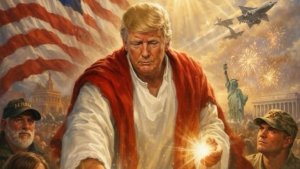
This is also where the confrontation reveals a crisis within Christianity itself, not between religions. Leo represents a tradition of faith-based witness that challenges power. Trump, during his feud with the pope, posted an image depicting himself as a Christ-like figure that drew criticism even from some of his own supporters as blasphemous. This represents Christianity fused with national power, religious identity as cultural dominance rather than moral accountability.
When religion becomes the chaplain of empire it becomes, in Abou El Fadl’s terms, another idol. The same crisis runs through Muslim institutions: the imam whose theology is certified by American military officers; the scholar who tells his congregation that boycotting a company funding military violence is un-Islamic because the ruler permits it; the institution that stays silent while its own professor is imprisoned for speaking truth.
Australia: The pattern is here
These issues are not distant. In January 2026, the Combatting Antisemitism, Hate and Extremism Act passed federal parliament with civil liberties organisations raising concerns about its breadth and speed. In Queensland, amendments specifically banned the phrases “from the river to the sea” and “globalise the intifada” and the first arrests came within hours.
In New South Wales, Christmas Eve legislation granting police sweeping protest powers was later struck down by the Supreme Court as unconstitutional, but not before enabling what lawyers called the most violent crackdown on protesters in decades. In Canberra, police declared a crime scene at a café displaying anti-fascist satirical artwork, seizing the posters before returning them when no offence could be established. As one senator noted: the first scalp under the new hate laws was not a Nazi group, it was a bar with an anti-fascist poster.
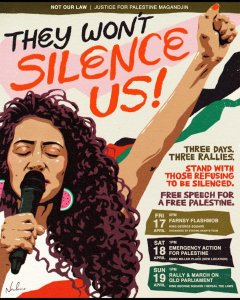
Laws introduced to fight hatred are being applied to phrases, peaceful protests, and satirical art. The space for dissent is contracting selectively. When law shapes not just behaviour but permissible expression, it functions as a modern idol: demanding deference, punishing resistance, conditioning people to call its demands reasonable.
La ilaha illa Allah is not merely a theological article of faith. It is a declaration that no power is absolute, no authority beyond accountability, no system beyond moral judgment. Leo XIV, from within his own tradition, made the same declaration. And the reaction it provokes from power is the reaction that declaration has always provoked.
The greatest danger is not that power will be openly unjust. It is that enough people will come to believe its injustice is reasonable — the bombing necessary, the arrests proportionate, the silence wise. That is when fasad spreads not through institutions alone, but through the moral imagination of a people.
Islam does not permit that surrender. The question is whether we have the courage and the clarity of intellect that Allah has entrusted to us to stand up and be counted.




Comments