

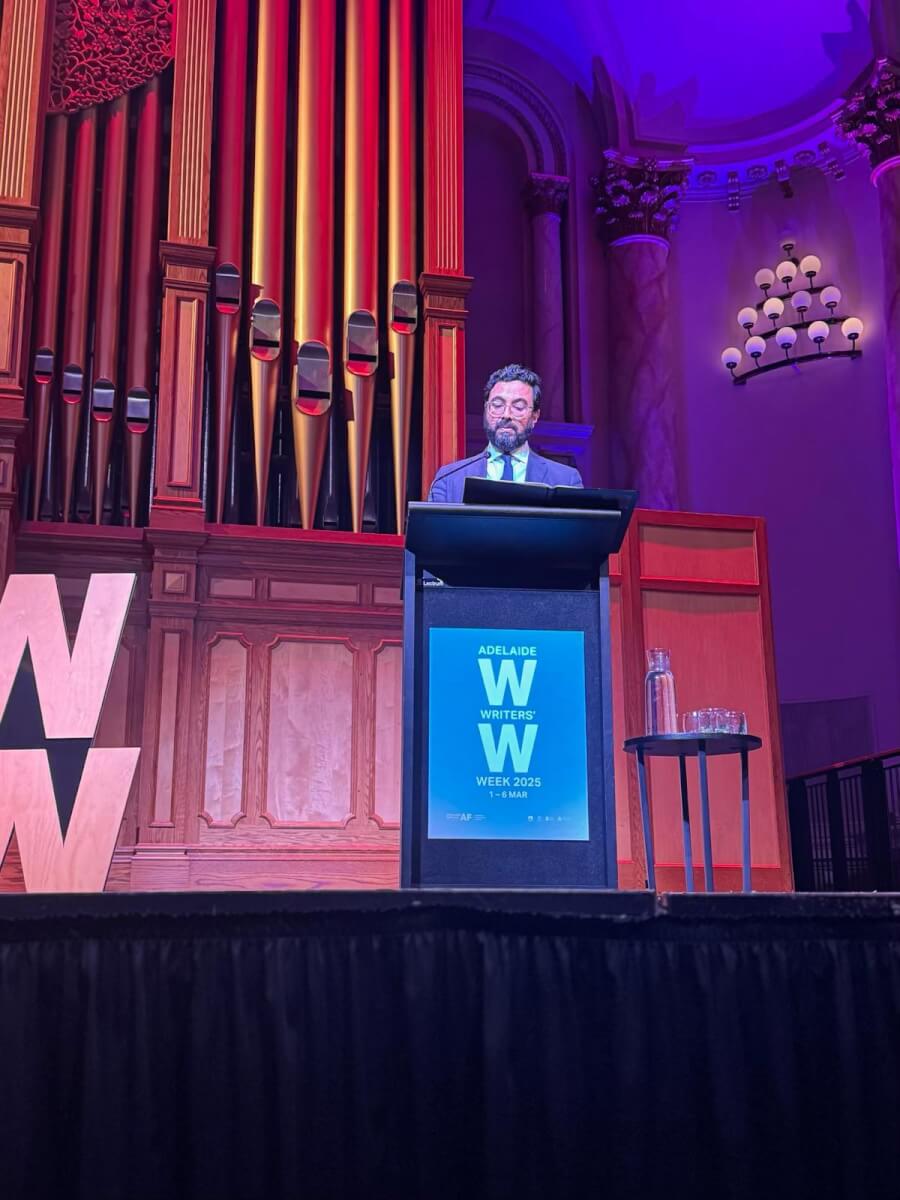
The following are the introductory remarks by Aftab Malik, the Special Envoy to Combat Islamophobia to a conversation between Waleed Aly and Susan Carland, on the topic “Islamophobia: What’s the Problem?” at the Adelaide Writer’s Festival on Sunday 2 March to a packed audience at Adelaide Town Hall.
The event is a significant literary festival because it’s the biggest free literary festival in Australia, and one of the world’s most important. It attracts some of the world’s most important celebrated writers and thinkers.
We convene to learn more about what Susan Carland has described as a “documented, growing reality” that has emerged in our society—a reality that demands our attention and action.
While Islamophobia did not begin on 7 October 2023, since then, we have seen a surge in anti-Muslim sentiment. In the year that followed, The Islamophobia Register Australia recorded an alarming 932 reports of Islamophobic incidents—a staggering figure that surpasses the combined total of the previous eight years.
This is not just a statistic; it is a reflection of the lived experiences of many Muslims across our nation.
During my travels across Australia in late 2024, I listened to the stories of individuals and families who faced discrimination, hate, and violence simply because of their faith.
What I found was a landscape where Islamophobia is a daily reality for far too many. I heard stories of Muslim women being physically assaulted, headscarves being ripped away, and children being harassed on public transport.
They are targeted only because they are Muslims.
In stark contrast to my experiences and reporting, a survey released on Australia Day revealed that only 9 per cent of the Australian public believe that Islamophobia has increased since 7 October — a decrease from 14% just three months earlier.
This disconnect between the experiences of the Muslim community and the perceptions of the wider Australian public is troubling. It is exacerbated by voices within our political establishment who regrettably dismiss Islamophobia as “fictitious.”
The stories I heard during my travels reveal a troubling truth: many Muslims feel that their experiences of hatred and violence are not taken seriously.
They fear that reporting such incidents will lead to inaction, and thus, they remain silent. This silence is not born of apathy per se; it is a profound sense of disillusionment.
Why is there such a divide between the lived experiences of Muslims and the acknowledgment of those experiences, by the broader community? Simply put, the everyday reality of Islamophobia goes unnoticed, and overshadowed by more sensational acts of hate.
And so the normalcy of Islamophobic hate is endured out of the media spotlight, and out of knowledge of Australians. Yet, there are exceptions—moments of violence driven by Islamophobic rage that cannot be ignored.
Consider the case of a prominent imam in New South Wales who was allegedly targeted and nearly run over in December, while his alleged assailant is accused of later threatening an Egyptian mother and daughter in a Kmart.
Then there were the recent alleged attacks on two women wearing hijabs at a shopping centre in Melbourne’s north.
When there is a perceived lack of outrage from our political leaders and the media in response to such incidents, it only deepens the sense carried by many Muslims; Islamophobia really doesn’t matter.
Furthermore, when leaders fail to condemn Islamophobic attacks, it creates a perception that such hatred is not worthy of their attention, and feeds the perception that there is an inconsistency in their condemnation of hate.
In stark contrast, the reprehensible comments of the two remorseful Muslim nurses in Sydney, received extensive media coverage, and was met with swift condemnation as they should be.
This disparity however, perpetuates a narrative that the media is only interested in Muslims when they are viewed as alleged perpetrators of hate and violence, but not when they are victims of hate and violence.
The Scanlon Institute’s recent report showed that 34% of Australians hold negative views towards Muslims—the highest of any religious group surveyed.
The consequence of this ugly episode involving the Bankstown Hospital nurses is that it feeds and drives Islamophobia, whose belief is that Islam and Muslims are irrational; it is a religion of violence that supports terrorism.
Understood as such, Islam forms the basis of an ideology that views Muslims as a threat to western civilisation. This then creates an othering, where a section of society views another with suspicion, fear, and hate.
You just need to read the social media responses to this incident, for this all to become self-evident.
In that same week, there were reports of an undercover Jewish man with spyglasses walking into a popular Egyptian café in Sydney, wearing a Star of David cap, allegedly in an attempt to capture responses to his presence.
Moments later as the man left, a journalist and videographer enter the café, asking questions to staff.
The restaurant owner, Hesham El Masry claimed that “our staff members were subjected to a deliberate, orchestrated incident.”
Using internal documents of the newspaper, Crikey alleges that this was part of an undercover operation to use an undercover Jewish man to see “what it’s like being Jewish in Sydney.”
The newspaper’s editor later issued a statement which in part said that they “never intended to provoke an incident” “nor to report that its staff are anti-Semitic,” and acknowledged that “our approach could have been better handled.”
This all comes against a backdrop in which the Australian Federal Police are investigating the possibility that the anti-Semitic attacks we have seen, may be orchestrated by overseas groups hiring local criminals through cryptocurrency.
Waleed commenting on this revelation in a January op-ed, argues that this introduces a new dimension to understanding the anti-Semitic violence, complicating the narrative of who is responsible.
He asks us to consider the differences between terrorism, organised crime, and espionage: reminding us that each type implies different motivations, making it difficult for authorities to address the root cause of the anti-Semitic hate, effectively.
Confirming Waleed’s concerns about the commodification of violence and its impacts on social cohesion, the link between organised crime and acts of anti-Semitism has become “a stronger line of enquiry” according to The Sydney Morning Herald.
Following the discovery of a caravan containing explosives and a list of Jewish sites and an address of a synagogue in Sydney in January, we learned last month that, and I quote, “underworld crime figures offered to reveal plans about the caravan weeks before its discovery by police, hoping to use it as leverage for a reduced prison term.”
An investigation into the lives of those accused of carrying-out some of the anti-Semitic attacks, reveals that they are low-level crooks and “apolitical people desperate for money.”
Complicating the Islamophobia landscape is the frightening development in which it appears that Australian Palestinian existence is increasingly being framed in terms of extremism or anti-Semitism.
This reductionist narrative denies Palestinians their moral agency, portraying them as caricatures of the archetypal threat within.
Such a portrayal not only erases the complexity of Palestinian identity and experience but also serves to silence their voices in public discourse.
This systematic marginalisation is a grave concern that undermines the principles of justice and equity, and only further entrenches divisions and polarisation.
Our common sense is being suffocated by anxiety, as it is hyper-charged in an environment that feeds fear.
Social cohesion is on fire, and no one wants to be an unwitting accelerant.
It’s bad enough that both Muslims and Jews already have shared fears and anxieties that erode their sense of safety and wellbeing, without having to contend with forces that seek to capitalise on this, forcing two communities to be gridlocked by fear.
In such an environment of incredible social volatility I find two insights from the Islamic and Jewish traditions instructive: “The servants of the Merciful are those who tread lightly on the earth, and when ignorant people deride them, they reply ‘peace,’” and: “That which is hateful to you, do not do to your fellow man. That is the whole of the Torah. The rest is explanation. Now go learn.”
We live in a world characterised by far too much misunderstanding. Research tells us that most people who have negative views of Muslims, are most likely not to know a Muslim.
It is important to remember that the world’s 1.9 billion Muslims, 25% of the world’s population, are members of the Abrahamic family under which Islam sits alongside Judaism and Christianity.
The Qur’an commands Muslims to respect the other family members. To protect their synagogues and churches. We have a shared faith in all the Biblical prophets, and the messianic reality of Jesus.
Love of God connects Muslims to love of His Creation, articulated by the thirteenth century theologian, Fakhr al-din al-Razi, who said “all of Islam can be reduced to two principles: devotion to the Creator and mercy towards God’s creation.”
Christ reduced the Ten Commandments to: “Thou shalt love God thy Lord with all thy heart and with all the mind. And thou shalt love thy neighbour as thyself.”
We need a world in which everyone feels safe.




Comments