


Raised in Harlem and now based in Melbourne, Mr Green draws deeply from lived experience in crafting stories that centre belonging, identity and confidence for young Muslim readers.
When he writes about eight-year-old Ibrahim navigating the bustle of New York City with his friends in the Childhood Champions series, he is drawing from memory.
“Harlem shaped my sense of community, voice and storytelling,” he says.
“It’s a place where people carry history, culture, struggle and pride all at once.”
That foundation continues to influence both his creative work and his current professional role within Victoria’s Department of Education.
Now 50, George has been living in Melbourne for several years, building what he calls the “next chapter” of his life and work.
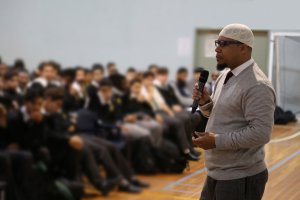
In addition to being an author of children’s books, Br George Green has a very fulfilling role in the Victorian Education system, working as an African Community School Liaison Officer.
While the move took him across the globe, it didn’t introduce him to diversity.
“I grew up surrounded by many cultures in New York,” he explains.
Instead, Melbourne’s multicultural rhythm has reinforced what always felt natural – communities where languages, traditions and identities exist side by side.
That commitment to authentic diversity sits at the heart of Childhood Champions.
The series follows Ibrahim (an African American Muslim boy) and his friends Jannah, Bilal, Malak and Yasin, whose Malaysian, Arab, Puerto Rican and African backgrounds reflect the true global nature of Muslim communities.
“Muslims are often portrayed as if they are all Arab,” he says.
“But in reality we come from every race and culture….I wanted these books to mirror my community.”
More importantly, he wanted Muslim children simply to be seen as children.
“Having adventures, making mistakes, laughing with friends – their identity is part of who they are, but it’s not the only story being told.”
George Green’s professional life deepens that perspective.
He works in a unique role with Victoria’s Department of Education as an African Community School Liaison Officer, sharing his time between a primary and a secondary school.
The dual setting allows him to witness the full arc of development – from young children learning to name their feelings to teenagers wrestling with identity and independence.
“In primary school, you see how strongly children respond to stories and imagination,” he says.
“In secondary school, they’re asking deeper questions about who they are and where they’re headed.”
That insight reinforces his belief that storytelling plants early seeds of confidence and empathy that are later tested in adolescence.
Although Childhood Champions was created before he entered classrooms in this capacity, working closely with students has strengthened his understanding of how children engage with stories.
“Young people learn through connection and curiosity, rather than lectures,” he says.
“Stories allow lessons to unfold naturally.”

Mr Green’s own journey has also shaped his work.
Raised Christian, he embraced Islam in 2011.
The transition brought spiritual growth but also challenges, particularly around family expectations and navigating the line between religion and culture.
“Changing faith affects identity, routines and relationships – it’s a lot more than about religion.”
Some relatives struggled with the shift, especially around long-held traditions.
Within Muslim communities, he also faced the learning curve common to many converts.
“You’re stepping into spaces where culture and religion can be intertwined but it takes time to understand what is essential faith and what is cultural practice.”
In 2013, he performed Hajj, later completing Umrah four times.
The Hajj pilgrimage left a lasting impression.
“Standing among millions of people from every background strips away labels and reminds you that faith is about sincerity and character.”
The experience wasn’t without hardship, but he describes it as grounding – strengthening patience, perspective and resilience.
Growing up in Harlem also meant growing up surrounded by the legacy of Malcolm X.
George’s childhood home stood just two blocks from Mosque No. 7 in Harlem, where Malcolm X delivered many of his major speeches.
He also maintains longstanding relationships with Malcolm’s family, making that legacy both communal and personal.
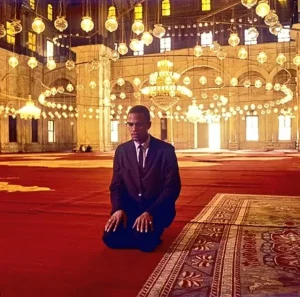
The late, great Malcolm X.
“His story was never distant,” George says.
“And his growth after embracing Islam showed me that transformation is part of faith and that you can change without losing strength.”
That belief in growth informs Mr Green’s creative philosophy.
Through books such as Aminaah’s Space Suit and Black Is Beautiful, alongside educational tools and games, he centres identity, confidence and belonging.
At 50, he says he is less concerned with trends and more focused on impact.
“I think about legacy – what I’m leaving behind and how young people might carry those messages forward.”
He adds that faith, creativity and responsibility aren’t separate paths.
“My faith shapes my intentions, creativity shapes how those intentions are expressed and my responsibility to young people keeps me mindful of the impact.”
As Melbourne continues to mirror the multicultural streets of his Harlem childhood, Brother George Green remains committed to telling stories where children see themselves reflected with dignity and joy.
“I want them to know their story matters, and that they belong.”




Comments