


How two island stories shed a light on Israeli-America attacks on Iran and Western complicity and a better alternative
Two island stories — one written in the twelfth century from the perspective of the Islamic philosophical worldview, the other written in 1719 from the perspective of the emerging Western philosophical worldview — offer more than a contrast in literary styles.
They crystallise two competing visions of humanity’s place in creation, visions that have shaped the last 500 years and continue to resonate in the destruction of entire peoples, lands, and ecosystems.
Robinson Crusoe chillingly illuminates the imperial mindset behind Western colonialism and neo-colonialism that is today driving West Asia’s devastation at the hands of Israel and the US.
As March 2026 airstrikes pounded Iran and Netanyahu pursues his 40-year obsession with crushing the country and, with US support, dominating West Asia, Robinson Crusoe reveals the logic at work.
Both Hayy ibn Yaqzan and Robinson Crusoe begin with someone shipwrecked or marooned halfway around the world on a desert island.
Yet beneath this shared setting runs a profound fault line between respect for the ‘other,’ environmental sustainability as well as the contemplative, metaphysical and cosmological values of Islam on the one hand and the emerging European imperial mindset of commerce, empire, mastery, and intervention on the other.
This is not to deny the genuine spirituality of many Europeans but to shine a light on the imperial mindset that has come to dominate Western thought.
Published by Daniel Defoe in 1719, Robinson Crusoe coincided with dawn of European colonialism. Shipwrecked, Crusoe immediately measures land, fences territory, domesticates animals, exploits resources.
He declares himself proudly “king and lord of all this country.” Encountering Friday, he renames him and teaches “Master”—instant hierarchy and forced conversion.
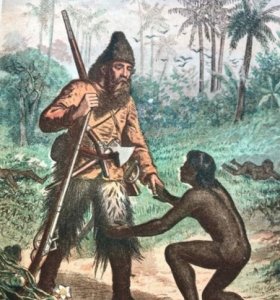
This was the mentality dominating the colonisation of the Americas, Australia, New Zealand, and Palestine. This was also the mentality of the colonial empires of Britain, France, Holland, and Belgium, as well as the American Empire that succeeded them.
General Wesley Clark revealed in 2007 that days after 9/11, a Pentagon official showed him a memo: “We’re going to take out 7 countries in 5 years—Iraq, Syria, Lebanon, Libya, Somalia, Sudan, finishing with Iran.”
However, five centuries before, another work reflects a mindset offering a more hopeful view of humanity. In the 12th century, Andalusian philosopher Ibn Tufayl wrote Hayy ibn Yaqzan, about a child marooned on a desert island, raised by a gazelle.
Rather than domination, he discovers God through tafakkur—reflection on the ayat (signs) of God in the kitab al-kawun, or “Book of Creation.”
“In the creation of the heavens and the earth and the alternation of night and day are signs for people of understanding” (Qur’an 3:190).
Through these signs, Hayy recognises unity behind creation’s diversity. The universe emerges not as possession but divine trust.

From this flows humility. Humanity’s role as khalifah—steward or trustee—is responsibility, not power for domination. Knowledge leads to restraint before the sacred order already governing all things.
Where Hayy contemplates creation’s harmony, Crusoe claims absolute dominion. The island becomes a prototype of empire: nature as raw material, natives as subjects.
This colonial imagination reshaped the globe. Lands without European sovereignty appeared as empty space for mastery; non-European peoples as obstacles requiring control, discipline, or removal.
Ziauddin Sardar, Merryl Wyn Davies, and Ashis Nandy describe how colonial thought constructed the “barbaric other”—irrational, violent, backward societies whose conquest posed as civilization.
West Asia bears this legacy catastrophically. Zionism’s colonisation of Palestine. Iraq’s 2003 invasion dismantled the state, unleashing sectarian carnage that continues.
NATO’s 2011 Libya intervention transformed a prosperous African nation working for African unity and its own gold-backed currency—not the US dollar—into militia chaos and slave markets.
Syria’s civil war fractured the country into proxy battlegrounds. Sudan split in 2011; now genocidal fratricide consumes it.
These appear as policy failures, yet follow a pattern: dismantling strong states, igniting internal divisions, dominating the fragments serving external powers.
Iran confronts this fate now. March 2026 sees US and Israeli strikes on nuclear facilities, oil infrastructure, Revolutionary Guard bases, schools, hospitals, oil depots, and water desalination plants.
Netanyahu—pursuing his 40-year vendetta—threatens to “bring hell.” Lebanon reels from renewed devastation post-Hezbollah weakening. Gaza remains rubble, population halved.
Analysts warn Israel may next turn on Turkey. Wesley Clark’s seven-country list may become eight, then the Gulf monarchies and Saudi Arabia.
Crusoe’s island maps onto this reality. Gaza’s siege echoes his fenced plantation. Friday’s renaming mirrors targeted assassinations of Iranian scientists, Palestinian journalists, health workers, artists, and destruction of health facilities, universities, agriculture, housing.
Each crisis justifies “security necessity,” echoing Crusoe’s providential right to rule “savages.”
Hayy’s vision offers sharp corrective. Deeper knowledge yields greater awe before creation’s preexisting order.
“We shall show them Our signs in the horizons and within themselves” (Qur’an 41:53) undercuts claims to absolute sovereignty over lands or peoples. The khalifahconcept is stewardship, not colonial mastery—harmony, not discord.
Yet Crusoe’s heirs claim moral cover: Zionists invoking biblical promises from the Nile to the Euphrates, forcing regime change through violence and chaos without even the pretence of a civilisational or democratic mission.
“Barbarians”—Arabs vilified as terrorists, Iranians as fanatics—rationalize their dismemberment. Millions flee as refugees; economies collapse; societies drown in endless violence.
This embodies Crusoe’s worldview: mastery weaponized through industrial might and imperial ideology. West Asia’s destruction foreshadows planetary fate, ecological collapse mirroring regional balkanization.
Two paths diverge. Persist as Crusoe—”lord” parcelling “wastelands,” bombing divine signs into submission. Or rediscover Hayy: recognize creation’s entrusted balance demanding humility over hubris.
Iran’s burning refineries, Gaza’s mass graves, Lebanon’s ruins show us the choice. Those in power follow Crusoe. Humanity’s survival demands Hayy’s wisdom: see the universe not as territory to conquer, but signs calling us to stewardship.




Comments