

The incident on Eid day on Friday 20 March at Lakemba Mosque, where a number of worshippers heckled the Prime Minister and the Minister for Home Affairs during Eid prayer, has sparked a potentially polarising firestorm of online commentary.
To many, it felt like a rare moment of “speaking truth to power.” But we must ask ourselves: did that moment actually change the power dynamic, or did it simply release the pressure of our collective pain?
To say “we understand their pain or frustration” actually diminishes the value of our own extensive efforts to remedy our pressing situations.
For those of us who have lived with the agony of Gaza, Iran, Kashmir, East Turkistan, and the plight of the Rohingya since these struggles began, this pain is not a new suit we put on for a protest.
It is a constant, heavy weight we have been carrying and working to lift for decades. This is not a “your pain is my pain” sentiment; it is a proactive, lifelong reaction to that pain.
But as any weightlifter knows, if you want to successfully move a 200 kg bar, you don’t just scream at it. You train for it.
The training we refuse to fund
If I know that I can succeed in a 200 kg lift and I want to test my limits, I try 210 kg. If I succeed, I try more. If I don’t, I train to get stronger before I try an even higher weight.
Unfortunately, our community often refuses to fund the “training” required to get stronger; we simply expect to be powerful without putting in the right effort.
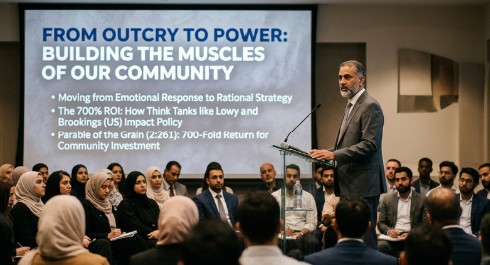
We remain stuck in an emotional space, funding only “feel-good” projects while neglecting the infrastructure that builds real political muscle.
We don’t have our own Lowy Institute or Brookings Institution. These are are high-performance “gyms” that birth tremendous political influence.
The Lowy Institute operates with an annual budget of roughly $12 million to $15 million, while Brookings in the U.S. commands over $100 million.
These funds pay for the research, the polling data, their research creates very favourable media editorials and the policy drafts that sit on a Minister’s desk long before a decision is made.
The 700% return: Strategy vs spirit
Throughout the Western world, life is effectively a “survival of the fittest” environment, often obscured by a thin veil of human compassion.
When we hear the Western constructs of a “dog eat dog world” or the “rat race,” we are hearing candid admissions of how the competitive game is played.
In this competitive world, the predator, apex or otherwise always finds the stragglers to be the easiest picking. This reality is captured by the prophetic warning: that “the wolf eats only the stray sheep” (Abu Dawood).
In this arena, the “easy meal” for predators is not a unified force, but the herd’s stragglers, those who seek to milk victimhood or those who inexplicably abandon the herd to scream an emotive reaction.
Successful groups are not stragglers; they are organised investors who understand that political investment is a high-yield business transaction.
A 2026 study by the University of Cincinnati quantified this, demonstrating that corporations can secure up to a 700% return on their political investments.
For every dollar they spend on the “training” of lobbying and think tanks, they receive seven dollars back in favourable legislation, subsidies, and financial benefits.
They are funding the exact strategic muscle that our community consistently neglects.

Ironically, our own tradition offers a parallel equation for success, though for a higher purpose. In the Qur’an, we are given the parable of the grain that grows seven ears, each with a hundred grains (2:261)—a 700-fold return for those who spend selflessly for the common good.
The difference is fundamentally one of intent. The “other side” may invest for personal profit, utilising their resources to skew the system, a practice we are strictly cautioned against:
“And do not consume one another’s wealth unjustly or send it [as bribery] to the rulers in order that [they might aid] you to consume a portion of the wealth of the people in sin, while you know [it is wrong].” (Qur’an 2:188)
While they seek a 700% ROI to gain an unjust advantage, we are called to invest for communal justice—to build the “gym” and the political muscle needed to restore balance and equity, not to buy it. Yet, we hesitate to put our hands together for the rational, institutional work that would trigger this growth.
The difference is one of intent: the “other side” invests for personal profit, while we are called to invest for communal justice. Yet, we hesitate to put our hands together for the rational, institutional work that would trigger this growth.
The rational path
In human society, the rational approach is always the most effective—and it works significantly faster when we put our hands together. We must abandon the performance of victimhood and focus on building our muscles so that we can unemotively and effectively assert ourselves.
By moving from the emotional to the strategic, we stop being the “easy meal” for predators. We move from being a collection of stragglers to a unified force.
When we finally fund the “gym”—the think tanks, the policy experts, and the institutional foundations—we won’t need to heckle to be noticed. We will have the strength to command the room and secure the policies our community deserves.


Comments