


The Indian Minority Education Society of Australia Inc (IMESA) organised the Annual IMESA Victoria Dinner on Saturday 31 May 2025 at at Laila Reception, Brunswick in Melbourne.
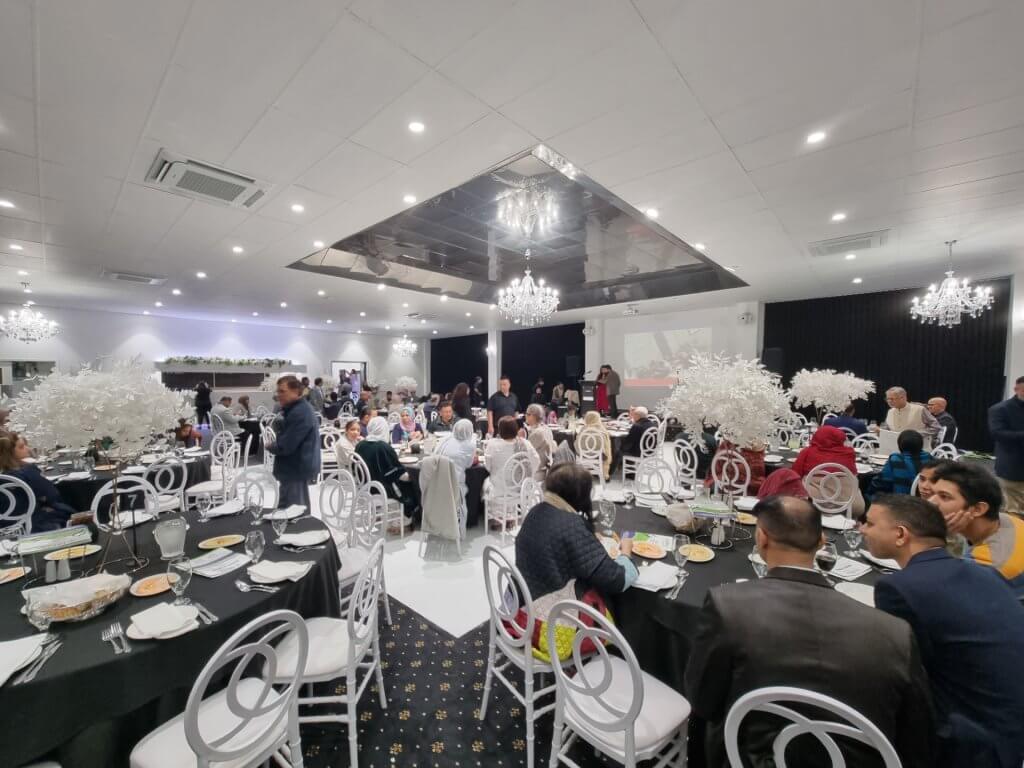
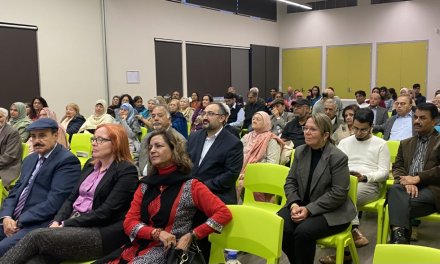
Nearly 150 people, including several dignitaries, filled the main hall to learn about IMESA’s charitable work in educating the most underprivileged Muslim children in India.
MCs Mr Shahnwaz Ali and Ms Saheem Wani welcomed the guests and described the event’s purpose, which was to create awareness and understanding of the urgent need for IMESA’s work to uplift the poorest sections of Muslims in India through education.
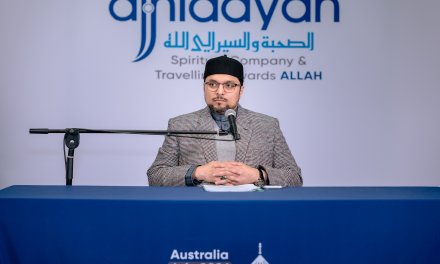
The program commenced with the recitation of Quran and a talk by Shaikh Abdinur, the highly respected scholar within Victoria’s Muslim community, a senior member of the Board of Imams Victoria and the Australian National Imams Council.

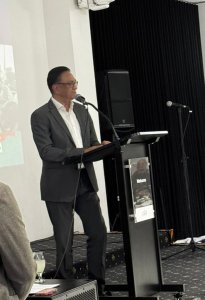
Shaikh Abdinur Dr Aejaz Sheriff
The Sheikh recited the relevant verses, highlighting both the significance of education and emphasising the importance of charity in supporting educational causes. He spoke about the glorious past of Islam when the Islamic world produced notable scientists, astronomers, mathematicians, doctors, and philosophers.
The Sheikh also mentioned the significance of the timing of the event during the holy period marking annual pilgrimage of Haj and Eid al-Adha to engage in charity and Ibadah.
Dr Aejaz Sheriff, the well-known Muslim community figure, formally welcomed the guests. Dr Sheriff applauded IMESA’s effort, saying it isn’t just a charity, it’s a movement with the belief that financial hardship should never be a barrier to education, dignity, or a child’s future.
“What makes IMESA stand out is not just how much they raise, It is how responsibly and effectively funds are used on the ground. Their strength lies in transparency, ethical governance, and unwavering dedication,” Dr Sheriff said.
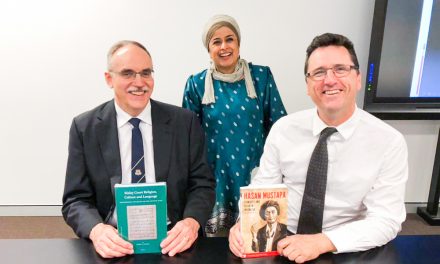
MC Ms Saheem Wani introduced the keynote speaker, Dr Zouhir Gabsi, a senior lecturer in Arabic and Islamic studies at Deakin University, Melbourne.
Dr Gabsi was named Australia’s lead researcher in Middle Eastern and Islamic studies by the Australian Research Magazine for 2024.
A regular writer for ABC, his recent publications on Islamophobia, including his 2024 book Muslim Perspectives on Islamophobia: From Misconceptions to Reason, the Arab Spring and religious and political discourses, are well acknowledged among academic circles.
Dr Gabsi, during his talk titled Breaking the Cycle of Poverty: Perspectives on Education and Islamophobia, told the audience that Poverty is a Shared Social Responsibility and its alleviation includes Education and Skill-Building, Emphasis on Work and/with Dignity, Microfinance, and Interest-Free Loans (Qard Hasan).
For Muslim minorities in a non-Muslim majority country, it is also coupled with Islamophobia. Muslims must pay and seek out zakat, both giving and, if eligible, receiving without shame.
They should pursue education and skills, and teach children practical and religious knowledge. They should break harmful cycles with help, spiritually and practically, build strong family/community networks, and uphold ethical work practices and fairness in business.
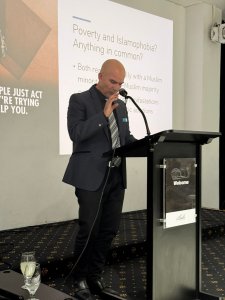
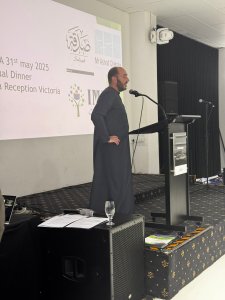
Dr Zouhir Gabsi Dr Ashraf Chehata
A video showcasing IMESA’s aims and objectives, a description of the problem, its work on the ground in India, and interviews with the beneficiaries was screened.
IMESA’s projects have expanded across India to Bengaluru (Karnataka), Boisar (Maharashtra), Dehradun (Uttarakhand), Dinajpur (West Bengal), Hyderabad (Telangana), Lucknow (Uttar Pradesh), Shaheen Bagh, New Delhi, Patna (Bihar), Saharanpur (Uttar Pradesh), Vadodara (Gujarat) and upcoming projects in Tonk (Rajasthan), Nuh (Mewat) (Haryana) and Srinagar (Kashmir).
Introducing another inspiring speaker, MC Mr Shahnwaz Ali described Dr Ashraf Chehata, an orthopaedic surgeon, as an activist beyond the surgical landscape, fostering a strong sense of community involvement through social media and places of worship.
Dr Chehata spoke on the emphasis of Sadaqah (charity in Islam), describing it as a repentance for a person’s sins. Under Islamic belief, the money given in Sadaqah is in fact the money that belongs to the poor and not to the donor.
To begin the fundraising, Mr Shahnwaz Ali explained IMESA’s project expenses and utilization of funds. He described available options and reminded the audience of the tax deductibility status of donations to IMESA and the opportunity to take advantage of end of financial year offers.
Dr Nisa Sheriff applauded the noble cause and appealed to the audience to contribute to it. Dr Zaffar Ghouse actively engaged the patrons and volunteers, uplifting the charitable spirit.

Impressed with IMESA’s work, inspired by the speakers’ emphasis on helping the poorest through education and the religious significance of charity, the audience responded wholeheartedly during fundraising. They opened their hearts and donated generously.
Mr Zahid Jamil, during his vote of thanks, expressed gratitude towards IMESA’s teams in India and Australia for their dedicated efforts in running the Taleemi Jamaat project.
He thanked Melbourne team for organising a very successful event, with special thanks to Dr Talath Sheriff, Dr Aejaz Sheriff and Ms Saheem Wani for their exceptional efforts.
Mr Jamil applauded the patrons, thanked them for their gracious presence and generosity in supporting the noble cause of educating the poorest children in India.

The audience enjoyed the delicious cuisine and thanked the organisers for their hospitality, describing the event as extremely well managed.
The fundraising event was a tremendous success, especially considering this was IMESA’s first formal fundraising event in Melbourne.




Comments