

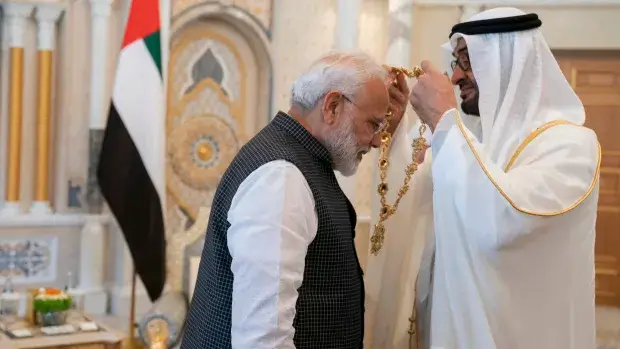
The Indian PM Narendra Modi has been flooded with awards by the governments of the countries he has visited over past few years.
What is interesting to note is that during these visits, the media in these countries, many political leaders and human right activists openly criticised Narendra Modi and his Hindu Nationalist party, the BJP for authoritarianism, repression of minorities and human rights abuses and questioned their governments’ decisions to bestow these awards on him.
During his latest visit to France he was awarded Legion of Honour, the Grand Cross, the highest civilian honour of France.
In June 2023, during state visit of Egypt he received Order of the Nile award Collar, the highest civilian honour of Egypt.
Although he did not receive an award during his visit down under, he was given rousing reception by the Indian diaspora where Aussie PM Anthony Albanese showered praises on him calling him ‘The Boss’.
During his tour in the region, he received Order of Fiji, Companion, the highest civilian honour of Fiji.
He also received Order of Logohu, Grand Companion, the highest civilian honour of Papua New Guinea.
During his visit to US in December 2020 he was honoured with The Legion of Merit, issued to members of the eight US Military servicemen as well as to military and political figures of foreign governments.
Not only Egypt, other Muslim governments did not lag behind in decorating him with National Awards.
Bahrain awarded Narendra Modi, King Hamad Order of the Renaissance, the highest honour of Bahrain awarded to foreign dignitaries.
UAE conferred upon him the Order of Zayed, The highest civilian honour.
Even Saudi Arabia and Afghanistan awarded Modi during his visits.
The list goes on.
In France, where Mr Modi was invited to attend the country’s annual 14 July Bastille Day national festival as guest of honour, there were severe reactions from opposition parties.
“India is a friend. But Prime Minister Narendra Modi is far right and violently hostile to Muslims in his country,” Jean-Luc Melenchon, head of the opposition radical left France Unbowed Party, tweeted.
The head of the Green Party, Marine Tondelier, said the choice of Modi as guest of honour was a “grave political error” by Macron.
“It has to be reminded that since Narendra Modi came to power in 2014, India, which is usually called the largest democracy in the world, has kept regressing when it comes to human rights and fundamental freedoms,” Tondelier wrote in an article in French newspaper Liberation.
During his visit to UAE and Bahrain, Samah Hadid, a Beirut-based human rights advocate wrote “With several Gulf states in an ever-tightening embrace with Modi, human rights have been discarded in favour of economic opportunities.”
In an open letter to Crown Prince, Mohamed bin Zayed Al Nahyan, British parliamentarian Naz Shah from the Labour party asked him to reconsider giving the award due to the “brutality” she described Modi as directing.
“I ask you to question this decision and reconsider giving such an award, not only because the majority of the Kashmiri people share the same faith as you, but because we have a duty as human beings to stand up against the disregard of human rights and evil,” Shah wrote.
Such reactions were numerous wherever he went. Large protests were also held in many Western countries during his visits.
The question arises that why all these governments have been so keen to confer awards on a controversial figure like Narendra Modi.
In 2005, the US denied Modi a diplomatic visa and revoked his existing tourist/business visa under the Immigration and Nationality Act on religious freedom for his role in Gujrat riots.
Only recently a BBC documentary exposed Modi for his role in Gujarat riots. Human Rights organisations have expressed repeated concerns on treatment of minorities since Narendra Modi became India’s Prime Minister in 2014.
Yet, the awards continued to be bestowed upon Mr Modi.
One obvious reason is that with India’s rise as an economic power, many countries are keen to have their share in this emerging world economy.
Secondly, Western countries need India to counter China in current geopolitical crisis both on financial and military fronts. They need India as a pro-Western counterweight to China and this has become a key factor in Western foreign policy.
Russia is the largest supplier to Indian Military and Western countries such as France and US are keen to lure India to their weapons markets.
India is also the world’s third-largest consumer of crude oil and thus important for the oil-rich Gulf states.
Despite all the good reasons, the Western and Muslim governments should have been reluctant in honouring Narendra Modi with the highest national awards due to controversies surrounding his political career.
It is highly likely that Indian diplomatic missions in those countries pursued the governments to consider honouring their visiting prime minister.
BJP has huge support among Indian diaspora overseas, thanks to Hindu Nationalist movement. They would have also played a role in reaching out to their MPs to pursue honouring of their Prime Minister.
Such awards are usually given due to lobbyists actively pursuing it. It would have been easy to create pressure due to economic and geopolitical interest of those governments in India.
Surely, Indian PM finds pleasure in the awards which encourage him to continue his policies of repression of minorities and Hindu nationalist agenda.




Comments