


The fifty-year long IICP research and implementation project successfully reduced 40 different prediction criteria for Islamic calendar construction to 3 variations of imkane ru’yah (expected visibility) criterion and 3000 local observing places reduced to 4 global zones and reference points. Future need is the convergence to a single Primary Zone with one reference point and criterion.
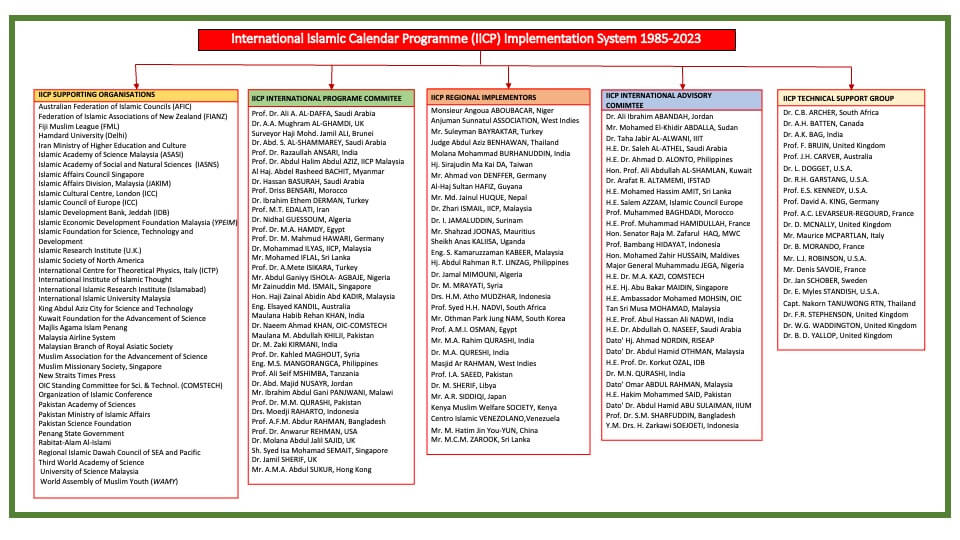
Through International Islamic Calendar Programme (IICP) (Phases 1-9), the global effort initiated in Malaysia since 1970’s supported by OIC, COMSTECH, Rabeta, IFSTAD, RISEAP, national organisations, grassroots, communities, Ulema, scientists, national governments with huge research outlay, succeeded in establishing a Unified Islamic Calendar world-wide.
Abolition of intercalation in Islamic year (Qur’an 9:36) ensured unity of sighting and expected visibility calculations.
The ‘not self-lighted’ moon should be well above the horizon outside sun’s glare at sunset (Jurist Qadi Ibn Rushd, 6th Century Hijrah; 12th Century CE!).
Calculations of expected visibility at an infinite number of places for each date was impossible until computer age.
In the 1970’s, Main Frame fast computers entered into scientific domain. The author, part of a rocket research programme at Adelaide university, was fortunate to train on and make use of early computers in Australia, Malaysia, and Europe for the breakthrough research on the continuity of global visibility of lunar crescent, called as International Lunar Date lines (ILDL) and their use is now standard in global moon sighting projections.
Variations in criterion result in different date lines and removal of these practices was achieved systematically by implementing unified scientific imkane ru’yah (expected visibility) criterion for reference places or regions using sharia’s ‘Ikhtalaf al-matale’ (one sighting for a zone).
The Imkane Ru’yah Calendar developed in Malaysia after considerable research by this author has been implemented successfully on the basis of various international resolutions. Malaysia, Indonesia and South East Asia: 1995; Saudi Arabia, West Asia 1999; Morocco and West Africa 2000; Pakistan, South Asia, Iran etc. 1997; Turkey and nearby countries 2016; European and American communities and elsewhere in intermediate times.
Alhamdolillah, the Imkane Ru’yah based calculated calendars have become standard for the dates of Ramadhan, Eids, Hajj, Muharram etc. in most Muslim countries and communities including Saudi Arabi, Malaysia, Indonesia, Morocco, iran etc. We did produce zonal calendars to help implement standard use but regional authorities have adopted 3 variations of Imkane Ru’yah criterion for calculations (2, 5, 6 degrees) which produce some discrepancy globally.
To overcome the slight variations in criterion and dates, we need to implement a single Primary Zone with a single reference place and single criterion for calculations of dates utilising Shariah’s broad Ikhtalaf al- matale (zone sharing same night) concept. Indeed, towards this objective, a 21-year Primary Zone calendar (Afro-Asia-Europe) has been distributed (in Arabic and English). Also, related ideas were presented at recent conferences in Makkah, Dubai and Istanbul.
The great outcome of our community’s 50-year long striving is reflected in Poet Dr Iqbal’s couplet (ke khoon-e sad hazaar anjum se hoti hai sahr paida): The sacrifice of thousands of stars results in the rise of a new morning.



Comments