


The Lebanese Muslim Association is awaiting the outcome of a fresh application with the City of Canterbury-Bankstown Council to broadcast the Adhan – the Islamic call to prayer – from loudspeakers attached to the minaret of the iconic Lakemba Mosque, every Friday before Jumu’ah.
The renewed bid follows last August’s decision by the Canterbury-Bankstown Local Planning Panel (LPP) to refuse the original application on noise impact grounds.
It’s worth understanding how the development application (DA) process works.
In Greater Sydney, elected councillors no longer have any power to decide development applications.
Since landmark 2017 legislation designed specifically to remove politics from planning decisions, that role falls to independent Local Planning Panels made up of expert appointees.
Public submissions on the current application have now closed, but as councillors, property developers and real estate agents are these days prohibited from sitting on LPPs, this is once instance where writing to your local alderman would have been to no avail.
The renewed application will be decided by the same Canterbury-Bankstown LPP that refused the first one.
As usual, LMA spokesman Hajj Gamel Kheir has been on the front foot and is having none of the opposition’s arguments.
Speaking to Sydney’s Daily Telegraph, he dismissed the objections in no uncertain terms, calling them “a blatantly racist, Islamophobic slur dressed up as concern for civil and community rights.”
Mr Kheir also pushed back firmly on the narrative that the first application was rejected, telling the Telegraph that the LMA had simply been asked to submit additional noise modelling – and that is precisely what the revised application addresses.
His words were even stronger in the Sydney Morning Herald.
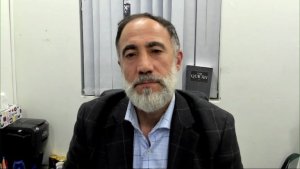
LMA spokesman Gamel Kheir.
“Unfortunately, the debate has shifted beyond planning to targeted hostility.”
“We’ve had to install additional CCTV cameras after receiving death threats.”
“There have been objections which are, in the worst-case scenario, purely based on paranoia – (the same old chestnut) that Muslims are taking over, and that somehow the call to prayer is associated with a terrorist threat.”
Mr Kheir also noted that many objectors live outside the City of Canterbury-Bankstown, adding: “No one objects to the ringing of bells at St Mary’s Cathedral in the CBD or the Maronite church in Punchbowl (Lakemba’s neighbouring suburb), yet somehow the call to prayer is perceived as a threat.”
Let’s put the noise question in perspective.
The LMA is saying that the recitation will last around three minutes, once a week, around midday on Fridays.
Those three minutes represent 0.030 of ONE PERCENT of the 10,080 minutes that make up a full week.
To object to that, in a suburb where more than 60 percent of residents identify as Muslim, and where the broadcast will only be heard in the vicinity of the mosque, requires a remarkable dedication to grievance.
Consider what people from not just Lakemba but most parts of greater Sydney currently endure without a murmur – sometimes for seconds, sometimes for minutes, sometimes for hours….sometimes 24/7.
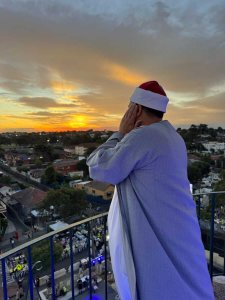
Lakemba Mosque’s Qāri Sheikh Mohamed Harby delivering the call to prayer from the top of the masjid’s minaret.
Lawnmowers and leaf blowers fire up on Saturday mornings across every suburb in the city.
Trains rattle through residential areas almost around the clock.
Aircraft descend over rooftops at regular intervals, day and night.
Construction sites jackhammer and drill from Monday to Saturday.
Car horns blast along busy roads. Dogs bark at all hours.
Sports ground announcers in the main love their own voices and go at it not only on Saturdays but on Sundays – the supposed “day of rest”.
Sydney’s famous New Year’s Eve fireworks shake windows and terrify pets.
And as the LMA’s own planning documents note (and as alluded to by Gamel Kheir earlier in this article), St Mary’s Cathedral sounds its bells regularly, with some sessions lasting up to an hour.
Nobody has filed 328 objections about any of that!
Lakemba business owner, John Mavroforas of JM Computer Repairs, had this to say.
“We are Christians but just like us, every religion has its religious holidays. They have (loud)speakers, we have bells – it’s just fair,” Mr Mavroforas told The Greek Herald.
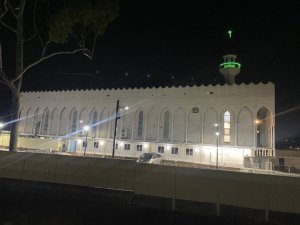
A side view of Lakemba Mosque, with the minaret standing out like a beacon.
Australia prides itself internationally on its commitment to free speech, multiculturalism and religious freedom, and if this country is as “fair dinkum” as we so often claim, surely this should make the approval of the latest application a no-brainer.
But will it?
The LMA has done everything asked of it.
The question for the Canterbury-Bankstown Local Planning Panel is whether those three values mentioned above mean anything in practice – or whether they apply only to some faiths and not others.
The outcome may not be known for several months – we await it with bated breath, for a positive response. Inshallah.
For the record
One comment repeated endlessly across social media by non-Muslim opponents of the proposal goes something like this: “We don’t want to hear your prayers. Go inside the mosque and do it.”
This is a sentiment worth addressing directly, because it rests on a fundamental misunderstanding of what the Adhan actually is.
The Adhan is not a prayer. It is a call to prayer — a vocal proclamation summoning Muslim worshippers to come to the mosque.
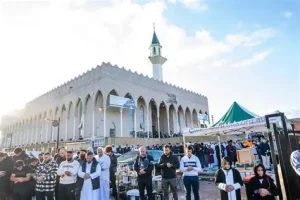
Lakemba Mosque is Australia’s most recognisable masjid.
The prayer itself happens inside, once the worshippers arrive.
In that sense, the Adhan functions exactly as church bells do: a community signal that it is time to gather.
Regardless of the outcome, it’s a pity some of the more outspoken opponents of the bid didn’t taken the time to educate themselves on the purpose of the Adhan before objecting to it!




Comments