


Photo: Professor Abdul Khaliq Kazi, AM (Dzavid Haveric, Victoria Museum)
Dr Abdul Khaliq Kazi, a renowned leader within both Victoria’s and Australia’s Muslim communities, passed away at the age of 98 earlier in 2026. This article commemorates his life and contributions.
Born in Karachi, he completed his early education in Pakistan before spending three years at Al-Azhar University in Cairo, where he studied Islamic theology. He later earned a Bachelor of Arts and a Doctor of Philosophy from the School of Oriental and African Studies at the University of London. In 1961, he migrated to Australia with his wife and settled in Melbourne.
A partnership among the University of Melbourne, the Myer Foundation, the Spalding Trust of Oxford, and the Pakistan government resulted in Dr Kazi receiving a five-year contract to establish an Arabic and Islamic Studies program at the University of Melbourne. He subsequently remained in Australia, where he was appointed Senior Lecturer in Islamic Studies within the Department of Middle Eastern Studies at the University of Melbourne. His scholarly contributions significantly influenced multiple generations of students and colleagues.
Dr Kazi made remarkable contributions to Australian Muslim communities, serving as chair of the Islamic Council of Victoria and as president of the Australian Federation of Islamic Societies (AFIS) for a decade. During his tenure as AFIS President, Dr Abdul Khaliq Kazi stated: ‘We needed one voice to show Australia who we Muslims are and what we stand for. Muslims wanted to familiarise themselves with Australia and also to familiarise Australia with Muslims’.
He supported the expanding and diverse Muslim community by assisting Muslims in maintaining their faith, deepening their understanding of Islam, and integrating harmoniously within broader Australian society. Dr Kazi welcomed the establishment of the Muslim Ladies’ Auxiliary in Melbourne, describing it as a ‘significant development for Islam in Australia’.
He also highlighted the importance of youth education and played a key role in initiating youth camps. Additionally, he served as editor of the Muslim journal The Australian Minaret, published in Melbourne, and was the founding president of the United Muslim Migrants Association (UMMA).
Dr Kazi visited several Muslim-majority countries, including Kuwait, the United Arab Republic, Saudi Arabia, Türkiye, Indonesia, Malaysia, and Pakistan. During his visit to Saudi Arabia, he met King Malik Faisal. Together with Sheikh Fehmi Naji El-Imam, he contributed to fundraising efforts for the Preston Mosque (Omar Bin Al Khattab Mosque).
The mosque’s opening in 1977 was attended by former Prime Minister Gough Whitlam, the Saudi Arabian Ambassador representing a major donor, and other notable guests, such as the Assistant Secretary-General of the World Muslim League, a representative of Prime Minister Malcolm Fraser, the Roman Catholic Archbishop of Melbourne, and other religious leaders. Mr Gough Whitlam officiated the opening ceremony, which was attended by hundreds of people.
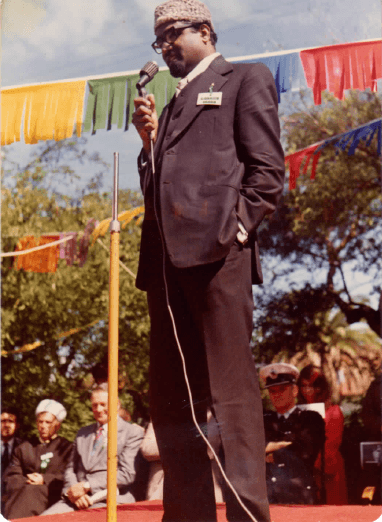
Dr Abdul Khaliq Kazi, Preston Mosque, 1977 (Dzavid Haveric, Melbourne Museum).
Alongside Sheikh Fehmi Naji El-Imam and Ibrahim Dellal, Dr Kazi played a pioneering role in Muslim interfaith dialogues with Christians, Jews, and members of other faiths, promoting understanding and social cohesion among diverse religious communities. In recognition of his significant contributions, Dr Kazi received the Order of Australia (AM) and the Lifetime Achiever of the Year award at the 15th Annual Australian Muslim Achievements Awards (AMAA).

Dr Haveric with Dr Kazi late last year.
He also advanced research in Islamic history and interfaith relations by advocating for universal values within Australia’s religiously diverse society. I am grateful that Dr Kazi, a leading Islamic scholar of his time, wrote the Foreword for my book Muslims Making Australia Home: Immigration and Community Building.
In it, he stated: ‘We must remember that Islam is one of three faiths that share a common ancestor in Prophet Abraham (Ibrahim in Arabic), which gives them the designation of the three Abrahamic faiths. Furthermore, Islamic ideals and values are fundamentally integrated into the spirit of humanistic ideals and values in Australia.
Dr Kazi passed away at the age of 98. Softly speaking, he exemplified patience, kindness, thoughtfulness and wisdom. He is remembered with great respect. His janazah prayer was held on 19 2026, at the UMMA Centre in Doncaster East, and he was buried at Northern Memorial Park, Fawkner Cemetery.
To Allah we belong, and to Him we return.
Sources:
Dzavid Haveric, Muslims in Australia Collection, Museums Victoria.
https://collections.museumsvictoria.com.au/items/2278281
Dzavid Haveric, 2019, Muslims Making Australia Home: Immigration and Community Building, Melbourne University Publishing.
Dzavid Haveric, 2019, History of Islam and Muslims, Early Encounters, Settlements and Communities prior to mid-1940s, Published by Lambert Academic Publishing / Germany.




Comments