


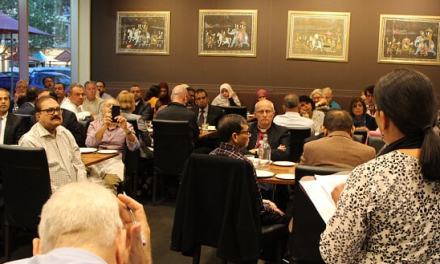
The Indian Minority Education Society of Australia Inc (IMESA) organised the Annual IMESA Victoria Dinner on Saturday 13 June 2026 at Laila Reception, Brunswick in Melbourne.
The main hall was filled to capacity, with several dignitaries and a distinguished gathering of doctors, professionals, business leaders, philanthropists, and members of the wider South Asian Muslim community.
They had come together to learn more about IMESA’s charitable work in providing educational opportunities to some of the most underprivileged Muslim children in India.


Dr Nisa Sheriff Ms Saheem Wani Dr Aejaz Sheriff
The Masters of ceremonies, Dr Nisa Sheriff and Ms Saheem Wani, welcomed the guests, including Sheikh Alaa Elzokm OAM, Mayor Mohammed Semra, Mr Yianni Zaparas, Managing Partner of the Zaparas Lawyers and Mr Fawaz Chawk, Editor-in-Chief of Al Wasat Magazine.
The program commenced with the recitation of the Holy Qur’an, followed by an address by Sheikh Alaa Elzokm, Imam of the Elsedeaq Mosque in Heidelberg Heights and a member of the Australian National Imams Council.
Introducing the distinguished scholar, Ms Wani noted that the Egypt-born Sheikh studied at the renowned Al-Azhar University in Cairo. He has dedicated himself to promoting a balanced and moderate understanding of Islam within the Muslim community in Victoria, emphasising peace, harmony, and positive relationships between Muslims and non-Muslims alike. In recognition of his tireless contributions, he received the Victorian Multicultural Award and was later honoured with the Medal of the Order of Australia (OAM) in the King’s Birthday Honours in 2023.
Sheikh Alaa recited relevant Qur’anic verses highlighting both the importance of education and the virtue of supporting educational causes through charity. He stressed that education occupies a fundamental position in Islam, noting that the first Qur’anic revelation began with the command “Read” (Iqra), and that the Qur’an repeatedly encourages the pursuit of knowledge, reflection, and learning.
Impressed by the professionalism displayed by the two women managing the stage, the Sheikh spoke about the importance of Muslim women serving in leadership roles within the community. He also reflected on the similarities between India and his homeland, Egypt—both ancient civilisations characterised by rich diversity and multicultural heritage.
Expressing his appreciation for being part of an event dedicated to education, he remarked that supporting the education of underprivileged children creates a far greater and more lasting impact than the continual construction of new mosques, a trend increasingly seen in many Australian cities.
He emphasised that educating disadvantaged children can transform lives across generations, helping to break the cycle of poverty and creating lasting positive change within communities.
Dr Aejaz Sheriff, a well-known figure in the Muslim community of Melbourne, formally welcomed the guests. He thanked the event sponsor, Zaparas Lawyers, for its generous support, noting that important initiatives such as this can only succeed with the backing of committed organisations and individuals.
“To the Zaparas team, we are truly grateful for your partnership and generosity,” Dr Sheriff said.


Sheikh Alaa Elzokm Mr Yianni Zaparas
He also applauded the IMESA team, who had travelled from Sydney for the event, including its founder, Mr Zahid Jamil.
“What makes IMESA stand out is not just the amount of funds it raises, but how responsibly and effectively those funds are used on the ground. Its strength lies in transparency, ethical governance, and unwavering dedication to the communities it serves,” Dr Sheriff said.
A video showcasing IMESA’s aims and objectives, a description of the problem, its work on the ground in India, and interviews with the beneficiaries was screened.
IMESA’s projects have expanded across India to Bengaluru (Karnataka), Boisar (Maharashtra), Dehradun (Uttarakhand), Dinajpur (West Bengal), Hyderabad (Telangana), Lucknow (Uttar Pradesh), Shaheen Bagh, New Delhi, Patna (Bihar), Saharanpur (Uttar Pradesh), Vadodara (Gujarat), Tonk (Rajasthan), Nuh (Mewat) (Haryana) and Srinagar (Kashmir) and upcoming projects in Chennai and Assam.
Dr Nisa Sheriff delivered an emotional and thought-provoking presentation on the devastating physical and mental health consequences of child labour. Reflecting on her childhood visits to India, she recalled vivid memories that have remained with her throughout her life.
“It was the child knocking on my car window, begging for just a few rupees. It was the child trying to sell cheap plastic toys as I crossed the road. And it was Mobina, who worked as a housemaid for our family. She was only a few years older than me, yet her daily responsibilities included sweeping floors, cleaning bathrooms, making roti, and even shooing away house lizards for us.”
Dr Sheriff explained that, as a child growing up in Melbourne, she would return from these visits feeling shocked and deeply saddened. With the idealism and innocence of youth, she struggled to comprehend the stark inequalities she had witnessed.
She contrasted the lives of impoverished four-year-old children in India, many of whom are compelled to perform demanding household chores or labour for a few rupees, with the carefree childhood enjoyed by her own four-year-old daughter, Aaniya.
The comparison highlighted the profound injustice faced by millions of children deprived of the opportunity to learn, play, and simply be children.
Dr Sheriff also recounted the tragic story of Iqbal Masih, the young Pakistani child labour activist whose courage inspired the world. Forced into bonded labour at a young age, Iqbal endured repeated abuse and beatings from his employer.
After escaping, he became a powerful advocate against child labour, speaking out on behalf of countless exploited children. His activism ultimately cost him his life when he was assassinated at the age of 12. The story moved many in the audience to tears and served as a powerful reminder of the human cost of child exploitation and the urgent need to provide vulnerable children with access to education and opportunity.


Mohammed Semra Shahnwaz Ali Zahid Jamil
The newly elected mayor of the City of Maribyrnong, Mr Mohammed Semra, was greeted with loud applause. His journey to becoming one of Australia’s youngest mayors is a remarkable story of resilience, leadership, and service.
His dedication to inclusivity, community engagement, and empowering the next generation has become his hallmark. We are honoured to have you with us this evening, Dr Sheriff remarked.
Mr Semra gave another powerful speech, telling his own story of a difficult childhood, as his parents migrated to Australia as refugees from war-torn Sudan.
“When I was younger, I came across a quote that has stayed with me ever since.”
“Defining myself, rather than being defined by others, is one of the greatest challenges I face.”
“I see education as the great equaliser. I would not be standing here today as one of the youngest mayors in Australia, and as a leader in my city, if it were not for education.”
Mr Semra recalled his story as he had severe speech difficulties and needed speech therapy treatment to recover from it:
Even as a child, I had a strong sense of justice. I could see racism affecting both myself and those around me, and I wanted to be part of addressing it. But I lacked the confidence and ability to express myself.
It is heartbreaking to look at the Indian statistics and see the barriers faced by disadvantaged communities, including many Muslim communities in India. It is heartbreaking to see the impact that poverty and child labour have on educational outcomes and future opportunities.”
“When I think about my role as Mayor, representation is incredibly important to me.
I believe that if leadership does not reflect the diversity and makeup of the community it serves, then we will never make decisions that genuinely take everyone on the journey together.
As a young man, visibly Muslim because of my name, and visibly African in appearance, I was often told that politics would be difficult for me. During my first campaign, people would say:
“Why don’t you change your name? You’re never going to get elected with that name.”
I could either change who I was in order to fit other people’s expectations, or I could remain true to my identity and trust that authenticity would matter more than conformity. And I chose to remain myself.
There are children who are studying today because of IMESA’s support. There are children who will go on to become professionals, leaders, teachers, doctors, and community advocates because someone believed in their potential and invested in their future.
We know what representation looks like across many sectors of Indian society, and we know that education is the key to increasing those numbers and creating greater opportunities.
When young Muslim leaders hold positions of influence, they can open doors for others. They can challenge barriers, reshape systems, and create pathways that did not previously exist.
If you look at Australia today, more than half of all Australians would raise their hand if asked whether they or one of their parents were born overseas.
Likewise, more than half would raise their hand if asked whether they or their parents speak a language other than English.
Diversity is not a future aspiration for Australia, it is our reality.
Yet despite this diversity, there remains a significant underrepresentation of culturally diverse Australians in leadership positions across many sectors of our society.
That is why education, opportunity, and representation matter.
Because when people from diverse backgrounds are given the opportunity to succeed, they not only transform their own lives—they help build stronger, fairer, and more inclusive communities for everyone.
A fundraising session followed the speeches. Inspired by the speakers’ emphasis on supporting the poorest through education, the religious significance of charity, and the impressive impact of IMESA’s work, the audience responded wholeheartedly to the appeal.
Mr Shahnwaz Ali explained the processes through which donations from IMESA patrons are disbursed and highlighted how the organisation has been able to expand its reach across India as its resources and support base have grown steadily over the past few years.
Dr Zaffar Sadiq Ghouse joined Ms Saheem Wani and Mr Shahnwaz Ali in encouraging patrons to contribute to the noble cause, outlining how their donations would help transform lives through education and community development.
The appeal received an enthusiastic response, with attendees opening their hearts and donating generously.
An auction of selected artefacts also attracted considerable interest from patrons. The items featured works by local Melbourne artists, including Mr Sohail Yamin, Dr Luqman Bilgrami, Dr Fayyaz Wani, Ms Fatima Rajap, and Ms Shaista Banu, adding a unique cultural dimension to the fundraising effort.
Mr Zahid Jamil, during his vote of thanks, expressed gratitude towards IMESA’s teams in India and Australia for their dedicated efforts in running the Taleemi Jamaat project.
He thanked Melbourne team for organising a very successful event, with special thanks to Dr Talath Sheriff, Dr Aejaz Sheriff and Ms Saheem Wani for their exceptional efforts.
Mr Jamil applauded the patrons, thanked them for their gracious presence and generosity in supporting the noble cause of educating the poorest children in India.
The audience enjoyed the delicious Indian cuisine and thanked the organisers for their hospitality, describing the event as extremely well managed.




Comments