


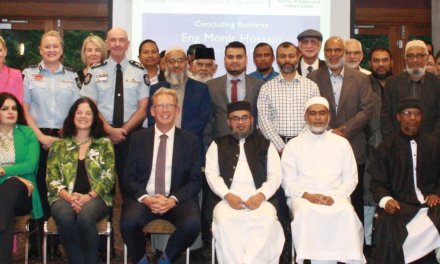
Photo: Youth leaders coming together to combat Islamophobia.
The Parliamentary Youth Summit held on Friday 13 March 2026, was a landmark event by the Countering Islamophobia Project of the Board of Imams Victoria. The Summit brought together organisations, government representatives and community advocates with expert perspectives on racism and islamophobia to co-design tangible recommendations at both community and institutional levels.
The Countering Islamophobia Project is a community-driven initiative that tackles Islamophobia through education, advocacy and collective action. Rather than only responding to incidents, the project focuses on long-term change and amplifying community voices to raise awareness and hold racists accountable for anti-Muslim hate.

Quran Recitation by Adam Abdelmula.
The Summit aimed to turn discussion into action, with a focus on outcomes including better accountability for Islamophobic incidents, stronger institutional support for affected communities and raising awareness of the International Day to Combat Islamophobia.
This is an annual day of significance recognised by the Victorian Government, Victorian Multicultural Commission, Wyndham City Council, City of Greater Dandenong and many others on the 15th of March every year.
The program opened with a Quran recitation by Adam Abdelmula from Surah Al-Hujurat (11-12) and an explanation connecting the verses to the harms of prejudice and discrimination.

Bronwyn Halfpenny MP with the welcoming address.
The welcome address was delivered by Ms Bronwyn Halfpenny MP, Member for Thomastown, who acknowledged the significance of hosting the Youth Summit at Parliament House. She emphasised the importance of creating space for meaningful dialogue at a parliamentary level.
The event featured a panel of distinguished speakers whose expertise and leadership served as a key showcase for attendees. The panel was moderated by Jazeer Nijamudeen, President of the Muslim Legal Network and Project Lead for the Countering Islamophobia Project of BOIV.

Panel of 3 speakers, Cr Mohamed Semra, Dr Susan Carland, Dr Mario Puecker
Cr Mohamed Semra, the Mayor of Maribyrnong, highlighted the crucial role of local government in promoting social cohesion and taking a firm stand against Anti-Muslim hate.
Monash University academic and author, Dr Susan Carland, whose work focuses on Islamophobia, and media representation, captured the urgency of the issue, stating that we should “ do something before it becomes a problem.”
Dr Mario Peucker, Associate Professor at Victoria University, brought a research-informed perspective on localised responses to racism.
Together, the panel helped inform key recommendations by the youth leaders.
Bakr Al Saudi’s keynote speech reflected on losing a friend in the Christchurch terrorist attack and what could have prevented it. On 15 March 2019, 51 people were killed by an Australian white supremacist in the worst terrorist attack in the history of Australia and New Zealand.
The event concluded with participants collectively developing key recommendations to combat anti-Muslim hate through education, youth engagement and cultural representation.
A central recommendation was the introduction of targeted training in schools, universities and workplaces focused on critical media analysis, with an emphasis on identifying and challenging anti-muslim narratives.
Participants also called for Muslim-led youth consultations to inform key discussions at the 2027 Parliamentary Youth Summit to Combat Anti-Muslim Hate, ensuring that young Muslim voices are included in shaping future policy responses.
In addition, the establishment of a Victorian Muslim Film Festival was proposed as a way to empower Muslim communities to share their stories, strengthen representation, and challenge racist narratives.
Participants were invited to continue the conversation by utilising social media platforms to raise awareness of the Summit, helping to reach the community.
By bringing together young leaders, community organisations and policymakers under one roof, the Summit reinforced that addressing Islamophobia requires sustained collaboration, not isolated action.
While the recommendations mark an important step forward, organisers emphasised that their impact depends on continued engagement from both government and the wider community.
As conversations extend beyond Parliament House, the message from the Summit remains clear: meaningful change begins with awareness, but it is sustained through action.
Readers are encouraged to stay informed, challenge harmful narratives when they arise, and support initiatives that promote inclusion within their own communities.





Comments