


An intimate iftar gathering in Melbourne’s southeast on Sunday 15 March brought together community leaders, politicians and advocates for an evening of reflection, discussion and candid conversation at a time of heightened global and local tension.
Held on Thomas Street in Dandenong, the dinner was attended by a cross‑section of public figures, including New South Wales Greens Senator David Shoebridge (the party’s federal spokesperson on foreign affairs, justice, immigration and related portfolios).
Other invitees included Samantha Ratnam, Victorian Greens politician and former Leader of the Victorian Greens and member of the Victorian Legislative Council; Steph Hodgins‑May, Australian Greens Senator for Victoria with portfolios including early childhood education, democracy and climate; community advocate Matthew Kirwan, policy professional, former Greater Dandenong councillor and now Lead Victorian Greens candidate for the South‑Eastern Metropolitan Region and others from civic and professional life.
The gathering, described by Mr Kirwan as “an evening of harmony and understanding at a time of conflict,” provided a space for open dialogue on issues ranging from rising racism in Australia to global injustice and the ongoing crisis in the Middle East.
For Samim Moslih, an independent political figure who stood for the federal seat of Calwell in the 2025 federal election, the evening underscored the urgency of confronting deeper structural issues affecting Muslim Australians.
“The racism towards Muslims gets confirmed and reaffirmed as being structural,” he told AMUST, pointing to recent public discourse as evidence of a normalisation of Islamophobia.
Mr Moslih also raised concerns about the evolving relationship between Muslim communities and government, arguing that it has shifted in tone and substance.
“Many in the Muslim community feel our relationship with the Albanese Labor Government has become fear-based rather than the respectful partnership that should exist between citizens and their elected representatives,” he pointed out.

(From left): Payal Tiwari, Matthew Kirwan, Steph Hodgins-May and David Shoebridge.
Mr Moslih warned against what he described as political narratives that rely on fear to maintain loyalty, adding that public funding should never be framed as a favour.
“Public funds are not favours from government – they come from the taxes paid by all Australians, including Muslim Australians, and should never be used in ways that make communities feel dependent or controlled.”
Moslih also cautioned against increasing political polarisation, urging Australians to resist importing more divisive styles of politics.
“Australia is a multicultural and multifaith society and that should define us,” he said.
“We must resist the Americanisation of our politics that breeds division, aggression and fear of the other.”
The discussion comes amid broader concern about public rhetoric, including a recent Senate exchange highlighted by academic Halim Rane, in which comments about Muslims drew criticism but were ruled permissible – raising questions about double standards and the boundaries of acceptable speech.
Senator Shoebridge echoed concerns about rising division while emphasising the importance of community connection.
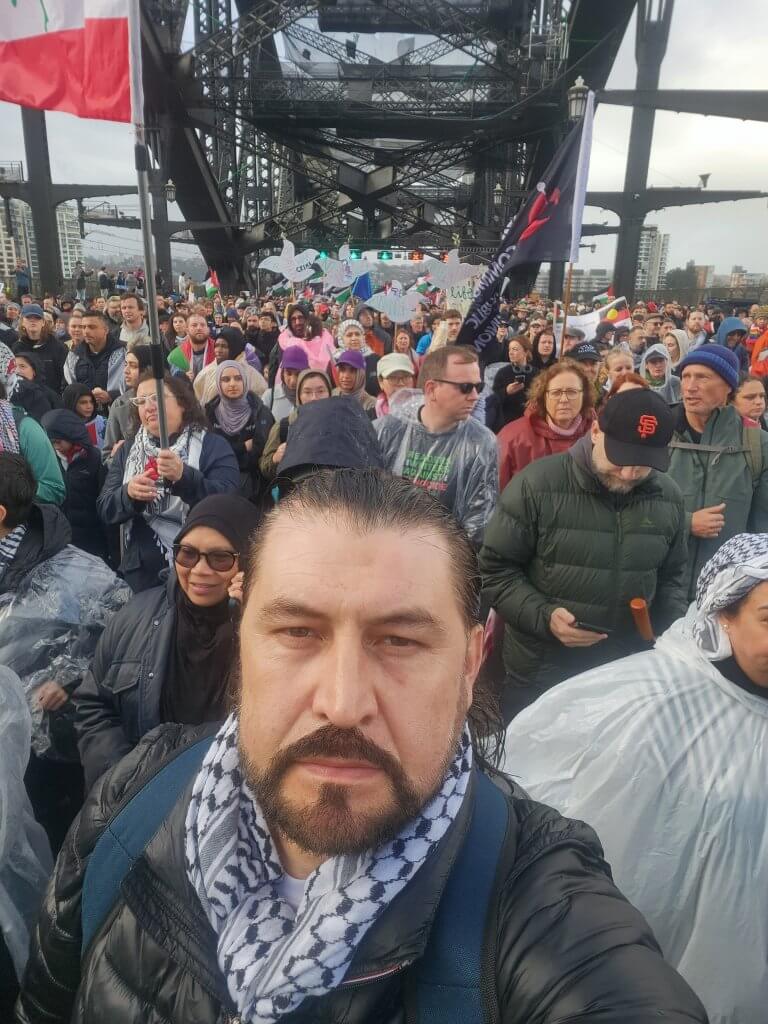
Samim Moslih during last August’s March For Gaza, across the Sydney Harbour Bridge.
“Australia is a proud multicultural community and I am happiest in my job when I get to see our country thrive through bringing together people from all walks of life,” he said.
“We have seen a disturbing and dangerous rise in racism and division over recent years.”
“This can only be confronted and defeated with a politics of hope and community.”
“I know that the joy and connection at events like the Ramadan night markets is stronger than any attacks seeking to divide.”
As far as Samim Moslih is concerned, however, such conversations must move beyond symbolism and into meaningful engagement.
He stressed the importance of creating spaces where communities can speak openly about the pressures they face – from cost of living and housing to international conflicts and political disconnection.
“Across our communities there are experts, professionals and people with deep lived experience who could help shape better policy and stronger communities if they were truly given a seat at the table,” he said.
The themes raised at the iftar echo sentiments expressed more broadly within the Muslim community recently, including at large-scale gatherings such as Eid prayers at Lakemba Mosque, where questions of political engagement, representation and community voice have come sharply into focus.
While perspectives differ across the community, the Dandenong iftar highlighted a shared desire for respectful dialogue, genuine representation and a renewed commitment to justice – both locally and globally.
As Mr Moslih concluded, meaningful progress will depend on a willingness to confront uncomfortable truths.
“If we are to move forward together, we must listen more carefully, speak more honestly and remain united in our commitment to justice and human dignity.”




Comments