

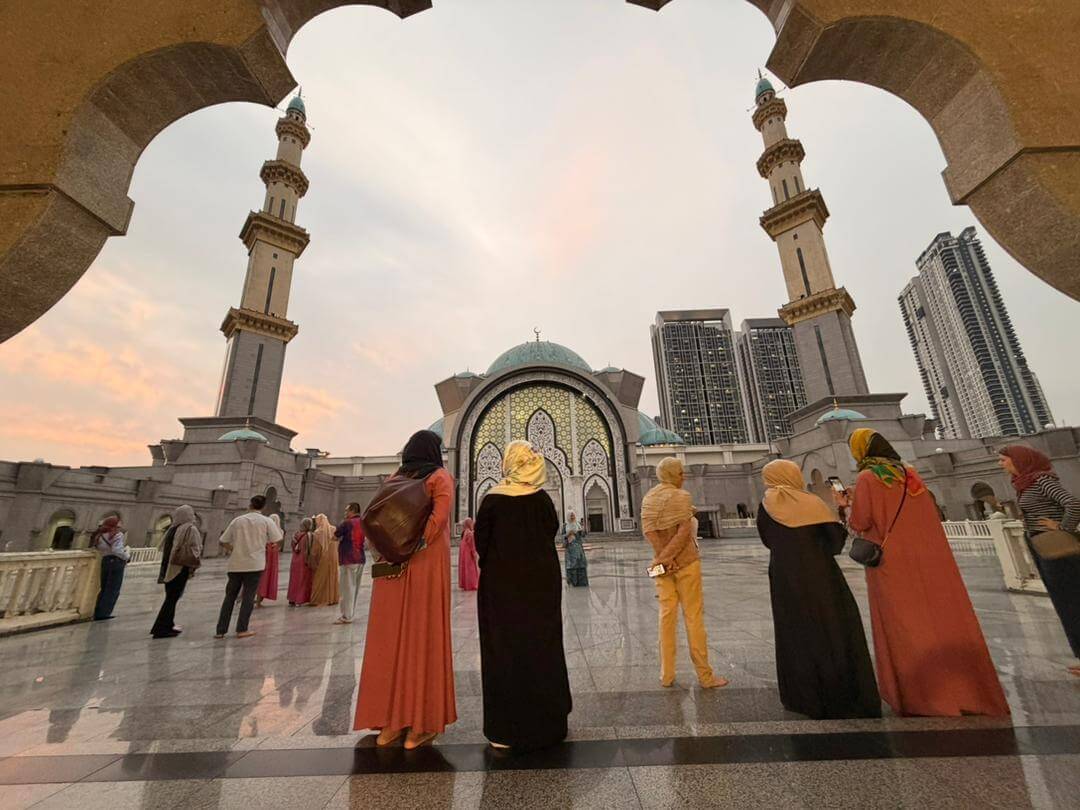
Photo: The external courtyard of Masjid Wilaya
Set in 6.5 hectares of land with 40,000 sqm of floor space, Masjid Wilaya is a premier tourist attraction in Kuala Lumpur that opened in 2000, tours began in 2009 with just a few volunteer guides.
After a short hiatus for Covid the operation has grown to over 140 volunteers ranging in age from early 20’s to 70+ while visitor numbers range from 1500 to over 2000 a month depending on holiday seasons.
Typically guests are tourists visiting Malaysia but special tours are also done for groups such as schools, colleges, other faith groups or conference parties in co-operation with the mosque management.
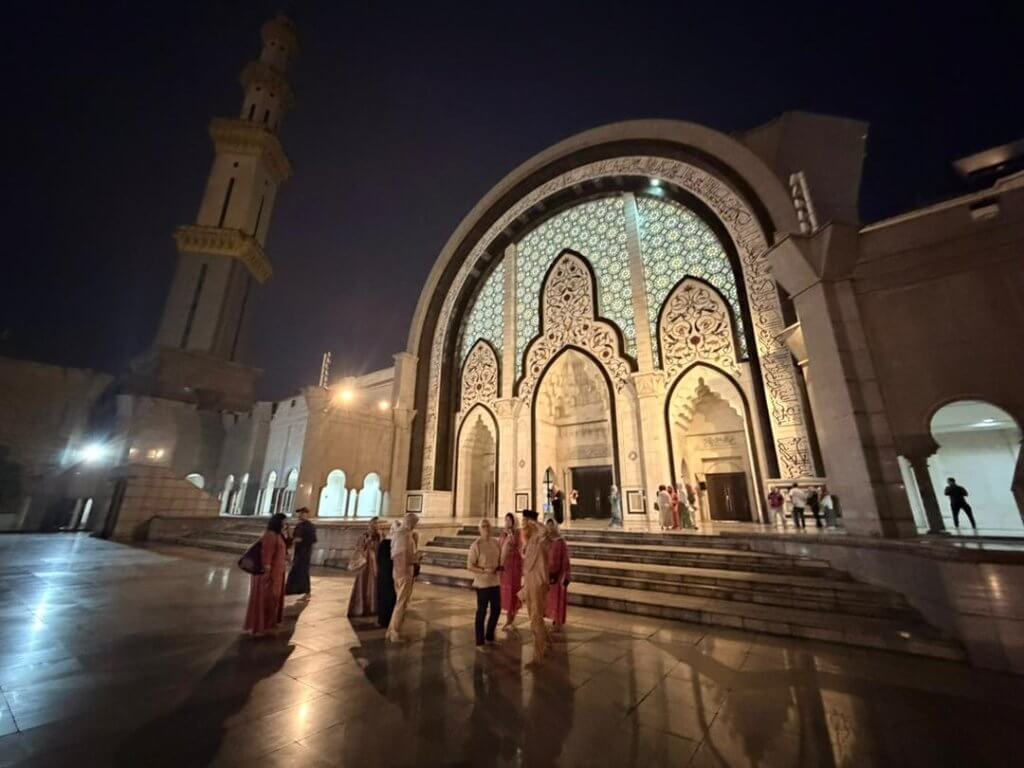
Exterior courtyard at night
Guides also volunteer to assist other mosques at their open days.
The mosque itself nestles in beautifully landscaped gardens and is partly enclosed by an artificial lake, reflecting the Qur’anic view of Paradise being a pleasant land with rivers and gardens.
The architecture is an eclectic blend of designs from around the Muslim world. The imposing archways are Moroccan style resembling those seen in the famous mosque in Cordoba, Spain. The 93-metre-tall minarets are Egyptian style as would be seen at major mosques in Cairo. The domes are covered in turquoise blue and yellow tiles reflecting Persian ceramic patterns.
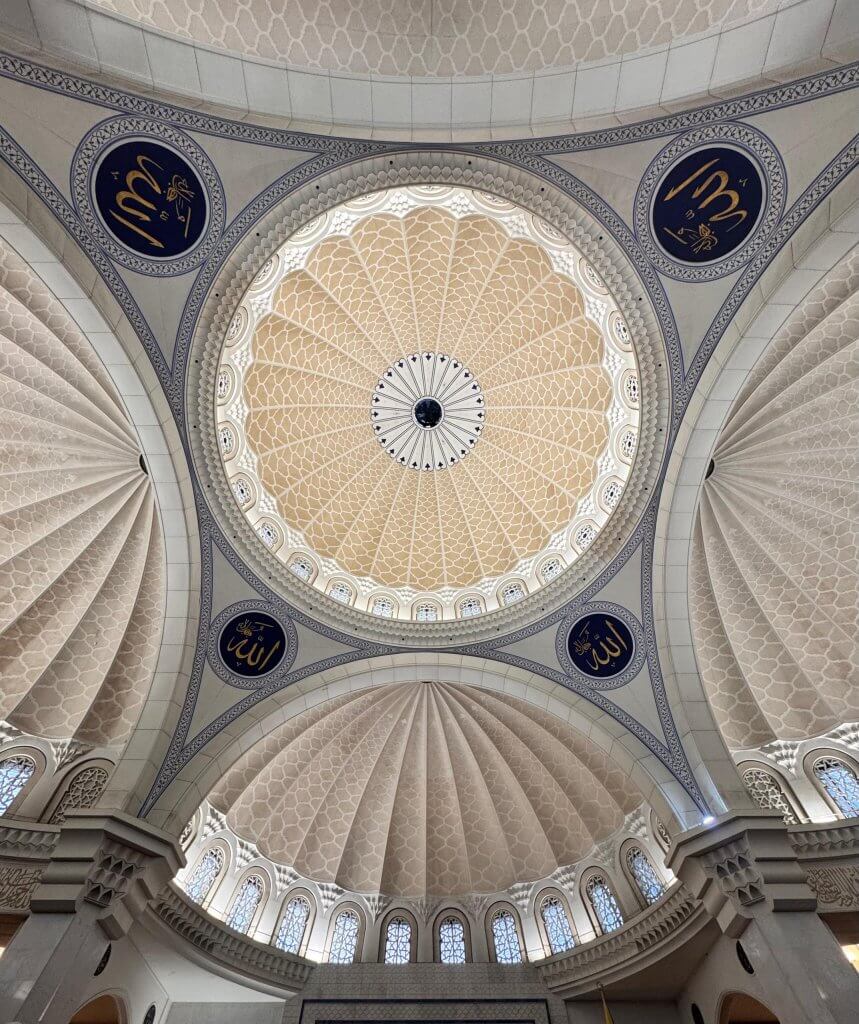
The stunning domes and half domes
Ceilings are decorated with repeated geometric patterns reflecting early Muslim’s mastery of mathematics and geometry. The doors are a tribute to Malaysian skill working with wood. The repeated floral patterns were carved in teak by master carvers from Malaysia’s East Coast. The door handles are made of the famous Selangor Pewter while the granite and marble flooring and facing stones are all from local sources.
The visual feast continues inside the prayer hall with even more carving on screens and the minbar, (pulpit). Abundant windows admit natural light, saving on energy costs. The large main dome sits on 3 half domes and an arch reflecting the Ottoman style of mosque architecture seen in mosques such as the Blue Mosque in Istanbul.
The main hall accommodates 7,000 worshippers with another 10,000 in outside courtyards making it among the top 55 in the world in terms of capacity.
In keeping with Islamic tradition, decoration is simple with Arabic calligraphy featuring the name of Allah and Muhammad (s) while the base of the dome is ringed with the Asma al-Husna, the 99 names of Allah mentioned in the Qur’an.
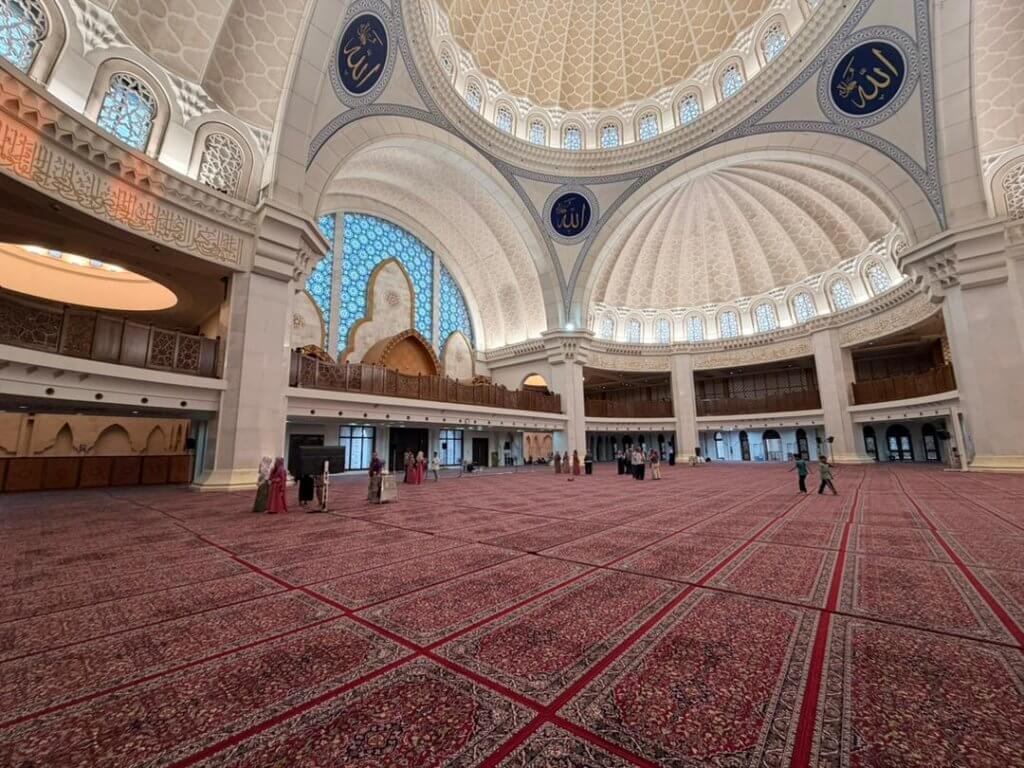
The centrepiece of decoration encloses the mihrab, (prayer niche) with calligraphic renderings of the opening chapter of the Qur’an, and other verses reminding Muslims of their duty to visit the mosque to pray, inset above.
The mihrab itself is flanked by stunning panels inlaid with semi-precious stones. These were done by direct descendants of the families who produced the inlay work on the Taj Mahal in the mid-seventeenth century.
The mosque is more than a place of prayer. It has reception rooms for weddings and visitors may see a wedding party in the mosque. It is a place of education with classrooms for school students and large and small seminar rooms as well as a superb library.
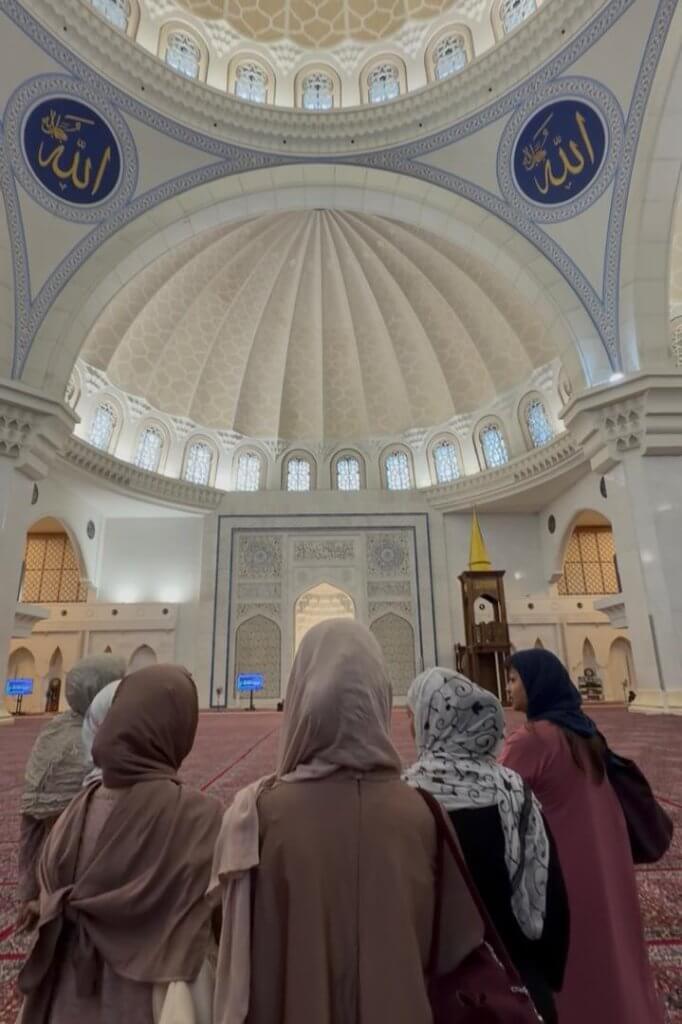
Visitors in mosque interior
Visitors who time it right will be able to observe communal prayer and individuals praying or reading the Qur’an in small study groups are a common sight.
Photography and videos in the mosque and surrounds are permitted but you should ask for permission to photograph any worshippers. Wedding parties are sometimes happy to pose with visitors. Guests are expected to dress conservatively out of respect for the mosque and culture, but robes and scarves are provided for visitors.
The tour includes an introduction to the Islamic faith, mainly aimed at providing information and correcting misconceptions. There is an abundant variety of information pamphlets available in several languages and access to translations of the Qur’an in several languages is also possible.
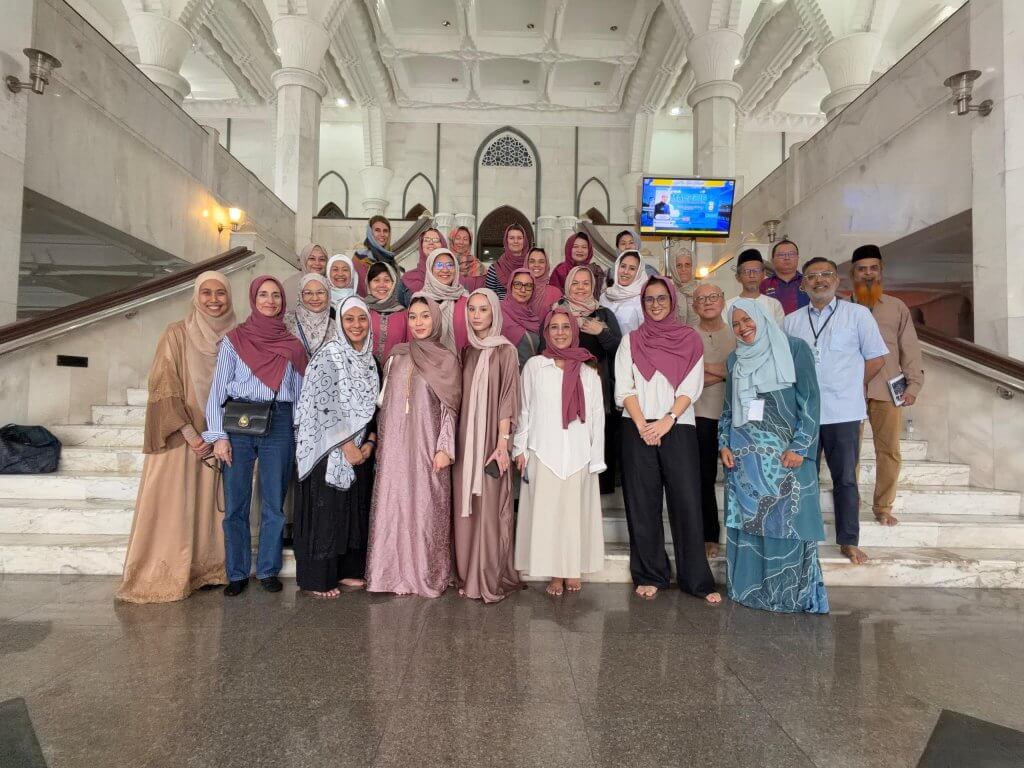
Guides are happy to answer questions and do not actively seek conversions. Occasionally a visitor at the end of their search for Islam will ask to convert. Where possible they are referred to the mosque management although guides will provide support and encouragement.
Tours are conducted daily from 10am to 3.30pm although there is a break from 11.30 to 3pm on Fridays for the major prayer when the mosque is at full capacity. Recently an evening tour has proved successful, and these may be held once a month.





Comments