

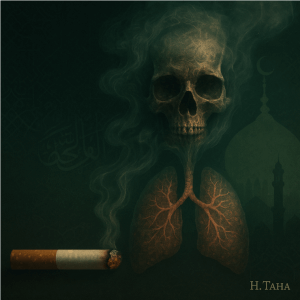
Faith, health, and eyesight – why smoking is a crisis the Muslim community can no longer ignore.
The contradiction we breathe
In many corners of the Muslim world, the scent of oud may linger in the air… but so does something far less fragrant: tobacco smoke.
Whether from a cigarette, hookah, or the new wave of vapes, smoking has become a common yet quietly accepted habit across our communities.
But what happens when we examine this issue through two lenses: faith and health?
It’s a story of contradiction – where spiritual guidance calls for preservation of life, while cultural habits slowly chip away at it.
The religious mirror: What does Islam say?
Islam places immense value on protecting the body, a trust from Allah. While tobacco did not exist during the time of the Prophet Muhammad (s), the Qur’an and Hadith provide guiding principles:
“Do not throw yourselves into destruction with your own hands.” (Qur’an 2:195)
“Your body has a right over you.” (Hadith, Sahih Bukhari)
For years, smoking was brushed off by some as makruh (discouraged). But with overwhelming medical evidence of harm, the verdict has shifted where most scholars now consider smoking haram (forbidden).
Yet despite this, smoke continues to rise – in homes, cafes, weddings, and even outside mosques.
And too often, it drifts into the lungs of non-smokers, including children. Second-hand smoke kills nearly 1.3 million people worldwide every year – people who never chose to light up.
The health wake-up call: What smoking really does
When people think of smoking-related diseases, the usual suspects come to mind: lung cancer, heart disease, stroke.
But smoking’s reach is far wider – and as future optometrists, it’s my duty to shine a light on what it does to the eyes:
- Cataracts: Smokers are up to twice as likely to develop cataracts — the clouding of the eyes lens that leads to blindness.
- Age-Related Macular Degeneration (AMD): Smoking increases the risk by 3–4 times. AMD destroys central vision the part you need to read, drive, or recognise faces.
- Blood Vessel Damage: Smoking narrows and weakens blood vessels, starving the retina of oxygen and increasing the risk of retinal vein occlusion.
- Dry Eye & Poor Healing: Smokers experience chronic dry eye and slower healing after eye surgery.
So while the harm to lungs and hearts is well-known, the impact on vision is often overlooked – literally and metaphorically.
A community perspective: Muslim optometrists speak out
To bring this closer to home, I reached out to Dr Gada Harmouch, a respected Optometrist and community advocate, emphasises that smoking does not only cut years from life expectancy but it robs people of their independence by taking away their sight.
“Smoking doesn’t just shorten lives; it steals independence. Blindness from smoking-related diseases means losing the ability to read, drive, or even recognise loved ones. As Muslims, protecting our sight is part of protecting the amanah (trust) Allah has given us.”
— Dr Gada Harmouch, Optometrist & Community Advocate
Beyond her clinical work, Dr Harmouch continues to raise awareness about health and lifestyle within the Muslim community.
You can follow her insights and community projects on Instagram @theeyegirl.
Final reflection: Smoke or sight — What will you choose?
In a world where smoke blurs truth, we need clarity – in faith, in health, and in vision. Islam is a religion of mercy, preservation, and responsibility.
Our eyes are among the most precious blessings we’ve been given. So why cloud them with something as toxic as tobacco or vapes?
Whether you’re a healthcare worker, a spiritual leader, or just someone trying to do better – the time to act is now. Because every puff has a price. And sometimes, that price is your sight.






Comments