

In Gaza, rubble is all that remains of houses, apartments, schools, all of its six universities, all of its 36 hospitals, its museums, parks, mosques, graveyards, orchards, farms, fishing boats, sewage and water systems.
Nothing remains and, in a final act of barbarity, starvation is wielded as a weapon in this live-streamed genocide, with at least an estimated 680,000 dead, most of whom were women and children.
The living are left scavenging amidst the ruins. The West Bank is fractured by hundreds of checkpoints and settler roads. Israel has openly rejected Palestinian statehood, entrenching a regime of violence and dispossession.
Against this backdrop, Canberra, alongside Canada and the UK, celebrates the “recognition” of Palestine as a bold, coordinated leap toward peace.
This gesture of recognition is a hollow exercise in coordinated international PR. The language of the statement is telling. It begins by “recognising” an independent, sovereign State of Palestine, but a few lines later, this independent sovereign state is mentioned only as an “aspiration,” not a right.
Where in this recognition is there any mention of the right of self-determination, of justice, or the right of return? Bizarrely, the only time rights are mentioned is Israel’s supposed “right to exist,” a concept that does not exist in international law. International law grants self-determination to peoples, not a “right to exist” to states.
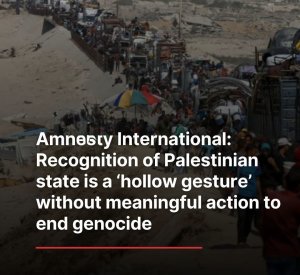
The statement imposes many conditions: demanding “reforms” in governance, finance, and education, and the exclusion of Hamas, the party that won Palestine’s last relatively free elections. What sort of sovereignty is this? It is a colonial diktat echoing a long colonial tradition of denying independence until the “children” are “ready.”
The moribund, incompetent, and corrupt Palestinian Authority that has failed the Palestinian people is invoked. The supposed sovereign “state” is not defined by the Palestinian people but by Australia and the West, right down to its political complexion and educational curriculum.
As usual, the two-state solution is rolled out as “the only path to peace.” But this mantra is just a smokescreen for perpetual inaction: it forecloses abolition of apartheid and erases the reality of genocide, just as Western states erased the voices and rights of Black South Africans under apartheid.
It changes a plaque from “mission” to “embassy,” repackages a concentration camp as a “state,” and insists that only those resistance movements accepted by colonisers have any legitimacy. Every serious effort at Palestinian democracy has been blocked by Western powers that will only accept elections if their preferred collaborators will win.
Australia should also never support a purported plan by the White House to have war criminal Tony Blair head up an interim Gaza administration.

Australia’s recognition statement restates Israeli atrocity narratives, reinforcing propaganda about hostages instead of the tens of thousands of Palestinians being tortured in Israeli prisons or the ongoing starvation campaign and genocide.
Australia, the UK and the US talk of “reconstruction” in Gaza, without any accountability for the ethnic cleansing and genocide. The main concern is public relations and mitigation, not justice or reparations.
There is no accountability. The international system, from the UN Secretary-General to leaders in Western capitals, is silent about sanctions or prosecutions, even after independent commissions of inquiry have declared Israel’s actions genocide.
Australia, the UK, and the US continue arms exports, allow settlement goods to flow, and shield Israel from legal consequences, refusing to make any effort to halt complicity.
The Red-Lines Legislative Package: Real Justice, Not a Symbolic Gesture

Justice demands not more symbolism, but bold legislative change. The Thorpe-Payman Genocide Red-Lines package, introduced in Australia’s parliament, would:
- Remove the Attorney General’s power to block genocide prosecution, opening a path to hold perpetrators to account in Australia.
- Require businesses to report and counter genocide risks in their supply chains.
- Ban government and charity investments in companies operating in illegal settlements.
- Prevent export permits for weapons and military equipment that risk contributing to genocide or war crimes.
- Establish an Anti-Genocide Commissioner to monitor compliance and accountability.
Passing these laws should be the minimum benchmark for integrity. Rejecting them would show that this recognition is purely symbolic, a political cover for continuing complicity in war crimes.
What Australia needs to do if it is serious
If recognition is to mean anything, it must break with the coordinated international effort to define Palestinian rights out of existence. It must be the beginning, not the end. To move from symbolism to justice:
- Pass the Thorpe-Payman Genocide Red-Lines Package.
- Suspend all arms sales to Israel.
- Ban imports from illegal settlements.
- Back ICC and ICJ cases for accountability.
- Support humanitarian corridors and global boycotts.
- Demand sanctions, not just statements, against genocide and occupation.
- Support a UN General Assembly resolution on Uniting for Peace which can bypass the Security Council veto and authorise the use of force.
A moral test
Australia now faces a stark choice. Will recognition remain a cynical stunt—a plaque on a prison gate—or become the first step towards genuine justice? Palestinians need the right of return, reparations, protection, full rights, and freedom—not jargon, not slogans, not colonial conditions, not a distraction from genocide and ethnic cleansing. History will remember those who choose symbolism over real justice.




Comments