

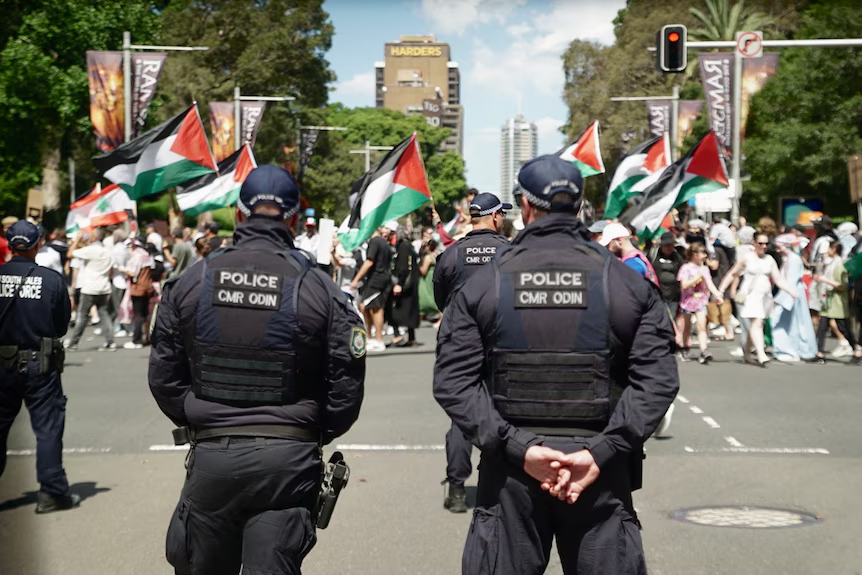
During the Sydney Harbour Bridge Palestine march for humanity on Sunday 3 August, police presence was heavy and relentless, yet procedural failures within the force compromised the safety and security of over an estimated 300,000 protestors.

Police mounted on horses behind crowd of protestors at the Palestine March for Humanity. (Photo by Dean Lewis AAP)
While the media had anticipated 50,000 participants, organisers now claim that around 300,000 Sydneysiders attended the march for humanity.
Despite this, it appeared that the NSW Police Force had not made an appropriate plan to control the crowd in the event that numbers exceeded expectations. This caused confusion amongst protestors who were left stuck on the bridge for up to an hour while awaiting police instructions.
This was clear through the emergency geo-targeted text messages that were sent out to protestors within just 30 minutes. They instructed protestors to stop the march before directing them back across the bridge, before police closed off the North side of the bridge.

Emergency geo-targeted texts sent by the NSW Police Force to protestors on the Harbour Bridge.
These texts were sent out while protestors were still entering the bridge from the Southern side, creating great risk and possibility of a crowd crush. No clear direction or communication was given by the Police Force to inform protestors of the new route, with Legal Observers NSW stating that one police officer had told a woman the messages were “a scam.”
Further reporting by the Legal Observers NSW stated that a police horse had pushed over an elderly man with a walking stick.
The NSW Police Force emphasised on their official website that they support the right to peaceful assembly and democratic protest, and their presence was solely to focus on the safety and security of protestors. Despite this, their inadequate planning and communication within their Force failed to facilitate the very safety they promised.
The dangerous conditions on the Harbour Bridge raise serious questions about whether the right to protest is truly protected in this country. When people gathering for justice are met with confusion, conflicting orders, and physical danger, the message is clear: civil protest may be legal, but it is not welcomed.
And in moments of mass mobilisation, that hostility becomes a form of quiet suppression.





Comments