


The Indian Minority Education Society of Australia Inc (IMESA) organised an education awareness programme in the conference hall of the India Islamic Cultural Centre, New Delhi on Friday 12 July 2024.
With its bright turquoise dome, built with uneven tiles donated by the Iranian government and inscribed with Quranic verses, the India Islamic Cultural Centre stands out among the other government buildings on Lodhi Road in India’s capital.
The purpose of IMESA is to increase the educational levels of poor minorities in India, including Muslims.
Mr Zahid Jamil took the opportunity during a private visit to India to hold the event and presented a brief introduction of various activities of IMESA in his inaugural address. He informed the august gathering that IMESA is running nine learning centres in eight different states of India.
Mr Jamil requested the audience to extend their support to IMESA’s work for the upliftment of the education level of the Indian Muslim community.
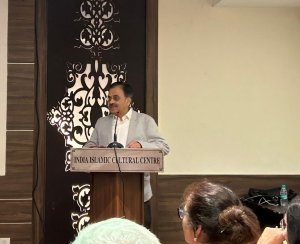
A video showcasing IMESA’s aim and objectives, a description of the problem, its work on the ground in India, the beneficiaries and how the audience can be part of the noble work was screened at the event.
Mr Jamil said that the Muslim community face the highest poverty among various religious groups of India.
The poor Muslims live in a large number in slums and very poor localities of towns and cities across India. Charity begins at home and the Non-Resident Indian Muslims of Australia feel obliged to support their community back home.
Mr Jamil said all project expenses at various IMESA centres are met through the funds raised in Australia. He appealed to the local Muslims with means, including professionals and business people, to sponsor the poorest children and their struggling families.
The key component of IMESA’s Taleemi Jamaat project is to run after-school centres to provide free tutoring and other support to underprivileged children.
Mr Jamil equated IMESA’s humanitarian work to the concept of Haqooq Ul Ibad under Islamic Principles.
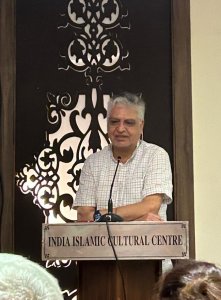
Prof Furqan Qamar, former vice chancellor of Himachal Central University, former Secretary General of the Association of Indian Universities, and presently Professor at the Faculty of Management Studies, Jamia Millia Islamia university, during his keynote address, appreciated the efforts of IMESA.
Prof Qamar emphasised that the Muslim community should participate in the development and growth of the nation. He said Muslims must not be reluctant to seek their rights from the Indian government in all fields of life, more importantly education.
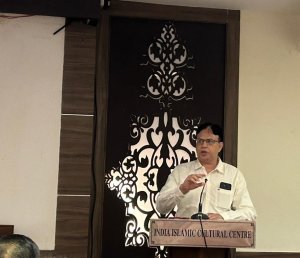
Prof Majid Jamil of Jamia Islamia University welcomed and acknowledged the presence of honoured guests. H provided details of the project and thanked various speakers.
Prof Jamil has been an integral part of the pilot Taleemi Jamaat project which began in the city of Saharanpur more than 10 years ago.
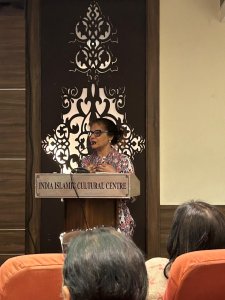
Dr Tabassum Ruhi Khan, an Associate Professor of Media and Cultural Studies at University of California, Riverside, during her address, suggested that various social and welfare organisations work together in a synchronised manner for the betterment of the Muslim community.

Prof Sabiha Zaidi of Jamia Millia Islamia university applauded IMESA’s effort and emphasised on women’s empowerment during her speech.
Mr Amir Abidi, The founding director of Taraqqi Foundation shared his experience of his stay in London and the work his organisation is engaging in educating the children in the villages of Gurgaon.
Dr Syed Zafar Mahmood, President of Zakat Foundation of India, famous social activist and Urdu poet Gauhar Raza were among several prominent guests at the event.
MC Abeerah Fazil, a young computer science graduate of Amity University, facilitated the programme with enthusiasm.
The event attracted a sizeable gathering of university professors, social activists, professionals and students who enjoyed the scholarly speeches and were impressed with IMESA’s work.




Comments