

Prime Minister Anthony Albanese’s 8 January announcement of a federal Royal Commission into anti-Semitism and Social Cohesion, alongside a series of incidents and policy debates affecting Muslims, prompted Melbourne-based commentator Jalal Kassab to speak out in more depth on issues he has long raised publicly.
In a subsequent conversation with AMUST’s Community Journalist John Mahoney, Mr Kassab reflected on identity, law and the implications for Muslim communities. What follows are Jalal’s own words:
Imagine a legal landscape where “Islam” and “Jew” are treated as interchangeable categories under the Royal Commission, as though the complexities of identity, ancestry and lived experience can be collapsed into a single political definition. Israel, Palestine, Iran, Lebanon – these are all societies with Semitic peoples. Arabs are Semites. Many Muslims are Semites.
I am a Muslim and a Semite; my DNA can testify to that. Yet a Jewish convert from New Zealand, with no Semitic ancestry at all, is still legally treated as a Semite, while an Arab Muslim from Yemen or Lebanon is not.
What exactly is the law trying to do here? Is this about tackling hate consistently, or is it about creating a special, selective category?
The recent hate crime against a Muslim Imam and his wife makes this even clearer. They weren’t attacked for their Bosnian ancestry. They were attacked because they were visibly Muslim.
Line them up with Muslims from Yemen, Lebanon, Iraq or Palestine, and the attacker wouldn’t have known the difference.
The slurs weren’t about ethnicity – they were about Islam. Yet the Prime Minister recently announced a federal Royal Commission into Antisemitism and Social Cohesion, not a Commission into religious hatred more broadly, and certainly not one that centres the Muslim experience.
So where does that leave the largest target of religiously motivated hate in Australia?
When a Royal Commission is framed around antisemitism alone, it risks creating a hierarchy of whose pain matters.

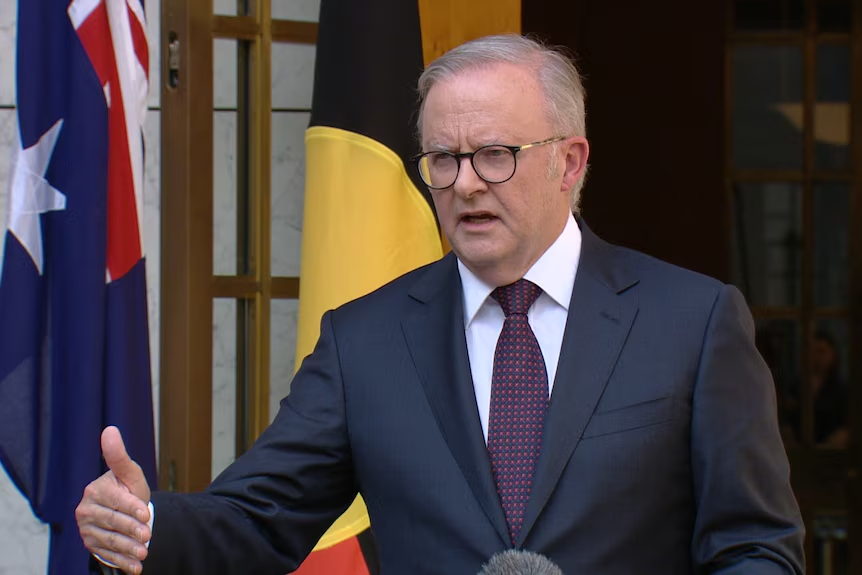
Jalal Kassab (above) warns that elevating some groups’ suffering over others risks creating a two-tier system of justice.
And when hate-speech laws start protecting political narratives instead of vulnerable communities, they stop looking like justice and start looking like blasphemy laws in secular drag.
It’s not framed as “heresy,” but as “hate speech,” “extremism” or “community safety” – anything that makes censorship sound humane and progressive.
My concern is simple: when speech is weaponised to shield illegal or questionable behaviour from scrutiny, and when criticism becomes criminalised, it’s dangerous for a free and open society.
Hate speech from grubs who want to incite violence should absolutely be dealt with – and we already have laws for that. Intent is paramount.
But when the nation begins to elevate one group’s suffering as uniquely sacred while treating others as politically inconvenient, the result is not cohesion. It’s a two-tiered system of protection.
And that’s the ugly part.
Because if the law treats “Jew” and “Semite” as interchangeable while ignoring that Arabs and many Muslims are also Semites, then it’s not defining hate – it’s defining hierarchy.
It’s deciding whose trauma is nationally significant and whose is merely unfortunate.
It’s deciding which communities deserve a Royal Commission and which must settle for a press release.
That’s not social cohesion. That’s selective sanctification.
And once the law begins sanctifying some narratives over others, it inevitably emboldens those in power to decide which ideas may be debated – and which must be shut down.
Backlash to the proposed Anti-Semitism and Social Cohesion Omnibus laws says a lot about where disharmony really comes from.
Communities aren’t the ones manufacturing division – it’s politicians and shock jocks who get endless airtime to stir fear, then act shocked when society fractures. And when leadership stays silent, that silence becomes consent.
If regulation is needed anywhere, it’s for those in power who weaponise words.
Expecting politicians to be honest and principled is like expecting a fox to run a security company – technically possible, historically unlikely.
When a state bans an organisation not for violence, not for incitement, not for coercion, but for ideas – especially ideas about governance – it’s signalling something very specific:
“We are confident enough to rule, but not confident enough to debate.”
And as a post script….
It’s remarkable how the government and mainstream media have settled on a story where “antisemitism” is something that only Muslims do.
That’s their idea of social cohesion – pick a minority, blame them for everything, and pretend the rest of society is spotless.
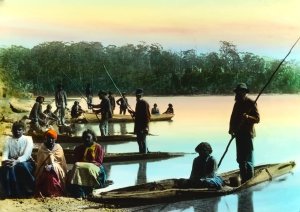
Hand-coloured photo of a fishing scene at Lake Tyers, Victoria, circa. 1900. (Photo credit: T W Cameron).
It’s the same parody logic as taking policy advice from people nostalgic for the White Australia Policy, or pretending First Nations people needed ‘civilisation’ from a culture that put them under Flora and Fauna legislation while they’d lived with the land for 60,000 years.
Western civilisation talks like it’s the moral compass of the planet, yet it’s the one that built the concentration camps, the gas chambers and the industrial machinery of genocide.
But somehow the “real problem” is Muslims and their supposedly ‘violent religion’! The hubris is unbelievable.
This isn’t about safety or cohesion. It’s about manufacturing a villain so no one has to look in the mirror.



Comments