

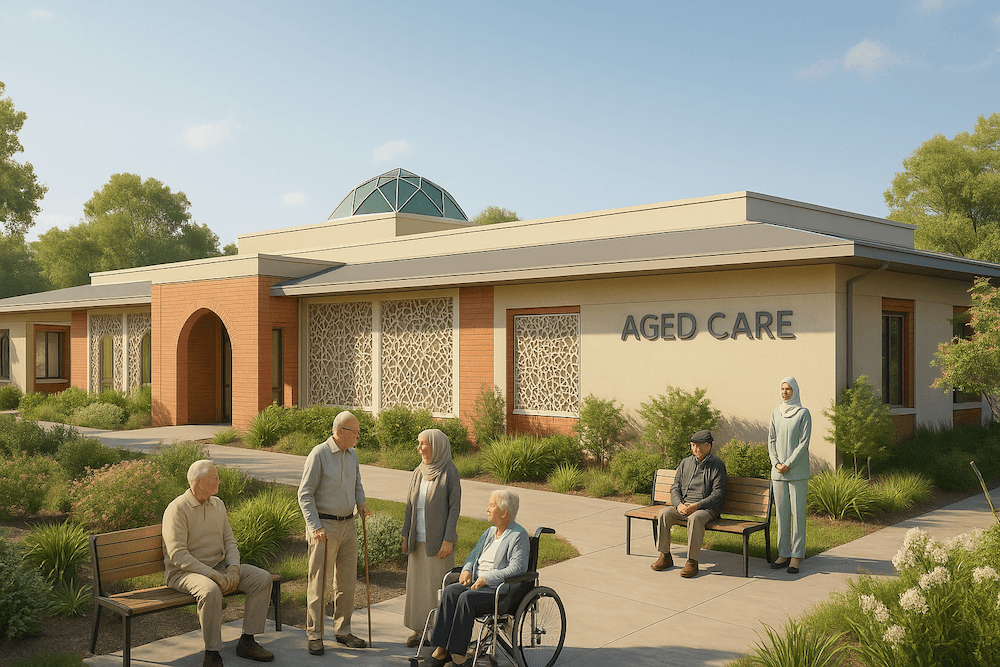
In the early 1980s, there were fewer than 100,000 Muslims in Australia. Today, the 2021 Census counts 813,392, or 3.2 per cent of the national population.
This growth reflects decades of migration, settlement, contribution, and community-building. Beneath this success lies a quieter shift: a rapidly growing cohort of older Muslims who will soon need aged care that respects their language, culture, and faith.
The ageing tsunami has a Muslim face
Australia is facing an ageing tsunami. Older Australians aged 65 and over grew from 4.6 per cent of the population in 1922 to 16.2 per cent in 2021 and are projected to exceed 20 per cent by 2066. Among non-Christian and migrant communities, the growth is sharper.
The 65 and over population identifying as Muslim increased more than fourfold between 1996 and 2016, one of the fastest growth rates of any religion.
The first waves of Muslim migrants from Lebanon, Turkey, South Asia, Southeast Asia, and Africa are now entering retirement age together. They are not a niche; they are a sizeable, ageing cohort.
We built mosques. Now we must build aged care
Since the 1970s, Muslim communities have invested energy, time, and savings into building mosques, prayer rooms, Islamic schools, and community centers. Today, there are around 500 mosques and musallahs across Australia, with numbers continuing to grow alongside the population.
Western Sydney alone is home to dozens of mosques in Auburn, Lakemba, Bankstown, Parramatta, Blacktown, and surrounding suburbs. These spaces were established through community fundraising, volunteer efforts, and close collaboration with local councils and state authorities on planning and approvals.
We have proven that when we are united, we can build major community infrastructure. Governments and councils can work with Muslim communities to support spaces that serve both spiritual and social needs. The next challenge is to secure space for our ageing with dignity.
What older Muslims are asking for
Many Muslim families are now seeking retirement living and aged care that align with their values. These are often retired professionals, business owners, and long-settled migrants who are financially secure, educated, and community-minded. They are not asking for luxury; they want:
- Halal food and kitchens as standard
- Gender-sensitive care, especially for personal care
- Prayer spaces and spiritual support, including Jummah and Ramadan arrangements
- Culturally competent staff who understand modesty, family roles, and end-of-life rituals
- Respect for family involvement
This growing, financially capable cohort, together with their families, is looking for a dignified, culturally safe place to spend their retirement years in peace, security, and faith-aligned community.
The $90 million challenge
Muslim organisations have built mosques and schools through donations and modest loans. But the multi-million-dollar scale of a modern aged-care facility is beyond their reach; traditional fundraising alone cannot make it happen today.
For example, building a 200 bed aged care facility, with high care and dementia capacity, can cost around $90 million for land, construction, fit-out, and compliance. Without new funding models, small scale community initiatives will continue to fall short.
Why PPP and co-design are essential
Public-Private Partnerships (PPP) allow community vision to be combined with:
- Government support through grants, land, and aged-care funding streams
- Private investment and institutional finance
- Aged-care and health providers with operational expertise
- Philanthropic investors focused on social outcomes
Public-Private Partnerships (PPP) bring community vision together with government support, private investment, operational expertise, and philanthropic backing. They spread risk, accelerate delivery, and ensure long-term sustainability.
Hospital care is costly: a single admission can run between $6,000 to $7,000, with a bed-day averaging $1,800 to $2,400. By contrast, aged care costs $250 to $300 per resident per day.
Even preventing or shortening one hospital admission per resident every two years in a 200 bed aged care facility saves around $600,000 annually, amounting to millions over ten years, while providing elders with better outcomes, dignity, and a home that truly meets their cultural and personal needs.
These aged care facilities must be co-designed with elders, families, community leaders, imams, health professionals, architects, and planners from the start. Co-design that ensures the aged care home is not a mainstream facility with cultural add-ons but genuinely fit-for-purpose.
Western Sydney: The logical pilot
Western Sydney is the heartland of Muslim Australia, with the largest concentration of Muslims, well-established networks, a growing older population, and councils already planning hospitals, housing, and transport.
A co-designed, PPP-funded 200-bed aged care facility would ease hospital pressure, improve outcomes, create local jobs, and showcase how government, investors, and faith communities can collaborate effectively. Over time, such facilities should be replicated across other parts of Australia to meet the needs of ageing Muslim communities nationwide.
A call to action
The time to act is now. Peak Muslim organisations such as ANIC, AFIC, LMA, IFAM, IPDC, alongside Bangladeshi, Pakistani, Bosnian, and other communities and Muslim leaders across Australia, must take urgent, coordinated action:
- Establish a National Muslim Aged Care Taskforce to map needs, coordinate advocacy, and lead a unified national strategy.
- Commission a comprehensive feasibility study for a 200-bed PPP pilot in Western Sydney, including land, construction, operational costs, partners, and social and economic benefits.
- Engage proactively with government and industry to position Muslim-inclusive aged care as part of the solution to national aged-care and hospital pressures.
- Mobilise the community, particularly older and financially capable Muslims, through ethical investment vehicles, waqf-style endowments, and community bonds to create sustainable funding streams.
- Develop a 10 to 20-year national roadmap, starting in Western Sydney and expanding to Melbourne, Brisbane, and Perth, ensuring culturally appropriate aged care becomes a scalable solution.
This is a moral, social, and economic imperative: to protect the dignity, health, and wellbeing of our elders, and to demonstrate that the Muslim community can lead in shaping Australia’s ageing future.
Planning for the whole life course
For fifty years, Muslim communities have built mosques and prayer spaces, Islamic schools and childcare centers, and community halls and youth centers. These anchor Muslim life in Australia. Now we must build the next generation of essential infrastructure: faith-sensitive aged care, retirement living, day programs, respite, and home care.
A co-designed, PPP funded 200 bed flagship aged care facility in Western Sydney will demonstrate that the Muslim community is planning across the entire life course, not only how we live and worship but how we age, how we are cared for, and how we are honoured.
The ageing tsunami is coming. The question is not if; it is whether we are willing to act, think beyond the mosque, and partner with governments and investors to meet our elders’ urgent needs. We did it for our prayer. Now we must do it for our parents, and one day, for ourselves.
Let us begin together.




Hi Mainul,
Thanks for this great article.
One of the key points that stood out to me is in many Arab and Muslim families, we raise our children with the value of caring for parents at home, rather than relying on residential aged care.
I don’t see aged care as a negative option, and I don’t think it’s a bad idea at all, it’s just not something I’d personally prioritise. It may help to highlight why Muslim-focused aged care still matters for parts of our community, with real examples that show its value and impact.
Adding trusted community stories and practical cases could also help readers connect more with the importance of culturally aligned aged care services.
Just a thought and again thanks for raising these concerns.
Regards,
Sara
Dear Community members,
Salaam/peace!
Could you please integrate a prayer space for spiritual healing, community learning centre for futuristic thinking, medical centre for health & well-being in this precinct?