

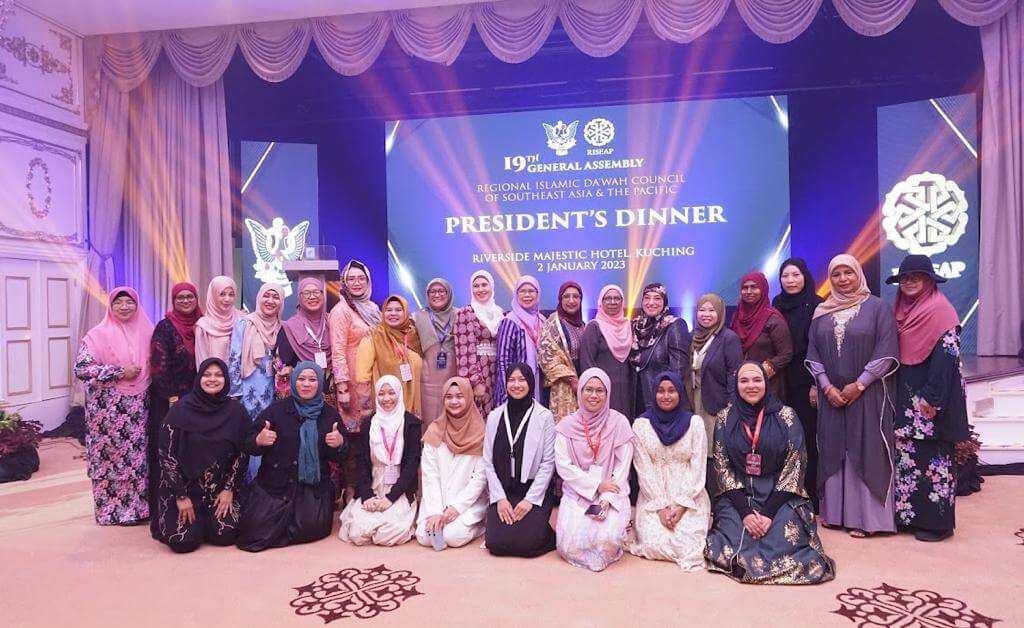
The three Australian Organisation members who participated in the 19th General Assembly Regional Islamic Da’wah Council of South East Asia & the Pacific (RISEAP) held at the Riverside Majestic Hotel, Kuching, Malaysia from 30 December 2022 to 5 January 2023 are as follows:
- Australian Federation of Islamic Councils (AFIC) – President, Dr Rateb Jneid.
- Australian Islamic Cultural Centre (AICC) – Managing Director, Sheikh Shafiq Khan
- Muslim Women’s National Network of Australia, Inc (MWNNA)- President Zubeda Raihman
Other Australian delegates and observers were Mrs Manal Jneid, Grand Mufti and Imam Abdul Quddoos Al-Azhari, Mrs Fayzah Khan and Ms Lina Harvey.
RISEAP in its third General Assembly in 1984 decided to form a Women’s Movement of RISEAP with each member country nominating a woman representative.
Since its inception, Australian, Hajjah Aziza Abdel-Halim A M, current Patron, MWNNA, had been the longest serving deputy and Chairperson of Women’s Wing and Executive member of RISEAP.
She is now succeeded by Malaysian Dato Hjh Hanifah Taib Alsree, President of PERKIM and current Vice President of RISEAP. Sr Rahayu Mohamad (Singapore) is the current deputy chairperson and executive member and I am the secretary and executive member of RISEAP.
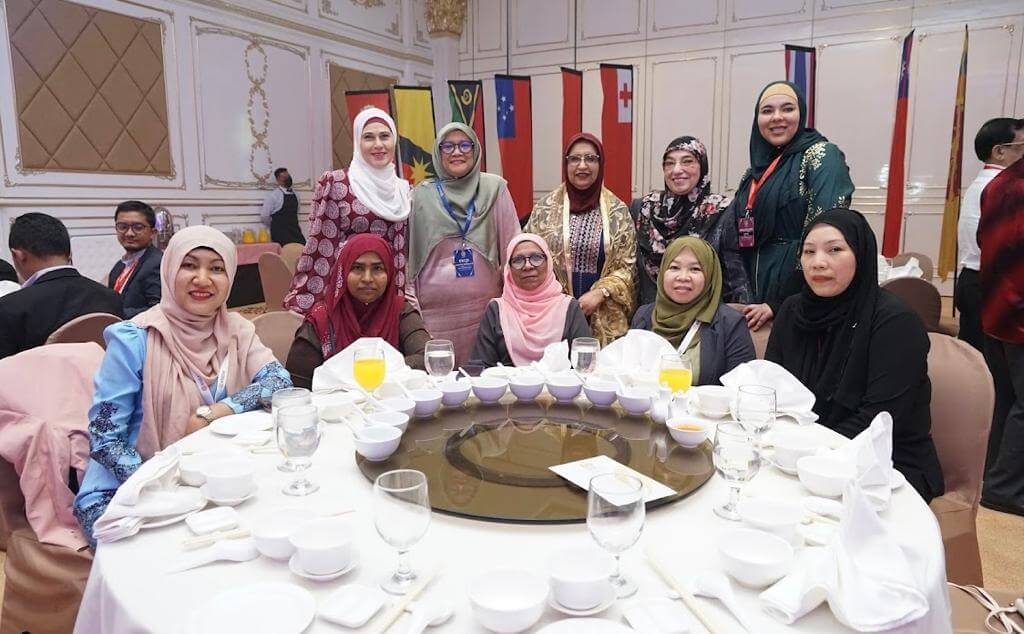
Women representatives and observers of the member countries took an active part in the discussions on the challenges and issues of concern that need to be addressed, such as:
- Support to develop the confidence of the women to volunteer and contribute;
- Funding to participate in regional programmes;
- High divorce rate and women’s loss of income and support;
- Establishment of Waqf as part of financial relief for the needy families;
- Collaboration with Corporate & Professional organisations to mentor young leaders
- Preparing the Muslim parents to be digitally equipped in their parenting style to help the children in facing the identity crisis;
- Opportunities for networking to support women in small business;
- Opportunities and accessibility to leadership
- Opportunities for networking to support women small business to expand their services •
In collaborations with our member organisations and RISEAP’s Secretariat we shall endeavour to work towards resolutions for the challenges and the concerns identified.
Background information about RISEAP.:
Most appropriately acronymed, RISEAP, pronounced Rise Up, was formed by Malaysia’s first President, Tunku Abdul Rahman, Putra al-Haj on 11 November 1980 with the founding members from 17 countries from 3 divisions:
- Northern consisting of Japan, South Korea, Taiwan, Hong Kong;
- Central consisting of Myanmar, Malaysia, Thailand, the Philippines, Brunei Darussalam, Singapore and Indonesia; and
- Southern consisting of Papua New Guinea, New Caledonia, Australia, Fiji and New Zealand. Now there are 24 member countries represented which includes Macau in Northern division, Cambodia and Vietnam in Central Division and the Pacific Island countries of Vanuatu, Tonga, Western Samoa., together with associate members – Maldives and Sri Lanka.
As the first president of RISEAP until 1988, Tunku Abdul Rahman pursued his vision of bringing together the minority Muslims in these countries and to encourage and support them in their service to their fellow Muslims.
His successor, Tun Abdul Taib Mahmud (1988 to 2022) also followed Tunku’s passion and encouraged the leaders of Muslim Organisations to grow in self-confidence and financial self-reliance as he promoted and supported the member countries to establish a WAQF fund.
In the Southern division, New Zealand has already implemented this fund. We hope Australia will follow suit in the near future.
The main areas of RISEAP’s focus are:
- Musolla – Strategies for the development of places of worship;
- Financial Self-Reliance – Encouraging more member organizations to work towards greater financial self-reliance.
- Halal Food – Extendting halal certificate and increasing the availability of halal food outlets and food production.
- Education – Development and refinement in the content of Islamic education and da’wah.
- Inter-Communal Relations – Fostering inter-communal relations and reinforcing the image of Islam as a religion of peace.
- Leadership – Strengthening and renewal for all Muslim organizations to ensure the continuity of good leadership.
The above focus emanates from the need to make it more convenient for Muslims to perform their ibadah, whether it be during the course of their work (such as the performance of salah, or access to the availability of halal food, and entrusting reliable Muslim organizations to distribute zakatul maal on their behalf), or leisure.
Also, the recognition of the need to discharge one’s social responsibility (fardhu kifayah) to ensure that Islamic education and da’wah addresses the social changes of our times, and a consciousness of a need to foster a system of leadership succession and renewal so that younger leaders are identified and the experiences of the older generation are passed down to newer generations.
Further, the need for a conscious effort to be made to foster inter-communal ties in the context of present-day plural societies, including collaboration with people of other religious traditions, especially in social causes.
Conclusion:
In our current difficult times of high cost of living and inflationary pressures one of the highlights of RISEAP’s contribution in our region is the promotion and encouragement of more member organizations to work towards greater Financial Self-Reliance, including the development of the institutions of Zakat collection and disbursement and the development of WAQF.
It is hoped that all the countries in our region will take heed and make our communities better equipped financially and sustainably.




Comments