

The demise of two rich and powerful Muslim Empires, 1857 (Mughal) and 1924 (Ottoman) disrupted the State patronization of Islamic astronomy resulting in decades of technical confusion among Muslims. Global institutionalization of Modern Islamic Astronomy was then undertaken in Malaysia with critical support provided by Tan Sri Musa Mohamad, former Minister of Education.
Islamic astronomy was considered farde-kifayah and was patronized by the Islamic state since Prophet Muhammad’s farewell sermon in 632CE. It received high priority after Al Mamun established Baghdad’s Baitul Hikmah.
An Australian international competitive fellowship gave me the honour, at the young age of 20, to join rocket & satellite-based atmospheric research at Adelaide University’s Physics Department and I got to work on one of Australia’s ‘first’ Main-Frame (CDC) computer.
I developed an interest in Islamic astronomy in Adelaide while having a physics teaching position at Adelaide University. To undertake serious Islamic Astronomy research, in 1976, I decided to move to Malaysia even though I felt like in the words of poet Ayub Rumani (Jab bahar aayee to sehra ki taraf chal nikla): when a breeze came (in the garden), I walked out towards the desert..
But for a gypsy since the age of 6, the objective was all that mattered in my life.
In Malaysia, I was to establish a new atmospheric programme including elite ozone research, which quickly brought international fame and honour for me to address Prime Minister Thatcher’s London Ozone Conference Plannery.

Newly established Penang Astronomical Research Observatory Centre (Left) and an operational Astronomical research Unit (right) as part of Global Modern Islamic Astronomy development. Some recent publications (centre).
My deepening passion for Islamic astronomy led to the publication of my world-acclaimed book with new insights on Imkane Ruyah and global visibility of the new moon (ILDL). The Muslim World thus technically became self-sufficient in this field again.
Then, I seriously considered moving out of the Islamic astronomy project but was advised that we had to expand into the implementation and institutionalization task, which needed an Al Mamun for sustained support.
In Faiz’s words (Chale bhi aao…): Oh, come at last (breeze)! so the affairs of the garden may flourish.
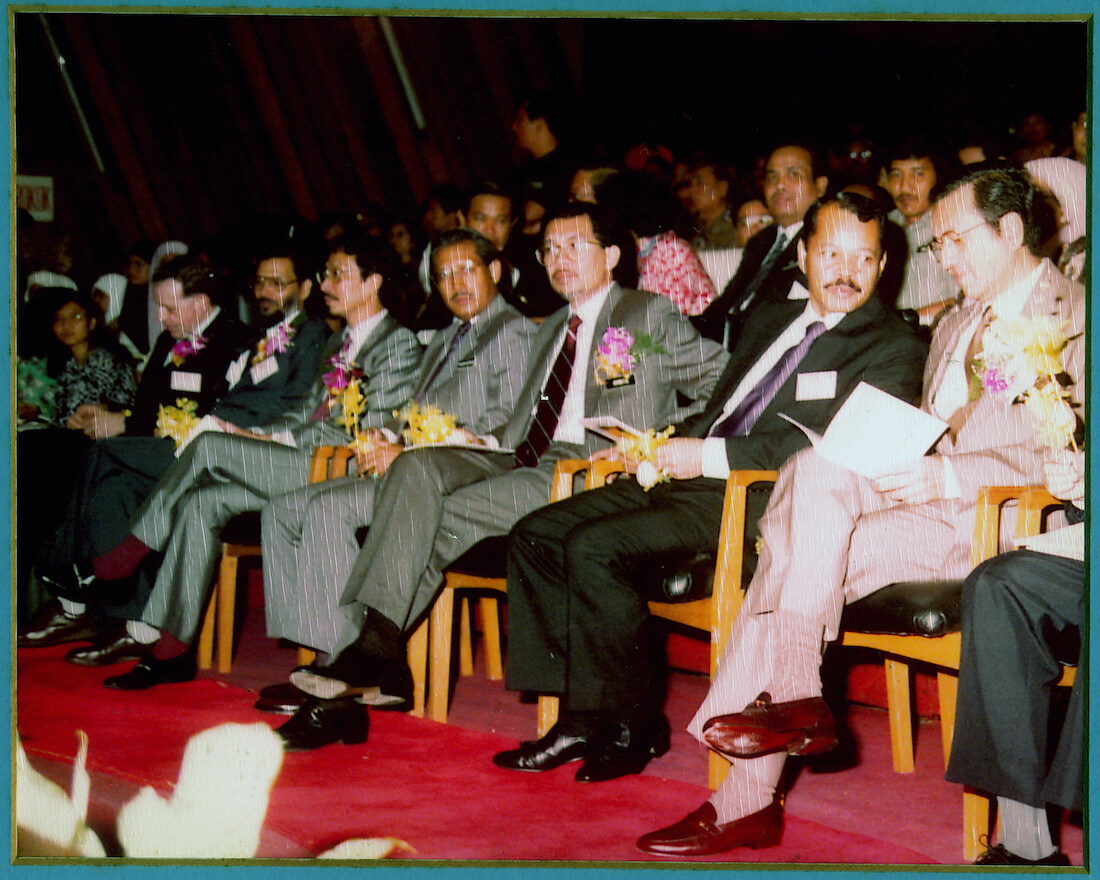
The Muslim community was fortunate to have Tan Sri Musa Mohamad, the then Vice Chancellor of Science University (later Education Minister), agreeing to this undertaking. He provided unlimited administrative and personal support by establishing an operational University Astronomy unit and an Observatory in Malaysia.
Our Islamic Astronomy work involves the worldwide community and the political machinery across dozens of Muslim countries like Pakistan, Indonesia, Turkey, Saudi Arabia, Iran, Morocco, Nigeria, South Africa, Egypt, and Muslim minorities in Australia, New Zealand, China, Taiwan, Philippines, UK, Europe, Canada, the Americas, etc. as well as key organizations including OIC, COMSTECH, IFSTAD, Rabeta, Nuffield Foundation UK, ICTP Italy, London University Observatory and RISEAP.
Forty international conferences/ seminars/ workshops, including a World Conference helped in the education, training and implementation of conference resolutions with distribution of scores of books and global data. The establishment of the First Islamic Observatory in modern times in Malaysia was followed by similar efforts in other countries.
Tan Sri Musa Mohamad stands out as the first administrator providing Al Mamunic leadership after a gap of nearly 200 years, making institutionalization of professional Islamic astronomy possible globally.
Poet Iqbal articulated this (Nigeh bulund, sukhan dil nawaz, …):
A lofty vision, gracious speech and passionate soul;
These are the essential attributes of a true leader.







Comments