

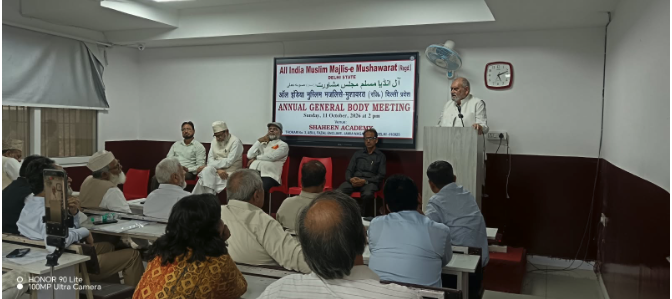
The Delhi State Unit of the All India Muslim Majlis-e-Mushawarat held its Annual General Body Meeting on Sunday 11 October 2026 at Shaheen Academy in Abul Fazal Enclave, Jamia Nagar, New Delhi. The meeting’s central theme was “UCC: Government Intentions and Our Responsibilities.”
Dr Zafarul-Islam Khan, national president of the All India Muslim Majlis-e-Mushawarat, community leaders, religious scholars, legal experts and members of the public attended and discussed the social and legal implications of the Uniform Civil Code (UCC) in India.
Advocate Firoz Khan Ghazi, general secretary of the South Asian Minorities Lawyers Association (SAMLA), delivered the keynote address.
He said, the UCC is not merely a legal debate. It raises vital questions concerning the Constitution, fundamental rights, religious freedoms and secularism—a basic feature of our Constitution.
The discussion, he said, should address three questions:
- What is the UCC, and what are the government’s objectives?
- Does uniformity guarantee equality and justice?
- What are the constitutional and community responsibilities in the present circumstances?
Drawing on developments following the implementation of the UCC in Uttarakhand, Advocate Ghazi said Article 44 of the Constitution, which directs the State to endeavour to secure a Uniform Civil Code, must be considered alongside the Constitution’s Articles 25 and 26 which protect freedom of religion.
“Equality before the law should not be replaced by uniformity imposed through coercion,” he said.
Advocate Ghazi stressed that women’s rights, inheritance and child protection must be upheld, while cautioning that placing all personal laws within a single framework could undermine constitutional rights and India’s diversity.
Among the issues he raised was the need to balance Article 44 with the protections guaranteed in the Constitution’s Articles 25 and 26, the distinction between uniformity and equality, social reform within the community, particularly in relation to women’s rights, and the importance of a research-based legal response rather than an emotional one.
Advocate Ghazi proposed a three-part action plan:
- Legal and constitutional preparation, including careful study of the UCC’s provisions by lawyers and researchers;
- Meaningful internal social reform to advance economic and social justice, women’s inheritance rights, consent in marriage, and children’s welfare;
- Democratic engagement with Parliament, state legislatures, courts and the Law Commission.
He also called for a coordinated approach with civil society, women’s organisations and other minority communities.
During his presidential address, Dr Zafarul-Islam Khan praised the Delhi branch for its activity and said he hoped Mushawarat’s other state branches would follow its example.
He said the subject should be considered from two perspectives.
First, the present government’s political agenda sought to weaken the rights and protections of Muslims and other minority communities, including Sikhs and Christians, through policy, legislation and political messaging.
He said we should not assume that the government’s approach would somehow change, while expressing hope that changing political circumstances could bring a significant shift.
Turning to personal law, Dr Khan noted that Article 44 is a Directive Principle, not a directly enforceable provision, and that many other Directive Principles in the Indian Constitution from Articles 38 to 51 have also not yet been fully or even partially implemented.
He argued that governments should consult affected communities before changing their personal laws.
Dr Khan recalled that, after independence, repeated assurances had been given in and out of Parliament that Muslim Personal Law would not be changed unless the Muslim community itself sought it.
Changing personal laws without consulting the affected community, he said, was unacceptable. Referring to the law on triple talaq, he said Muslims had not been consulted as a minister had said at the time in Parliament.
He addressed practices within the community, particularly the treatment of women. Forced marriages, oppressive customs, instant and triple talaq and the denial of women’s inheritance rights, he said, were serious concerns that needed to be addressed. Without addressing them, the issue of personal law “reform” will keep emerging.
The reason is we ourselves do injustice to our women and weaker individuals who then go to court.
Discussing the Shah Bano case, Dr Khan said it highlighted the hardship an aged divorced woman could face if left without financial support. He argued that resolving such matters within families in accordance with Islamic principles with justice and magnanimity will prevent legal disputes.
He criticised the practice of pronouncing triple talaq in one sitting, saying it contradicted the Qur’anic approach to divorce and closed the door for future reconciliation. He urged the community to address such practices in the light of the Quran and Hadith and shun bad and un-Islamic practices which have crept into the community over the ages.
Dr Khan condemned the widespread denial of women’s inheritance rights. Payment of lavish dowries and huge wedding expenses, he said, could not justify withholding a woman’s share in her father’s estate.
“Regardless of the dowry and cost of a wedding, a woman’s right to her inheritance must be respected,” he said.
Also, there must be no compulsion in matters of marriage, and talaq should be pronounced only according to the rules laid down in the Quran (2:226-233) which stipulate that talaq is to be pronounced only twice after which a person can re-marry his divorced wife but he cannot remarry her if he pronounces more than two talaqs.
Then there are many elaborate instructions to follow before and after talaq but Muslims today do not follow them and as a result Islam is wrongly blamed.
Advocate Aslam Ahmed said Muslim religious leaders, lawyers and Members of Parliament had, despite many challenges, largely succeeded in defending Muslim Personal Laws ever since the Constitution came into force in 1950.
He observed that the political climate had since changed, with the UCC becoming law in some states. Further developments in this direction are possible. Referring to reports about West Bengal, he said it was unclear whether the proposed legislation had been signed and that its provisions appeared similar to those of the Hindu law framework.
Advocate Aslam argued that the criminal law is not entirely uniform, pointing to special provisions for Scheduled Castes and Scheduled Tribes. In his view, most laws apply across communities, with differences concentrated in personal matters such as marriage and divorce.
Religious scholars, he said, should explain the provisions of Sharia and offer practical solutions. On maintenance, he urged the community to ensure that Muslim women who are widowed, divorced or otherwise without an income receive family support.
The priority, he said, should be protecting women from destitution and safeguarding their financial security. Under the Sharia, males of the family are responsible for meeting the expenses and requirements of women in the family.
Mufti Ataur-Rehman recalled the debate surrounding Muslim personal laws inclusion in the Constitution. He said Dr B R Ambedkar’s remarks on the subject were worth revisiting.
According to Mufti Ataur-Rehman, the provision was placed under the Directive Principles to be considered when circumstances were suitable, rather than imposed without regard to the situation.
He said drafting a law was only part of the challenge; implementation and enforcement were equally important. He questioned how a UCC would apply to tribal communities and whether it could feasibly be enforced among them.
At the close of the meeting, organisers reaffirmed their view that protecting India’s secular and democratic character requires preserving its diversity.
The session concluded with a shared commitment to defend fundamental rights, equality, freedom and fraternity through peaceful, legal and democratic means within the constitutional framework.





Comments