


Religious liberty is about more than protecting belief. It tests whether a plural society can preserve profound difference while sustaining the dignity, trust and relationships that allow us to flourish together.
Religious liberty brings that challenge into particularly sharp focus. It protects something profoundly personal: the freedom to believe, to worship, to question and to live according to conscience.
One of the defining tests of a plural society is not whether we can eliminate our differences, but whether we can learn to live generously with them.
But it also raises a larger civic question. Can people of different faiths, philosophies, cultures and convictions belong fully to the same society without first having to become alike?
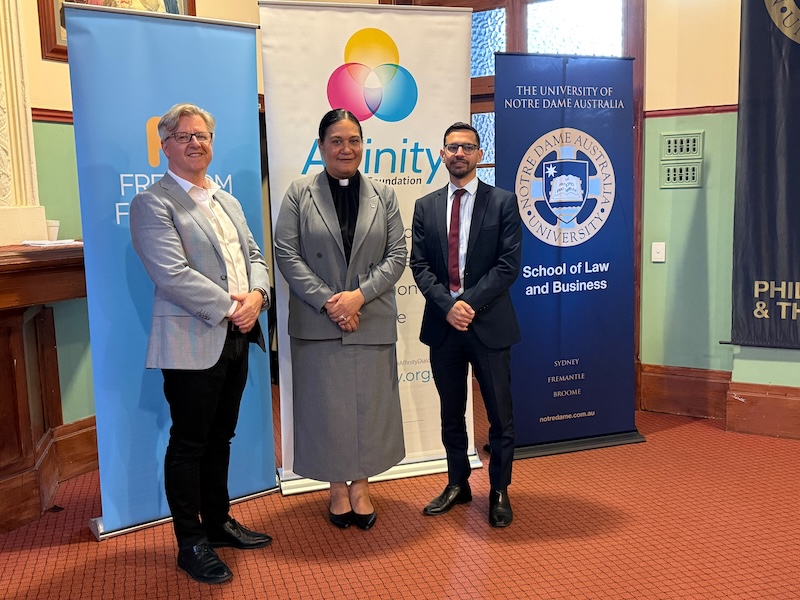
This question was at the heart of the 12th Annual Religious Liberty Lecture and Conference, held at The University of Notre Dame Australia on Thursday 17 and Friday 18 September 2026, in partnership with Affinity Intercultural Foundation, Freedom for Faith and the Sikh Association of Australia.

Across a major lecture and five panels, religious leaders, legal scholars, educators, human rights voices, journalists and civil society practitioners explored religious liberty not simply as an abstract legal principle, but as a lived question of conscience, belonging, safety and citizenship.
Emeritus Professor Michael Quinlan framed the gathering through the relationship between state interests and freedom of thought, conscience and belief.

Dr Lorraine Finlay, Australian Human Rights Commissioner, joined Rabbi Yehoram Ulman and Dr Rattan Virk in a discussion of visible faith and the protection of religious liberty beyond the majority.
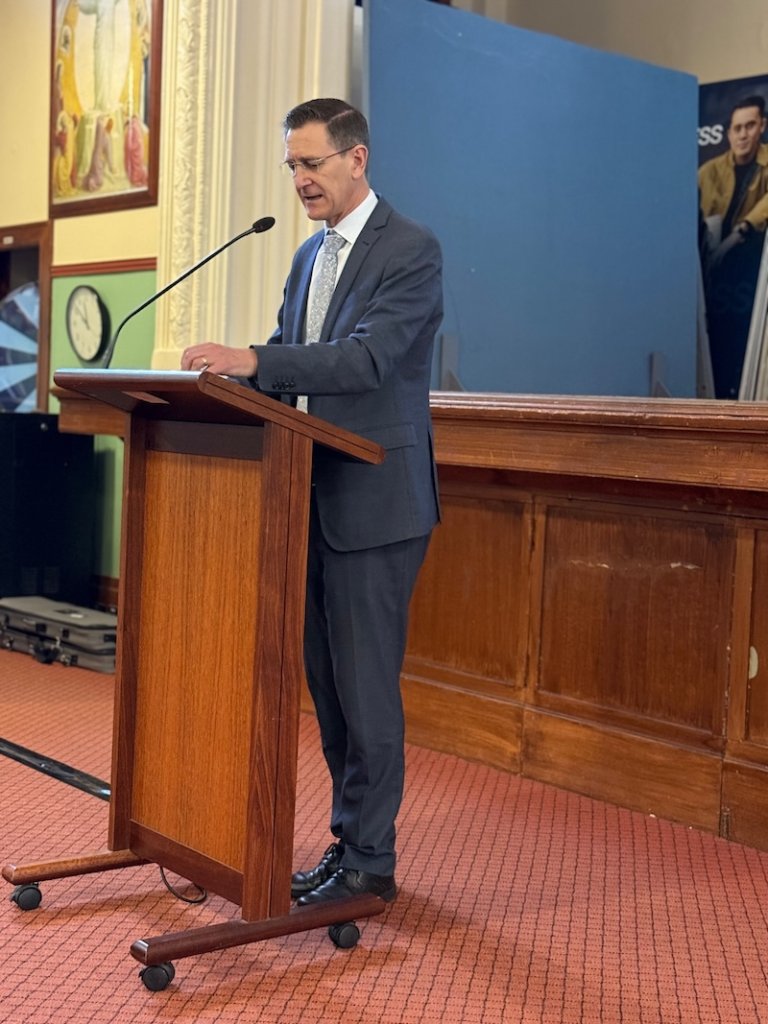
Bishop Michael Stead, Anglican Bishop of South Sydney, Monica Doumit, Chancellor of the Catholic Archdiocese of Sydney, and Zia Ahmad OAM, Editor-in-Chief of the Australasian Muslim Times, considered the responsibilities of faith leadership in the aftermath of Bondi.

Later discussions brought legal and public-policy perspectives into conversation before Rev Faa’imata Havea Hiliau, Parviz Deamer and Professor John Rees turned to perhaps the broadest question of all: how dialogue, faith and community leadership can strengthen social cohesion in a time of division.
The programme began with religious liberty. It ended with the question of how we live together.
That progression matters.
Freedom must belong to everyone
Religious liberty is easiest to defend when the beliefs being protected are familiar to us. Its deeper test comes when the conscience at stake belongs to someone whose convictions, practices or worldview differ markedly from our own.
The discussion on visible faith brought this question directly into public life. Bringing Jewish and Sikh perspectives into conversation with Australia’s Human Rights Commissioner underscored a principle that reaches beyond religion: belonging should not require invisibility.
A confident plural society should be able to accommodate people who enter public life authentically as themselves.
Nor should social cohesion be confused with social conformity. Cohesion is not achieved by making difference disappear. It grows when difference can remain real while people retain an equal claim to dignity, safety and participation.

The later discussion on religious liberty and public safety, involving Mike Southon, Dr Paul Taylor and Professor Keith Thompson, illustrated how difficult that balance becomes when questions of faith intersect with hate, violence and the limits of expression.
These are not questions that lend themselves to slogans. A democratic society must protect conscience and expression while confronting genuine harm. The challenge is to do both without allowing fear to turn legitimate difference into suspicion.
Pluralism asks something difficult of us: to hold freedom and responsibility together.
Human dignity cannot be selective
That responsibility came into particularly sharp focus in Zia Ahmad OAM’s reflections on faith leadership, courage and the moral cost of looking away.

He began with greetings drawn from different traditions: “Assalamu alaikum. Shalom aleichem. Peace be with you.”
Different languages and traditions carried a shared hope for peace. Yet his larger point was that peace cannot remain merely a greeting; it must become visible in how we receive, protect and care for one another.
The sentiment reflected the wider multifaith character of a gathering in which Christian, Muslim, Jewish, Sikh and Bahá’í voices entered the same civic conversation.

Ahmad’s remarks rejected anti-Semitism, Islamophobia, anti-Christian hatred and hatred directed towards people of any faith or none. The principle he articulated was simple and demanding: “Human dignity cannot be defended selectively.”
If dignity is universal, our defence of it cannot depend on whether another person shares our theology, culture, politics or history. The freedom we seek for our own conscience must also be a freedom we are prepared to protect for others.
That does not require the surrender of conviction. As Ahmad observed, “Solidarity is not sameness.” We can hold genuine differences, sometimes profound ones, while remaining committed to one another’s dignity and safety.
To disagree without denying one another’s humanity is one of the essential disciplines of a diverse democracy.
Dialogue must lead somewhere
The conference’s final panel turned explicitly to social cohesion and the role of dialogue, faith and community leadership. Its placement was significant.
After conversations about rights, education, minority experience, moral leadership and public safety, the discussion arrived at relationships.
For me, this is fundamental.
We speak frequently about dialogue. We organise conferences, roundtables, dinners and interfaith gatherings. These encounters matter because they bring into relationship people who might otherwise live alongside one another yet seldom truly meet.
But dialogue should not be measured simply by the number of conversations we hold. It should be measured by what those conversations make possible.
Dialogue begins with encounter: with people who might otherwise remain strangers choosing to meet.
Conversation creates the possibility of listening; listening can deepen into understanding; and, given time, understanding can become relationship, and relationship can mature into trust.
But trust is not the end of the process.
Understanding acquires its fullest meaning when it becomes responsibility.
Once we understand one another more fully, we begin to see not only the person before us but also the society around us: its anxieties, challenges and possibilities.
Dialogue then moves beyond the question, “How can I understand you?” towards another: “What can we do together?”
That is the point at which dialogue becomes civic practice and understanding begins to serve the common good.
This is also why trust cannot be manufactured in a moment of crisis. As Ahmad observed in his prepared remarks, it must already have been built.
Social cohesion is cultivated patiently in ordinary times, through relationships capable of enduring beyond crises and public attention.
Governments cannot create that trust by declaration, and communities cannot wait for a crisis before discovering one another.
Relationships are built in quieter times: through conversation, education, hospitality, shared service and the ordinary work of knowing one another.
This philosophy has long informed the work of Affinity Intercultural Foundation.
Building bridges is not an end in itself. Dialogue, education and service create opportunities for encounter, but their deeper purpose is to allow encounter to become relationship, relationship to generate trust, and trust to make cooperation possible.
Diversity may describe a society; relationships are what allow that society to hold together.
The dignity of difference
The larger lesson of the conference extends beyond religious liberty.
Australia does not face a simple choice between diversity and cohesion. The more consequential question is whether we can cultivate the civic culture and human relationships through which diversity becomes part of a confident shared life.
A society flourishes when human dignity flourishes.
Our shared society belongs to all of us: people of different faiths and philosophies, cultures and traditions, convictions and worldviews.
Pluralism does not ask us to become the same. It asks us to make room for one another, to recognise the dignity of difference and to understand that the flourishing of each of us is bound to the flourishing of all.
This cannot remain an abstract aspiration. It requires relationships among faith and community leaders before crises occur; greater religious literacy; meaningful opportunities for young people to encounter those unlike themselves; shared service; responsible public language; and the consistent protection of the freedom and safety of all communities. These priorities also resonate with the practical proposals set out in Ahmad’s prepared remarks.
But something quieter is required as well, and perhaps something more enduring: the habits of listening, decency and generosity through which strangers gradually cease to be strangers.

Living together is not a passive condition. It is a civic achievement.
It requires freedom, certainly. But freedom alone is not enough. It also requires reciprocity, courage and a willingness to accept responsibility for the society we share.
The conference created a valuable space for that work. The real measure of such a gathering, however, lies in what survives beyond it.
Pluralism does not promise a society without disagreement. Its deeper promise is that profound difference need not make us strangers to one another, or prevent us from belonging to one another’s future.
That is the work before us, in Australia and beyond: not merely to coexist across our differences, but to encounter one another deeply enough to discover that difference can deepen understanding, and that beneath all that distinguishes us lies a shared humanity to which we all belong.





Comments