

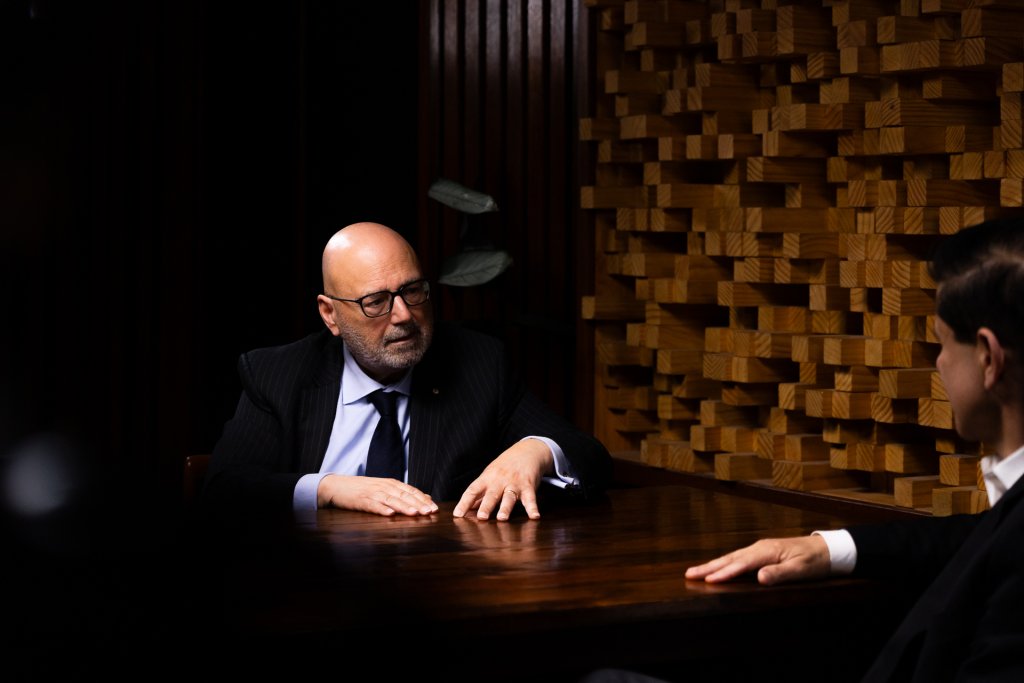
▶️ WATCH ABOVE: Interview with Arthur Sinodinos on ‘Uncommon Ground’
🎧 LISTEN on: Spotify | Apple Podcasts | Web
In 2022, former US President Obama addressed Stanford University’s graduating class. “Inside our personal information bubbles, our assumptions, blind spots and prejudices aren’t challenged, they’re reinforced… deepening racial and religious and cultural divides.”
Now, in 2026, Obama’s words have come to fruition. Tribal politics has bred deep divisions across society and the echo-chamber of social media and modern news-cycles means we live in a largely binary world. It’s us vs them, left vs right, yes vs no.
Arthur Sinodinos, former Australian Ambassador to the US, senator and Assistant Treasurer, is a rare person and an even rarer public servant. Not only has his political career straddled two very different eras — pre and post-social media — but he also values an increasingly unusual quality in the current state of politics: nuance.
Perhaps the ability to see the shades of grey between black and white stems from his parents, who immigrated to Australia during the Greek Civil War, and held differing political views. Maybe it came from his deeply held passion for learning or his years spent as an economist in the Treasury Department, working under both Labor and Coalition governments.
Whatever planted the seed of tolerance, the decades since have seen it grow into a firm belief that Australia is stronger when we embrace our collective differences and that politics will always benefit from diversity of opinion.
We made the government’s approach richer
After receiving his Bachelor of Commerce from the University of Newcastle, Sinodinos moved to Canberra. He never imagined a future where he would be a member of parliament, instead hoped to influence economic policy to improve the lives of all Australians. “It was one of the reasons I was attracted to the public service. You could use economic tools to do good things.”
By the time he was in his mid-twenties, he was working as an economist in John Howard’s office, where he struck up a friendship with the man who would later become Prime Minister. Despite being of different generations, backgrounds and opinions on several important issues including multiculturalism, the child of Greek immigrants and the conservative Howard — who wrestled with the idea of a multicultural Australia for years — grew to like and respect each other. Over the following ten years, Sinodinos became a close confidant.
When the Howard government came to power after the 1996 election, Sinodinos became the Chief of Staff and one of the most influential people in the country. It was a role he held for almost a decade and one that showed him just how important diversity of opinion was.
“Part of the value I brought to the office was that I wasn’t a yes person.” While there were many things he and the PM agreed on, Sinodinos was prepared to give an opposing view when needed. On the issue of multiculturalism, he and like-minded colleagues provided the PM with different perspectives which proved vital when the government created a new vision of multiculturalism — one that was specific to Australia. Reflecting on the role he and others played, Sinodinos recognises that, “we made the government’s approach to the issue richer than it might have otherwise been.”

80% is better than 100% of nothing
History is littered with political figures who got so close to delivering generational change, only to fail when they refused to compromise. Arthur Sinodinos, with his knack for finding the middle ground, was never going to be one of them. In fact, when asked about his career-defining achievements, the list includes economic reforms that only succeeded because of negotiation and co-operation. In particular, the rollout of the GST is one that he takes immense pride in.
Apart from the nation-wide benefits, the four-year process taught him that making positive, long-lasting change requires two things. First, a determination to stay the course despite dogged opposition. The second part? Compromise is not a dirty word. It’s where true progress is made.
Sinodinos knows that even imperfect action can add up to real change. “You’ve got to advocate day in and day out and you’ve got to stay the course. But with reform, 80% of something is better than 100% of nothing.” Far too often, compromise is seen as a failure.
But failing to co-operate means the public is often left worse off. Not only do they not benefit from the required reform, but the all-or-nothing mentality of modern politics is cemented even further as a result. And that zero-sum game is one that very few walk away from as winners.
Your own mind can be a prison
In 2017, when he was Minister for Industry, Sinodinos was diagnosed with stage four non-Hodgkin’s lymphoma. In what could now be considered a trademark move, he resigned from the ministry but remained on the backbench throughout his treatment. “It’s like being in the Australian cricket team. Once you’re in there, you don’t want to be out.”
He focused on his treatment and rarely allowed himself to panic about the future. In fact, there were moments of beautiful clarity throughout the process. “Sometimes I’d think about things in the middle of the night, just before dawn. And I realised that your mind can be a prison. But you are also your own jailer and you’ve got the key.”
Decades spent considering issues deeply and from multiple points of view allowed him to compartmentalise throughout his treatment and recovery, even when the challenges — including developing potentially fatal sepsis, undergoing a bone marrow transplant and the months-long quarantine that followed — felt considerably tougher.
Arthur Sinodinos made a full recovery and in 2019, was named Australia’s Ambassador to the US during one of the most turbulent periods in recent history. From the final year of Donald Trump’s first term to the tumultuous handover to the Biden administration and Russia’s invasion of Ukraine, he has held Australia’s highest diplomatic posting. It’s hard to imagine a role where nuance would be more important.
You can listen to the full Uncommon Ground interview by clicking on the link at the top of this article.






Comments