

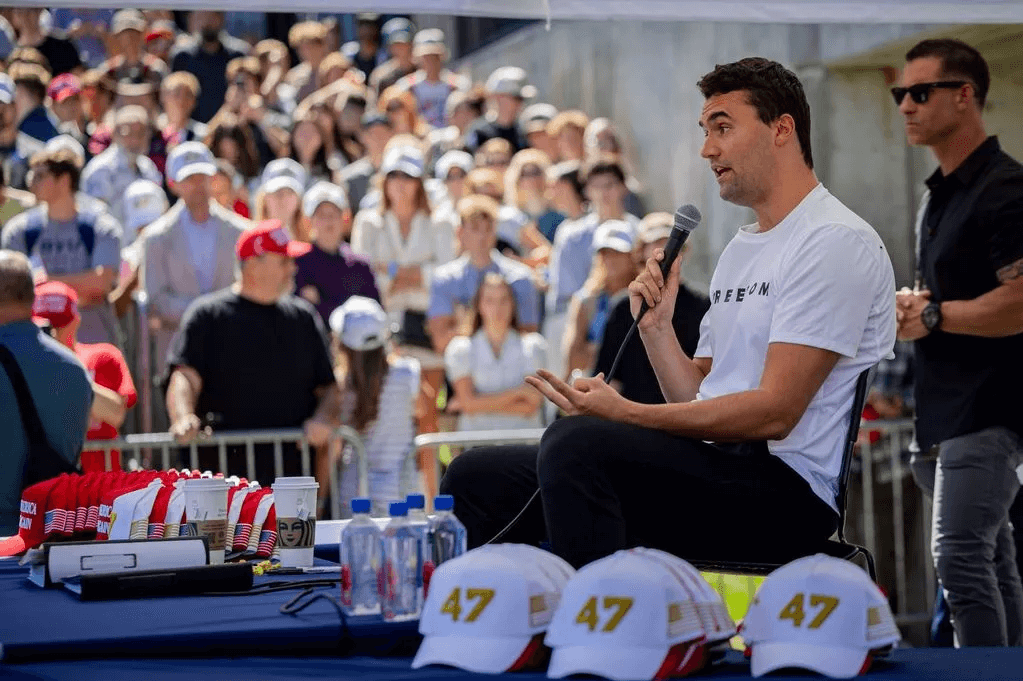
The shooting of far right-wing commentator Charlie Kirk in September 2025 is deeply symbolic of the wider crisis of populism affecting democracies across the Anglosphere.
Kirk, who built his career defending gun rights, was himself killed by gunfire—a devastating irony that should prompt sober reflection. But his death is not just a personal tragedy. It is a cautionary tale about where right-wing populism is taking societies in the US, the UK, and Australia.
Kirk’s meteoric rise came via Turning Point USA, an organisation that uses vast donor funding funnelled from Koch networks, the Bradley Impact Fund, and pro‑Israel aligned donors, including funds linked to Project 2025 as well as media theatrics to mobilise conservative youth and push policies that make politics into a zero-sum culture war.
At the Oxford Union this year, Kirk attacked “third-world immigrants” and “DEI parasites” but buckled when faced with evidence and critical debate. His style was, like Trump, Farage, Hanson and other populists pure performance: ignoring facts, brash, polarising, and focused on scoring rhetorical points, not building policy or community.
This is the core of modern authoritarian populism with loyalty to charismatic personalities replacing deliberation and institutions, leading to the decline in democratic norms and civilised discourse.
Personality-driven populist movements like TPUSA, and MAGA Trumpism, Reform UK and One Nation Australia aren’t animated by policy substance; they’re powered by outrage, money, and media spectacle and blaming the ‘other’ for the problems facing ordinary people.
Such politics thrive on scapegoats—especially migrants.
In America, the harsh anti-migrant policies Kirk supported have had a devastating impact. Aggressive ICE raids have driven families into hiding, kept children from going to school and parents from hospitals.
Communities live in perpetual fear of militarised detention and deportation. The fierce, enforcement-first stance Kirk advocated reflects a country drifting towards the routine use of force to solve social challenges, with migrant communities suffering the brunt.
The rhetoric that paves the way for such enforcement often singles out visibly Muslim communities where Muslim charities are targeted, and ‘counter-terror’ narratives are used to justify exceptional policing, reinforcing public suspicion and normalizing discrimination.
Australia’s offshore detention system—now in its thirteenth year—traps hundreds of asylum seekers, many from Muslim-majority countries, in limbo. Anti-migrant protests and media rhetoric frequently invoke “Australian values” to justify suspicion and hostility, disproportionately targeting South Asian and Muslim arrivals.
Policy debate on refugees is routinely interlaced with narratives about “terror” risk and social cohesion, painting Muslims as the perpetual ‘other.’ Thousands of people who sought asylum in Australia more than a decade ago remain trapped in precarious visa categories.
This crisis is worsened by recent immigration laws that expand government powers to deport forcibly, limit detainees’ rights, and remove access to natural justice.
In the UK, anti-migrant sentiment has become a national spectacle. Flag-waving protesters—often linked to far-right groups—stage demonstrations outside hotels and centres housing asylum seekers.
These protests, wrapped in Union Jack and St George’s Cross flags, deploy a rhetoric of Britishness that, in practice, excludes minorities—particularly Muslims. Mainstream politicians echo “illegal migration” panic, and high-profile platforms single out Muslim migrants for special vilification, further normalizing exclusion in national identity.
The Murdoch media empire amplifies these messages across all three countries—shaping public debate, lending legitimacy to xenophobia and Islamophobia, and deepening the divisions that populist movements thrive upon. In Australia, right-wing think tanks and lobby groups borrow international playbooks to target Muslims and migrants in culture wars.
The forthcoming CPAC Australia 2025 conference in Brisbane features speakers with strong records of anti-Muslim rhetoric, including Pauline Hanson, whose One Nation party has long promoted Islamophobic and anti-immigration policies. Other speakers such as Dan Wootton and Connor Tomlinson have openly targeted Muslim communities through media platforms, even suggesting third generation immigrants could be deported.
The conference’s ongoing promotion of culture war grievances will ensure Islamophobia remains mainstreamed in Australian conservative politics. Recent threats like the bomb threat to the Islamic College of Brisbane and the Gold Coast Mosque highlight the real-world dangers of this public normalization of hate.
Even though Charlie Kirk was a vocal supporter of Israel, he did occasionally voice some reservations about Israeli actions which triggered backlash, even against him. The growing populist trend to conflate any criticism of Israeli policies with antisemitism is deeply dangerous as shuts down legitimate debate, polarises discourse thus curtailing objective discussions about Israel, Palestine, and justice.
What unites these stories is the weaponisation of migration as a political tool and the normalization of anti-Muslim hate. In the US, ICE raids and militarised policing make cruelty routine. In Australia, lives are wasted in offshore limbo and communities are kept under suspicion. In the UK, street-level nationalism creates new enemies out of those simply seeking refuge.
Behind it all, right-wing movements like Kirk’s, emboldened by massive funding and unrestrained by principled debate, turn people’s problems into anger and fear, blaming migrants, Muslims, and political opponents alike.
This is a great threat to democracy, reasoned debate, and the social cohesion that the populists claim to support. The danger is when outrage becomes the language of politics, when vulnerable communities become scapegoats, and when force replaces dialogue, democracy withers. Societies do not collapse overnight—they erode gradually, through daily acts that treat some lives as lesser.
Charlie Kirk’s death should remind us what is at stake. The fight against authoritarian populism and normalised Islamophobia is not about left or right. It is about defending truth, decency, and the pluralism that make democracy worth protecting.




Charlie Kirk had just started to question the peculiar relationship between America and Israel. Also a fortified Israel and the Oct 7 lapses that just does not add up. He was talking about the late Epstein the person and his apparent blackmails. Then he got assassinated. ???