

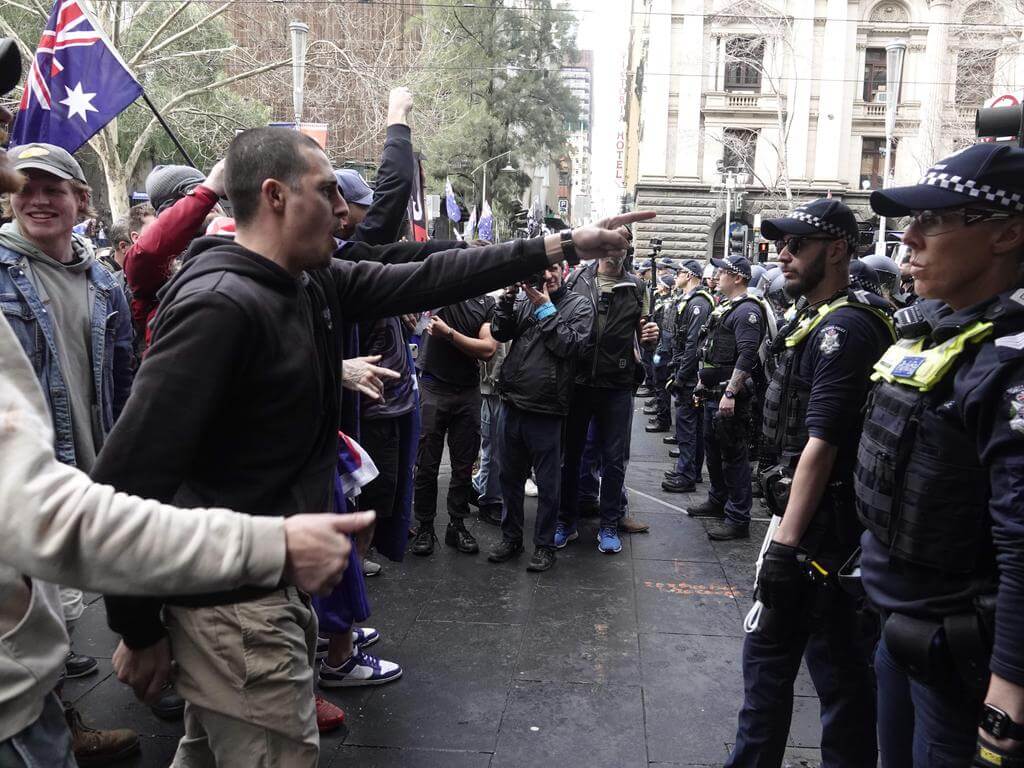
In the aftermath of the so-called “March for Australia” anti-immigration rallies held across the country on Sunday 31 August, a familiar pattern has emerged. Political leaders, media commentators, and even some of the attendees themselves have rushed to assure us that many of those who marched were not racist, but simply “ordinary Australians” feeling the weight of economic hardship, frustrated by the cost of living, struggling to find affordable housing, concerned about job security. The implication is clear: their motivations are understandable, even justifiable. Their presence at rallies co-opted, or in many cases led, by neo-Nazi groups is explained away as naivety or desperation, not ideology.
This framing is not new. We have seen it before. It is the same logic that has been used to explain Cronulla, to rationalise the rise of Pauline Hanson, and more recently, to interpret the failure of the Voice referendum. In each case, the response is characterised not by a willingness to confront racism, but by a carefully orchestrated effort to avoid it.
The narrative of “economic anxiety” functions as a convenient deflection. It creates the appearance of understanding without requiring any structural analysis. It allows institutions to express concern without engaging with their own complicity. Most importantly, it allows white Australians, including those in power, to preserve their innocence. Because if these actions are driven by economics, then they are not driven by hate. If this is about pressure and not prejudice, then there is no need to ask deeper questions. No need to address the uncomfortable truth, that racism is not a fringe problem, or a passing moment of tension. It is the architecture upon which this country was built.
To understand the August 31 rallies, we must be honest about what they were responding to. The timing is no coincidence. These rallies emerged in the direct aftermath of the “March for Humanity,” a massive pro-Palestinian protest that crossed the Sydney Harbour Bridge. This was not a fringe action, it was a cross-section of the Australian public: families, professionals, faith leaders, students, trade unionists. It was a visible, peaceful, and unapologetic show of solidarity with the people of Gaza in the face of an unfolding genocide.
The far-right didn’t organise a response because they had suddenly become concerned with migration statistics. They responded because they saw something that disrupted the racial order they rely on, the sight of everyday Australians standing with people of colour, with Muslims, with Palestinians. In their eyes, this was not just a political threat, but a cultural one. A moral one. A direct challenge to the fantasy of a white, Anglo-centric Australia. That is what they were reacting to. That is what the August 31 rallies were organised in opposition to.
Of course, not everyone who attended those rallies did so out of explicitly racist intent. But that is beside the point. It is not the individual motivations of each attendee that determine the meaning of a public mobilisation, it is the context in which it takes place and the political logic behind it. And when a rally is explicitly framed as a reaction to visible solidarity with the victims of a racialised genocide, when it is led by neo-Nazis, and when it ends in attacks on First Nations sovereign spaces, there is no coherent argument left to claim this is simply about housing or cost of living.
The real issue here is not just the racism of the rally, but the racism of the national story and the unwillingness of this country to confront it.
Australia was not merely touched by racism in its early days. It was born through it. The doctrine of terra nullius denied the humanity of First Nations peoples. The White Australia policy formalised the racial exclusion of non-Europeans. Refugees have been criminalised, black and brown youth have been vilified, and temporary labour schemes continue to treat Pacific Islander workers as disposable. These are not anomalies, they are consistent with a nation-state built on racial hierarchy and white dominance.
And this is why the “economic anxiety” narrative is so effective and so dangerous. It gives permission for this history to be forgotten. It allows structural racism to be reframed as poor policy, or the failure of a campaign, or the accidental mobilisation of vulnerable people. But racism is not accidental. It is not incidental. It is the logic that allows pain, real pain, to be redirected. People are struggling. That much is true. But the system doesn’t just fail to alleviate that struggle, it weaponises it.
Pain doesn’t automatically result in racism. That only happens when a society has already constructed an “other” to blame. And that’s precisely what Australia has done for generations. Whether it’s Indigenous Australians, African youth, Muslim communities, or Palestinian solidarity activists, there is always someone at the margins to carry the blame for failures that belong to government policy and corporate greed.
This is not to deny the reality of economic pressure. Far from it. People are hurting. But the answer to that pain cannot be found in demonising those who are already excluded. It requires holding power to account, demanding equity, justice, and dignity for all. And that cannot happen if we keep pretending that racism is a distraction from the “real issues,” when it is, in fact, the tool the system uses to avoid addressing them.
The refusal to name racism is not about caution. It is about control. Because once racism is named, it must be acted upon. It must be dismantled. And that is a reckoning this country has never been prepared to face.




Comments