

At times, ideas get entrenched – partly because of our innate thirst to understand, partly because our brains are programmed by our societies.
Some definitions
Let me define some terms, before I begin.
Abrahamic Religions
In the 20th century, as the world was coalescing, ‘Judaeo-Christian civilisation’ was paraded out in select halls. The world that ignores religion may not have noticed.
Here Islam was activity ignored and undermined, as were Orthodox Christians. Mostly on racist grounds – for their colour of skin (Islam), language (Arabic, that Edward Said so bemoaned), or proximity to Russia (seen as communist or socialist).
Despite the wishes of JD extremist fringe, Islam remains ensconced firmly in the family of Abrahamic religions – due to proximity, trade, co-lived populations, and ideas: the soul discussed here is one of them.
The West
The last time the use of term ‘West’ was appropriate was when the fastest distance travelled between any two regions was by a ship. That era is truly gone.
Newly mighty European nations, from cold/dark places of Europe and without an history, bonded together in 19th century, and called themselves as ‘West’ – usurping the Greek and Roman civilisations. Christian wasn’t a cool term anymore; also, that would have forced an accommodation of the Orthodox. Clearly there was allergy against Islam. Eeew.
Since those day, the term has progressively loosened, first to include catholic France and then Eastern/ Orthodox Europe. Now, I find myself in the tent, as are my fellow Indian Hindus! For Australia, geography belies the term.
The Mediterranean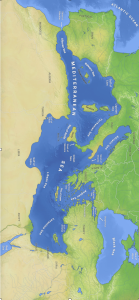
Up until the modern times, the Mediterranean Basin provided ‘safe spaces’ for civilisations to flourish. The Bronze Age Collapse was a ‘reboot’ to the system. Discovery of the New World broke its dominance, and air travel killed any importance of the tight ecosystem. Only reverence remains: from Rome to Istanbul, from Jerusalem to Makkah.
The safe seas provided cheap and secure travel of peoples, cargo and ideas. Humanity progressed, despite wars and urge for dominance.
Change the orientation of map, from polar to equatorial view – and the ecosystem is very obvious: the basin is connected to the east via Black Sea and Red Sea and beyond. On the west, the Atlantic Ocean was too rough, and riches too far worth the pain. We may as well call this as Mediterranean Metacivilisation.
Now, to the soul – as understood by these peoples.
Egyptian beginnings
If the Pharaohs of Egypt did not invent ‘soul’ as a unique trait of the monarchs – the divine rulers, they certainly used the concept to their imperial and personal ends: made stupid or worse, the slaves and the free, both wor
ked for them in hot sun and daily misery.
From 2700 BC (Old Kingdom era), the Pharaohs began making pyramids, believing their soul will fly through the pyramids and reach the heavens. However as they relented and allowed their wives and viziers to make pyramids, the magic and charm of mystic kingdom was gone.
By 1500 BC (New Kingdom era), the process of transmigration of individual soul was democratised: now, even a cat was mummified, for its soul to reach heaven with its master (who can be any random Egyptian). Pyramids from this era were tiny.
The animated Greeks
In the dying stages of Greek lordship of the Mediterranean Sea, around 500 BC, the pre-Socratic Greeks, added their feverish imaginations to the soul which they had learnt from their Pharaonic neighbours.
Now, human soul could incarnate, or supplant itself in animals, even in plants (or any living organism for that matter). Soul differentiated a living from non-living matter: the basic building block of developing philosophy.
In all seriousness
In the rapidly decentralising region, the famous Greek thinker – Plato (~400 BC) – posited that “our soul is immortal, and never destroyed”. That, even after death, it still “possesses some power and wisdom”.
Amongst the abstract notions (justice, equality, responsibility, happiness, etc) reasoned at this times, the soul was infused with a life of its own: the vices made the soul bad, while virtues making it good (and happy). A series of thought-bubbles defined what were vices and virtues. Yet an agreement was sorely lacking, as with many things Greek.
Aristotle (~350 BC), a pupil of Plato, introduced a more tempered view: vital functions that are mental are separate from the soul, and an attempt must be made to explain them.
Elite Greeks continued their soul-obsession, carrying themselves into all branches of human domain that dealt with emotions. However, the real game was Plato vs Aristotle: every human action concerned soul vs some
actions are independent of soul. The tussle would come to lay the future path of philosophy.
Roman times
 Romans were brute conquerors and rentiers, tempered by Greek sensibilities. They had no time to ponder on thought-bubbles during their hey days.
Past their prime, a Roman philosopher in Egypt (again!), Plotinus (~250 CE), re-animated the soul: he fashioned a chain connecting the beads of the One, the Intellect, the Soul, and its Sense Perception.
The pharaonic soul, once an elite mystic awe, now was weaved into the very conscious of every human action and connected its person to The One.
The Christian fathers
During a civil war, a Roman general (Constantine, the Great) became Christian. In 325, he managed to shore up the concept of Trinity by giving official blessing to Nicene Creed/Aqida. But only in 381, the Holy Spirit/the Holy Soul became a inseparable part of Trinity family.
Having won Rome by 326 CE, Constantine moved east to Byzantium (todays Istanbul, 330 CE) to nourish Christianity, away from prying eyes of still pagan Rome. Or to manage different branches of evolving Christianity. Or both.
Yet it was Augustine (the Berber, ~400 CE) who really established Christianity in the western part of the empire. He was manifestly influenced by Plotinus and his concept of soul. Christian fathers continued to follow this school, until Hume and Bacon (Enlightenment era, 1700s) raised serious questions, and revolutionary ethos of France (1800s) banished the soul out in the streets.
Before these revolutionaries, a new religion from the desert did the same but not so harshly.
Islam and its soul
Quran explicitly says ‘They ask you about the spirit. Say, its nature is known only to my Lord, and you have been given but little knowledge’ (Surah Isra, 17:85).
And so it was: people cared about deeds, and outcomes. There were plans, pondering, and programs. Humanity progressed. When they got to know the Greeks, they praised Aristotle and felt brotherly affinities. While Plato and his messy soul had little appeal for them.
Fatimids, and Platonism in Islam
In early 900s, Egypt (again!!!) had a large Christian population, which was aligned with Byzantium (who were quarrelling with Rome, and Baghdad). While Fatimids were Ismaili Shia of North Africa, who began a quarrel with Baghdad.
The battle of material (lands and tributes) crossed into the renting of minds. As interests of Egyptian Christians and Fatimids aligned, so did exchange of ideas.
The Salient Fatimid Attacks
Fatimi scholars pitched forth 3-fronted attack on Baghdad:
- The memory of long dead son-in-law of the Prophet was resurrected. Ownership of genealogywas claimed
- Ta’weel was invented. Exclusive ownership of Quran (and its interpretation) was claimed
- Cosmic soul was invented. Secular premiership of that work was claimed
Fatimid Cosmology
Inspired by Plotinus, they ran with his ideas (just like Christian fathers did).
Their Aqidah included: “…mankind is consummated in seven eras of various durations; each one inaugurated by natiq (a messenger) of a revealed message, which in its exoteric (zaahir) aspect contains a religious law (shariah)”.
The natiq of the first 6 eras were: Adam, Nuh, Ibrahim, Musa, Isa and Muhammad. Each of these was s
ucceeded by a wasi, who interpreted the inner/esoteric (baatin) meaning of the revealed message to the select-initiated (not the lay, common man). This secretive eliteness will define them for centuries to come, despite their fall.
Each wasi was followed by an imam who was the Guardian of the exoteric and esoteric meaning of the scriptures and the laws. Of course, those imams were Fatimi rulers.
The 7th imam of the sixth era, Muhammad bin Isma‘il, was to be the final imam – the resurrection of whose soul would reinstate piety and justice in the world. The concept of Mahdi was firmly installed in the workings of ruling and religious elite.
When the Imams faltered, the 7th cycle cosmology was extended to countless cycles, “leading the sacred history of mankind from its origins to the Great Resurrection”. Thus, despite repeated great hardships, even greater hope was offered – in-line with Egyptian Christian beliefs. Many Christians became Muslims. Many Muslims became Baatin believers.
Transformation of soul into baatin
Its this Ismaili gift that Muslims have been carrying for a millennia now, thanks to Ismaili-da’ee zeal who spent treasures to spread their ideology deep into the east.
Whilst their imams did not gain reverence (losing out to Salahaddin Ayubi in 1171), the concept of Baatin took hold. Now, any self-reflecting literate Muslim had to have a view on something, mostly bizarre.
Zaahir was the realm of researches and Ulema, who demanded daleel and evidence. Baatin people were free to
 beep their bugle or bang their drums.
Rise of two, and a fall of one
Immediately seizing the literary licence of imagination were philosophers: most innovative was Ibn Sina (~1000 CE), who improvised on Plotinus, by creating multiple intellects. All interesting, and curious.
The second group were the Sufis, who took every exception in Shariah and used it in the service of Baatin.
The authorities treated them very differently. The former will not submit to rules/Shariah; neither did they help add to or sustain one. The latter flourished as they submitted to the rules.
Eventually time was to be the judge: the philosophers could not stand on their two feet when stress came in the form of Mongol invasions (1240s-1260s). They were elitist, arrogant and did not work for truth or the lay. They were swept away to the ruins. The Sufis were instrumental in conversion of Turkic peoples to Islam, without genocidal tendencies.
Taqleed, and soul-seekers
The hundred year Mongol rule paralysed the ulema. They elected not to ponder anymore: this Taqleed (of following the predecessors) only helped infused the Baatin in the sinews of Muslim thought.
The new rules were: the old rules will remain, and no one will question the Baatin of another. Muslims carry this baggage as they search and travel, looking for purpose of life.
Mahmud Ghazan, the great grandson of Hulegu accepted Islam around ~1300, but his empire disintegrated by 1335. He was no Constantine. Turkish warriors, Shia or Sunni, (like Taimur) ravaged the region until Ottoman (1301-), Safavid (1501-) and Mughals (1526-) established some relative peace in the region.
As Enlightenment bloomed Europe, the ulema looked the other way. A vicious circle of lack of trust and opportunistic militarism devoured the spirit of progress; only the soul of Baatin got entrenched. Finally when the mighty came to the shores, the poor (of intellect) submitted as they must.
Salafism, and soul-tormentors
If Islam stagnated, Christianity went through its crisis too.
Thomas Aquinas (~1250 CE), inspired by Ibn Sina et al, brought in rationality. However, platonic soul will not leave his writings. Protestant rebellions (~1550s) brought in serious questioning, of everything; Islamic philosophers lost their respect. Empiricism (~1600s) ushered in Enlightenment (~1700s); now, Christian masters lost their awe too. Without reason, God did not make sense. However, life without God led to Nihilism and genocidal tendencies (1800s, Europe), and Pragmatism (1900s, United States and Soviet Union).
For Islam, Salafism (~1800s) came in for a reboot. Though they will take a very narrow path: disdain for human progress made thus far, will be their undoing. After smashing through the edifice of 11th century Islam and its Baatin cultural practices, they could not build a new framework for modern society to flourish and prosper. Or, the work is still in progress.
Today, our lives are suffused with science, and our children are being raised with a scientific temperament. Religion and faith is there to marry our souls with these principles and struggle for humane behaviour, for the future of humanity – away from extremism, away from learning wrong lessons of history, away from genocidal tendencies (vindictive killings of Melos, wanton massacre of Pedro Cabral, annihilation of the native Americans and Africans, Nazi holocaust and Gaza genocide).




Comments