


The doctors asked the nurse to cover the body and declared the patient as deceased. The nurse complied and preparations were made at the hospital to officially process the death of one of their patients. Suddenly the nurse noticed a toe of the deceased twitch and she rushed back to the doctors to inform them. They immediately arrived, resuscitated the patient and he was back alive. The following day, he was still at hospital with visitors and was found discussing Islamic legal intricacies.
Shaykh Talha Bukhari (1962 – 2024) survived many health complications over the last decade and more, including being airlifted to a hospital in Birmingham, suffering multiple heart attacks on a flight and remaining in a partial coma for several months in India.
But alas — on Thursday 5 September 2024, one of the ummah’s hidden scholarly gems – Shaykh Talha Bukhari – passed away at Queen Elizabeth Hospital in Birmingham, with his funeral prayers held on Friday 6 September 2024 at Birmingham Central Mosque. To the Almighty we all belong and to Him we are all returning.
I had the honour and privilege of knowing, learning and accompanying Shaykh Bukhari for nearly three decades. He was my teacher, advisor and friend. His ever radiant smile from the very first day I met him in Bradford in 1995 is still etched in my memory.
I wish not to list here what he did and what he achieved and define him as such but rather focus on who he was. He was knowledgable. He was compassionate. He was gentle. He was humble. He was righteous. He was rabbani – godly. He always had a smile. He never got angry nor did he ever raise his voice. He was humorous. He was inquisitive. He was caring. He was loving. He was honest. He was humble. He cared about the ummah. He was concerned about humanity. He cared very little about pursuits of worldly possessions.
Three aspects of his personality defined him:
a) His thirst for knowledge: Shaykh Bukhari had a brilliant and inquisitive mind. Trained from a young age by his own father, a scholar in his own right, his love for knowledge was evident for all. Every visit, even in hospital, would result in a discussion around an interpretation of a Quranic verse or text of hadith or revisiting and rethinking our legal tradition. He was Hanafi in methodology but would also challenge Hanafi positions. His grasp of objectives and legal induction and deduction was deep.
Once at a Ramadan fiqh program, when he was asked about whether using toothpaste would invalidate a person’s fast, he replied: “It depends on the toothpaste” and went on to explain his reasoning. If the toothpaste is the regular toothpaste one used prior to fasting, then it would invalidate the fast.
However, if it was a new toothpaste which someone was not accustomed to using, then the fast will remain valid. His rationale was that the objective of fasting was to break one’s routine and what one is ordinarily used to. Fasting intends to disrupt the routine and the norm — such that the nafs is subject to the will power and self-discipline of the fasting person.
b) Gentle presence: He was such a joy and inspiration to be with. He had a gentle disposition and presence. He would never refuse a request ala “And as for the one who asks, repel him not” (Quran: Al-Duha :10). Even though I was a teenager at the time, he never refused my request and honoured me by endorsing and writing a foreword to my first book on The Sirah of the Final Prophet (s).
Despite his ill health, he travelled from Birmingham to London to attend the aqiqa of my eldest son, Husain. He would always tend to the needs and requests of others. He would focus on making the teachings of faith accessible to all in a gentle way. He would remind us that when the Almighty mentions: “Be conscious of God, as much as you are able to” (Quran: Al-Taghabun:16) to remember not only the first part but also the second.
c) Humour and laughter: Humour is not normally an attribute associated with Islamic scholars but Shaykh Bukhari was an exception. He was humorous par excellence. Not a single meeting with him would end without us all laughing at something he might have shared or joked about. He once described Shaykh al-Islam Ibn Taymiyah’s position on the pronouncement of three divorces in one sitting as “trinity which doesn’t add up”. He was a good cook and loved food.
His close friend, Maulana Ali Anwar, narrates that they lived together in one apartment for nearly five years and when it was his turn to cook, Shaykh Bukhari would start eating from the cooking pot before it had even been prepared on the table. When Maulana Anwar once objected, he replied: “Look at the size of your stomach and look at mine. I think I need this food more than you”.
When the earliest Quran manuscripts at the Mingana Collection in 2015 at Birmingham University were discovered, the university requested Shaykh Talha Bukhari to verify its content. He had experience as a librarian at Aligarh Muslim University in the manuscripts department.
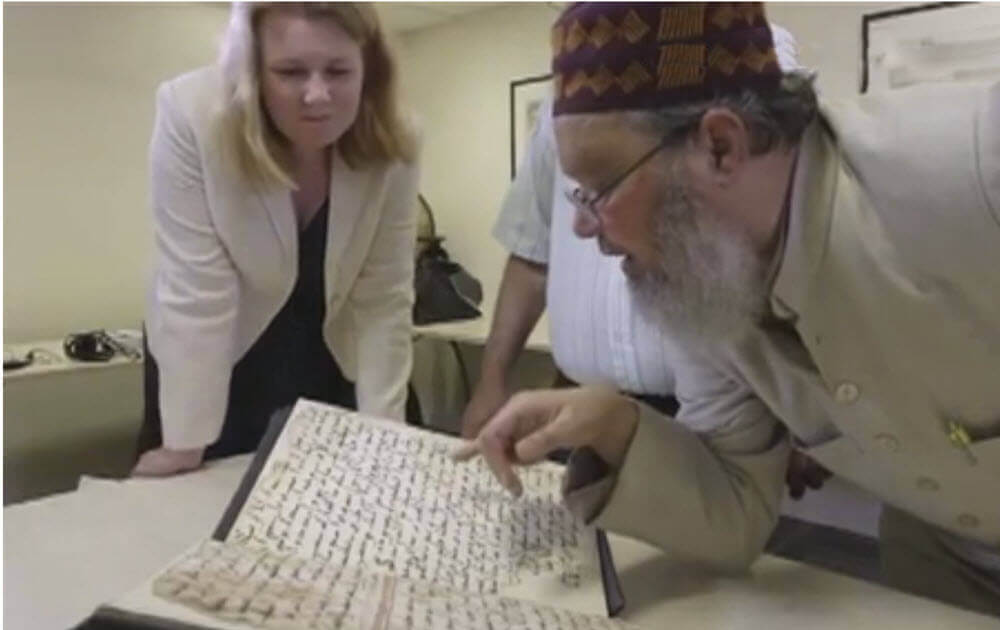
Allama Sayed Muhammad Talha Bokhari reciting from the oldest Quranic manuscript at the University of Birmingham, UK.
Perhaps his interest in manuscripts and the classical tradition also triggered his interest in classical art and culture. Shaykh Bukhari surprised me once by telling me he would be coming to Sotherbey’s in London! I responded “Maulana – you know about Sotherbey’s?!” He responded: “And why shouldn’t I?” He was the only scholar of his generation that I had come across who knew about the world’s largest auction house and brokers of art and collectibles.
Health, cure and especially alternative medicine were particular interests of his and he trained as a homeopath in India. Despite his bed-bound illness, he completed a professional homeopathy course over the last few years — the certificate for which he will now be awarded posthumously.
Shaykh Mufti Talha Bukhari hails from a family of scholars, the ranks of which include his grandfather, the Mufti of Bukhara in the early 20th Century. His family moved from Bukhara to India following the Russian persecution of Muslims.
His scholastic training was a synthesis of Darul Ulum Deoband and Aligarh Muslim University — representing two different intellectual approaches. He specialised in Quranic exegesis (tafsir), Islamic jurisprudence (fiqh) and issuing legal opinions (ifta) — all of which he pursed at graduate level at Darul Ulum, Deoband. In fact, he started teaching tafsir and fiqh from the young age of 19/20.
He obtained a BA, LLB from Magdah University (Bihar, India) in addition to an MA in Persian Language from the same university. He went on to obtain an MA in Islamic Studies, MA in Arabic Language (including Classical, Medieval, Modern and Indo-Arab Literature in addition to Advanced Grammar, Linguistics, and Translation skills from English into Arabic) from Aligarh Muslim University in India.
He further embarked upon a PhD in Hadith Sciences at the University of Lucknow, which he was not able to complete due to his migration to the UK in the mid 90’s. He mentioned to me once that had he remained in India, he would have changed his PhD topic to a critical analysis of Karl Marx’s (1818 -1883) economic theory from an Islamic perspective, particularly based on the socio-economic theory of one of India’s greatest intellectual icons — Shah Waliullah al-Dehlawi (1703-1762).
Shaykh Talha Bukhari migrated to the UK with a work sponsorship from UK Islamic Mission, one of the oldest British Islamic organisations. He was a member of the European Council for Fatwa and Research (ECFR) in the early years of its inception and chairman of Islamic Institute for Development & Research (IIDR) for 10 years and taught several courses, including at a one-month IIDR residential course in Nottingham in 2002. He later served as Imam, Khateeb and Senior Islamic Issues Consultant at Birmingham Central Mosque.
May the All Gentle forgive our teacher, grant him an elevated rank in the Hereafter and bless his beloved wife, family and loved ones with beautiful patience. I will miss him dearly.
Exclusive interview of Shaykh Talha Bokhari in AMUST:
Full profile of the author Shaykh Sharif Hasan al-Banna:
https://www.iidr.org/people/18-sharif-h-banna/





Comments