

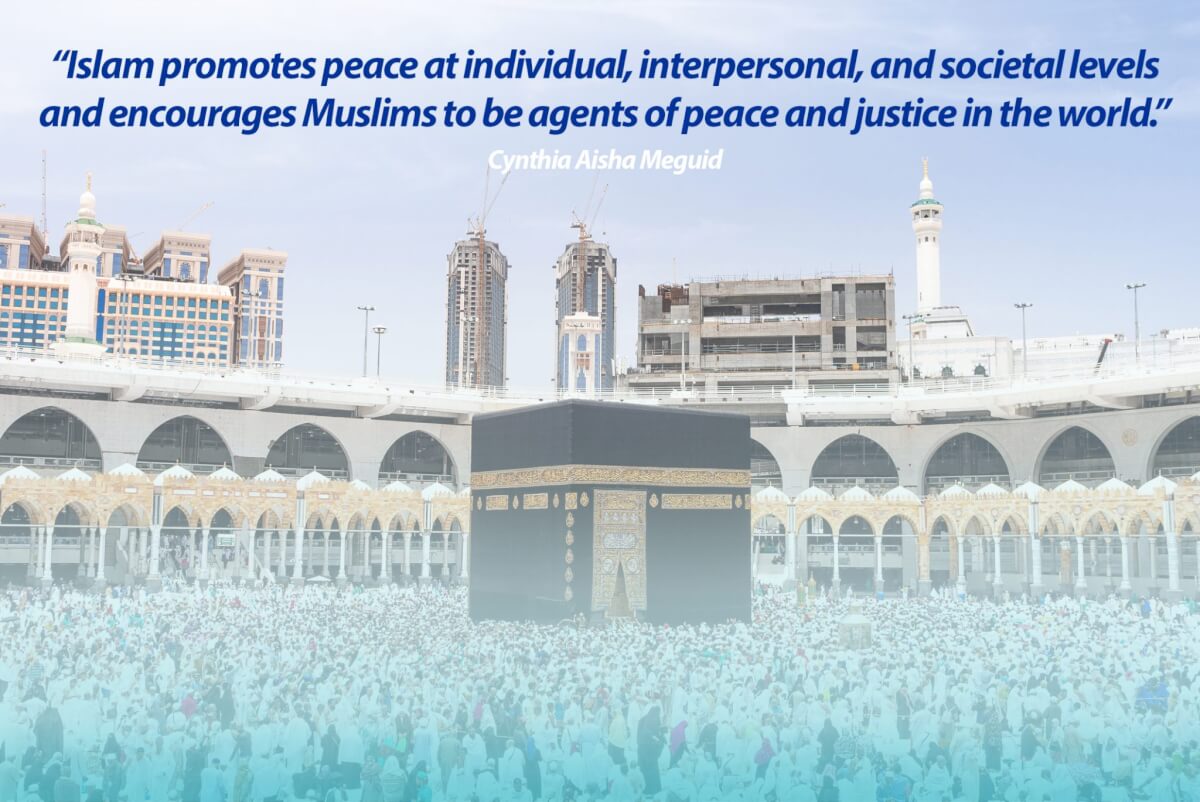
Islam promotes peace at individual, interpersonal, and societal levels, and encourages Muslims to be agents of peace and justice in the world.
Yet, a prevailing misconception surrounding Islam revolves around the unfounded notion that it advocates for violence or terrorism.
Before embracing Islam, I too entertained this misconception. That changed dramatically, with my immersion in its wise teachings, ongoing educational exploration of Islam, coupled with countless interactions with diverse Muslim individuals spanning three decades.
So where does the misconception that Islam advocates violence come from? It can be attributed to three key factors – inadequate comprehension, misinformation, and perpetuated stereotypes.
There are many instances where global conflicts arise due to factors related to geopolitical issues, cultural influences, or misinterpretations of religious texts. These conflicts *cannot* be attributed to the essence of Islam in any way or form.
It is essential to differentiate between the teachings of Islam and the actions of individuals or groups who distort or misrepresent those teachings.
Peace is a core value in Islamic ethics:
For me personally, as well as for millions who follow Islam, our faith stands as a religion and way of life that places a dominant emphasis on peace, justice, and compassion.
Instances of violence perpetrated by certain individuals or factions who ‘call’ themselves Muslim, does not align with authentic Islamic teachings. To connect such actions to define an entire faith or its adherents is a testament to ignorance.
Here is why. Islam is deeply infused and connected to the divine concept of peace. The word “Islam” itself means “submission” or “peaceful surrender” to God’s will. Peace is an integral part of every aspect of Islamic teachings and principles.
Some mighty ways that Islam promotes and emphasizes peace & justice are:
1 – The peaceful Quranic teachings: The holy book of Islam, contains many verses emphasising peace, justice, and reconciliation. It encourages Muslims to seek peaceful resolutions, promote compassion, and maintain harmonious relationships with others. A beautiful example: “And the servants of the Most Merciful are those who walk upon the earth in humility, and when the ignorant address them [harshly], they say [words of] peace” (Quran 25:63).
2 – The peaceful example of Prophet Muhammad (s): Prophet Muhammad (s) is the benchmark and model of Islamic teachings for Muslims. Throughout his life, he promoted peace and reconciliation, even in challenging circumstances. The Prophet emphasized forgiveness, kindness, and the importance of resolving conflicts peacefully.
3 – Preservation of life and sanctity: Islam greatly emphasises the sanctity and preservation of human life. Muslims are taught not to harm others unjustly, and the taking of innocent lives is strictly forbidden.
4 – Peaceful coexistence: Islam teaches how to achieve peaceful coexistence and building good relations between individuals, communities, and nations. Muslims are urged in the name of God, to establish peace, justice, and equality in society, and to treat *all* individuals with respect and dignity, regardless of their religious or ethnic backgrounds. Islam promotes tolerance, understanding, and cooperation among people of different faiths. Unfortunately some other faiths fall short of this level of tolerating and accepting others.
5 – Internal peace and spirituality: Islam is a path and emphasises inner peace and spiritual development. Muslims are encouraged to cultivate peace within by seeking a strong connection with God, practicing self-awareness & mindfulness, and engaging in daily acts of sincere worship and devotion. Islam knows that only with inner peace can individuals contribute positively to society and promote peace in their interactions with others.
All the above information unquestionably demonstrates that the divine tenets of Islam remain utterly devoid of any manifestation of violence.
What is the solution to dispelling the misconception that Islam promotes violence?
- Seek accurate information and engage in respectful dialogue to dispel misconceptions about any religion, including Islam.
- Interact with diverse Muslim communities and learn from credible sources to help foster understanding and bridge divides.







Comments