

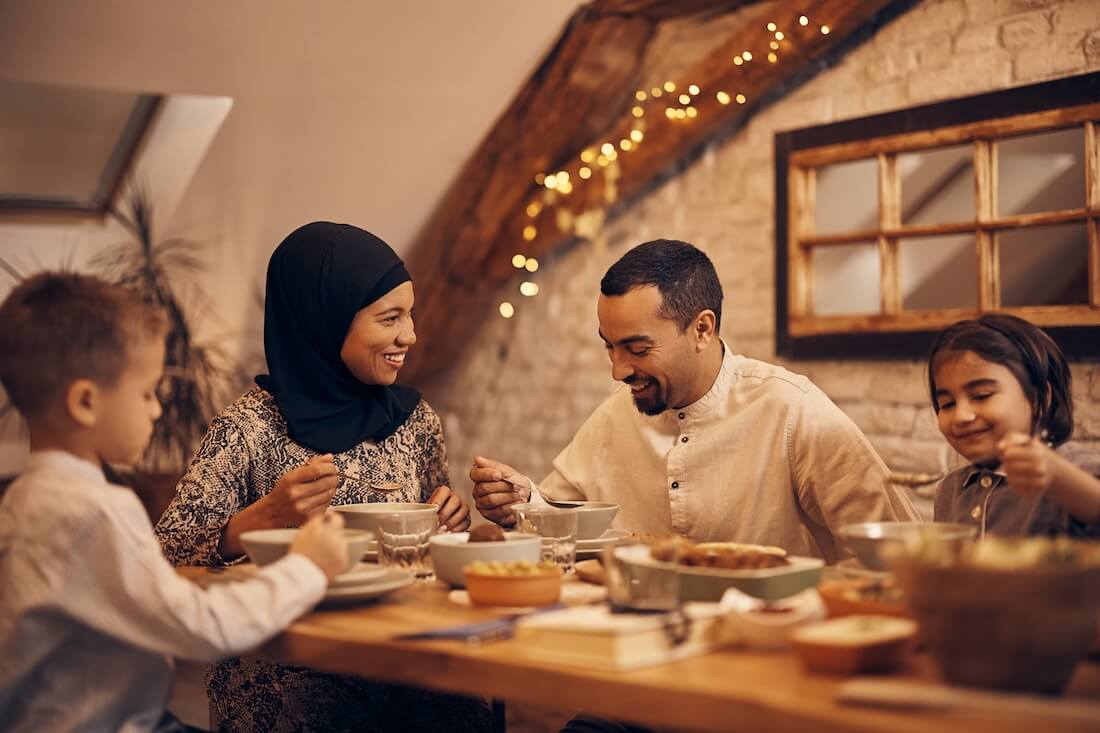

When the sun sets on a day’s fast, Muslims around the world reach for a date… or three. It’s a tradition that follows the example of the Prophet Mohammad (s) who the Hadith record breaking his own fasts with three ripe dates and water before prayer. High in sugar, dates help restore low blood sugar levels and reduce your chances of headaches or dizziness.
If you know, you know. But these aren’t things that everybody knows. Nor does everyone necessarily know that the month of Ramadan commemorates the time that the Angel Gabriel dictated the Quran to the Prophet Mohammad (s) as Allah’s Messenger.
Or that fasting is an exercise in self-discipline to increase compassion for those less fortunate; or that it is an important time for giving alms and undertaking acts of charity, the sharing of food after fasting being part of that. Or that for centuries, the date tree has been a symbol of hospitality and peace. Or indeed, that if you are invited to iftar, after that first date the food on the table may be very different depending where your hosts’ families originally came from.
When we started Recipes for Ramadan in the first Covid lockdown of 2020, we had three key intentions: to share food and stories just as we might at face-to-face iftars with our families, extended families, neighbours, colleagues and communities; to explain the beliefs and practice of Ramadan a little to non-Muslims; and to explore the rich diversity of Australian Muslim culture and heritage.
It was to be an invitation to connect with people, places and events we may otherwise have no experience of, and to help us understand the complex histories that we bring with us, histories which necessarily feed into the modern Australian story. Anthony Bourdain, the New York chef and TV presenter, would have called it an invitation to ‘parts unknown’, to ‘eat someone else’s food and walk in their shoes’.
Since that first lockdown in Ramadan in 2020, with contributions from Australian Muslims from different walks of life, we have published 63 recipes and stories from 21 countries via a dedicated website, Instagram, Facebook and YouTube. Others in the pipeline for this year include Fiji, Russia, Myanmar and Saudi Arabia.
Many of the people and their stories have lodged in my memory and affections. In 2020, one recipe and family story centred on Gaziantep in South East Turkey. I’d never heard of Gaziantep before but helping tease out the story and trying the food, I felt I’d got to know the place and the people in some small way.
I hadn’t travelled there but the food, the story, the place and the people stayed with me and that sense of connection became significant last month when the earthquake hit. Gaziantep was close to the epicentre and I felt people I knew and cared about, a place I knew and cared about, were affected. This sense of connection was what we hoped, and continue to hope, people will gain from the project.
As we prepare for Ramadan 2023, we have chosen to share Beyza Koca’s story and recipe from Gaziantep first. At this tragic time, it is one we are sure you will also connect with.
Over the next couple of months, we also plan to share other recipes and stories in AMUST’s Friday newsletters and April and May papers and Guardian Australia will also once again publish a series in its Saturday Lifestyle section, starting on Saturday 18 March 18 ahead of Ramadan.
The whole collection can be found at www.recipesforramadan.com. And via our socials @recipesforramadan on Instagram, @recipesforramadanau on Facebook and YouTube @recipesforramadan13. We’d love to hear from you. Do post your photos and tag @AMUST and @RecipesforRamadan.
Recipes For Ramadan was the winner of the NSW Premier’s Multicultural Communications Award for Best Use of Social and Digital Media.







Comments