


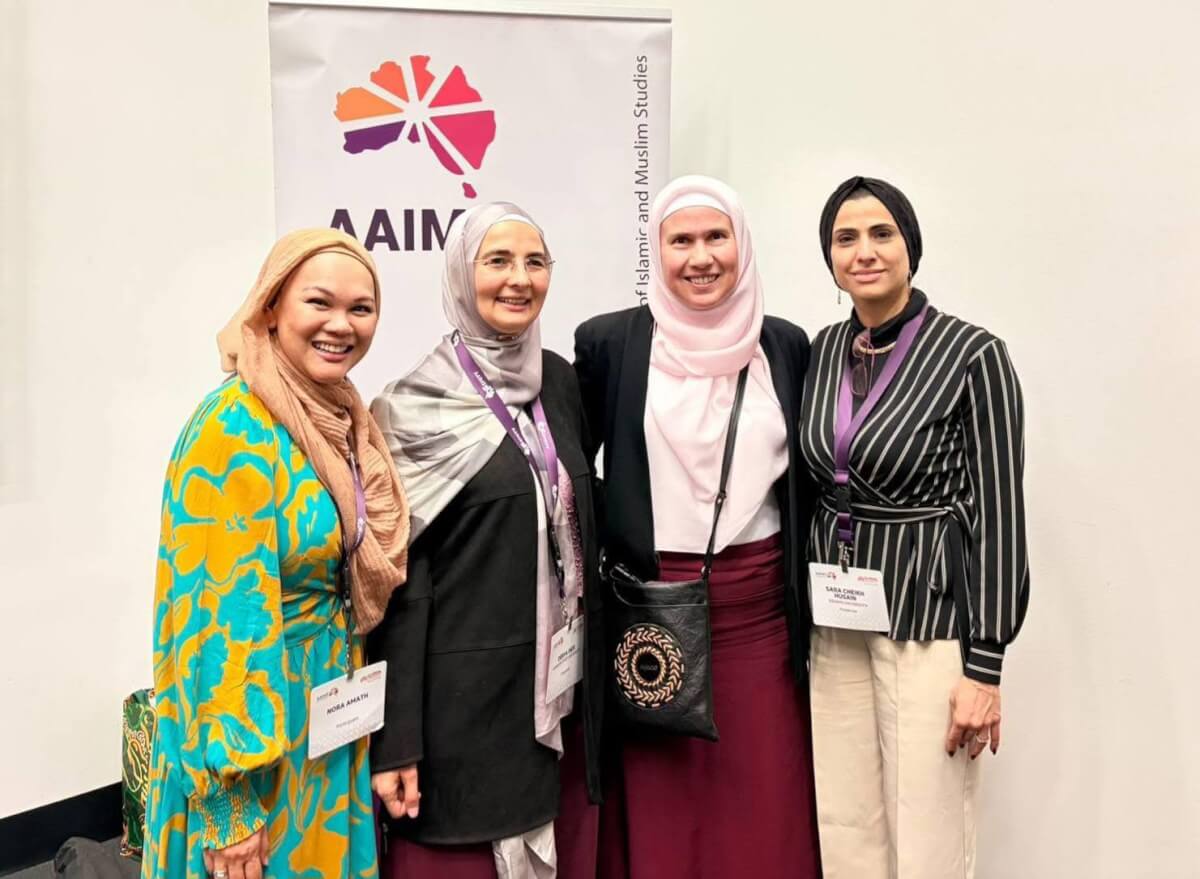
The 2025 Australian Association of Islamic and Muslim Studies (AAIMS) 5th National Conference was held over Thursday 30–Friday 31 October 2025 at Griffith University’s South Bank campus in Brisbane, bringing together scholars, practitioners and community leaders engaged in Islamic and Muslim-studies research and public policy in Australia and beyond.
The conference theme “Fractured World, Uncertain Future: Islam, Justice, and Humanity in Turbulent Times” leveraged the contemporary turbulence to interrogate the intersections of Islam, justice and humanity in a world shaped by conflict, technology, migration and multiple crises.
The conference opened with an acknowledgement of country by Prof Halim Rane recognising the sacred lands of the Jagara and Turrbal peoples and weaving in the historical ties between Makassan fishermen and Indigenous Australian communities—establishing a tone of relationality, stewardship and reconnection.
This grounding framed the conference not just as academic but as engaged scholarship in service of community and integrity.
Opening keynote
The keynote address — by Professor Hatem Bazian (University of California, Berkeley) — “Genocides in the Global South and the Collapse of the Post-WWII Order: Islam’s Call for Justice in Turbulent Times” set the intellectual and moral agenda.
Drawing on extensive historical and geopolitical analysis, Bazian reminded the audience that the post-WWII international order has faltered in its promise of “never again” and that Muslims in both majority and minority settings are among those bearing the tragic consequences.
His framing stressed that justice is not merely an academic ideal but a form of worship—silence in the face of atrocity becomes complicity, while faith-inspired moral courage demands witnessing, advocacy and structural reform.
Prof Bazian’s remarks served as a “searing indictment of global moral amnesia” and a challenge for Islamic scholarship to move from reaction to constructive engagement.
Key themes and major sessions
The programme comprised ten sessions across two days, spanning thematic areas such as covenants in Islam and global justice; interreligious relations and human rights; Islamophobia; leadership and the Prophet’s model; Muslim women’s voices; education and resilience; Muslim histories in Australia and New Zealand; and politics, affluence and power in Muslim thought.
Covenants in Islam, global justice and leadership (Session 1)
Chaired by Associate Prof Zuleyha Keskin, this early session included a presentation by Prof Halim Rane on “The Covenant (ʿAhd) of Allah in the Qur’an and Sunnah: Toward an Islamic Epistemology of Decoloniality and a Just Peace.”
The conception of covenant (ʿahd) was advanced as a key way of reconceiving Islamic knowledge: rather than seeing Islam through the lens of securitisation, the session invited scholars to view Islam as the basis of ethical imagination and global justice.
Dr Hakan Çoruh contributed a study of Isra’iliyyāt narratives in al-Khāzin’s Qur’an commentary, while Prof. Mehmet Ozalp offered a critical appraisal of al-Mīzān as a “covenant for the earth.” Imam Ensar Cutahija rounded out the panel with leadership lessons drawn from the five Ulū al-ʿAzm prophets. Together these papers reflected the refrain noted by attendees: “Justice is not a theme. It is a methodology.”
Interreligious relations and human rights (Session 2)
In this session the lens shifted to pluralism and human rights. Dr Hayba Abouzeid addressed the exclusion of Islamic justice in modern societies amid the “clash of civilisations” narrative; Ms Souha Korbatieh explored privacy in Islam and apostasy-law reform; Dr Junaid Amjad considered Mawdūdī’s thought in the age of AI and technocracy; and Mr Mohamed Arkam & Dr Fatmir Shehu reported on Buddhist–Muslim peacebuilding in post-war Sri Lanka.
The diversity of topics underscored the global interconnectedness of Muslim scholarship and the imperative of interfaith engagement.
Islamophobia – Drivers, impacts and responses (Sessions 3 & 6)
Sessions 3 and 6 together constituted deep explorations of Islamophobia: its structural foundations, institutional manifestations, intersections with anti-Palestinian racism and impacts on identity and mental health. Prof. Fethi Mansouri opened the first session on racism and Islamophobia; Assoc Prof Derya Iner reported on their national Islamophobia in Australia project; and Ms Sarah Alzoubi focused on the lived impact on Muslim women.
Session 6, chaired by Prof. Rane, probed further into “From Insecurity to Injustice and Genocide”—with Dr Nasser Al-Ziyadat, Dr Susan Carland, Dr Sara Cheikh Husain and Dr Abdu R Dardery conceptualising how hate, structural discrimination and global violence coalesce.
Muslim women: Identity, voice and resilience (Session 5)
Chaired by Assoc Prof Keskin, this session offered richly textured contributions: Ms Nadia M Mohamed addressed media narratives and global justice through Muslim women’s lenses; Prof Samina Yasmeen explored the political trajectories of immigrant Muslim women; Ms Hajer Jemai presented on culturally and religiously sensitive maternity-care frameworks; Ms Fajri Zulia Ramdhani investigated young Muslim women’s identity formation in Bali.
The session reiterated that justice must be realised institution-by-institution and that inclusive representation is a precondition for resilience.
Education, psychology & sociology (Sessions 7 & 8)
These sessions turned inward to questions of teaching, identity, resilience and belonging. Session 7 (Muslim Education and Islamic Schools) explored how faith-informed pedagogies and emerging technologies (e.g., the “virtual mufti”) need to align with global responsibility and local identity.
Session 8 (Faith, Psychology & Sociology) dealt with trauma, anti-Muslim hostility and community resilience: Assoc Prof Keskin, Dr Riyad Rahimullah, contributed pieces that draw together spiritual traditions with empirical research on Muslim wellbeing and social cohesion.
Dr Mahsheed Ansari & Dr Josip Matesic presented their biographical research on Muslim community pioneers titled ” Islam as Lived Philosophy: Tradition, Diaspora and the Ethical Vision of Dr Qazi Ashfaq Ahmad OAM.”
Muslim histories & lived experiences / politics, affluence & power (Sessions 9 & 10)
Day two’s final sessions cast us back into history and ahead into power-structures. Session 9 offered Australian and New Zealand Muslim experiences: Dr Usman Afzali’s Muslim Diversity Study, Mrs Mirela Cufurovic’s historical work on Australian Muslim identity, Dr Abu Bakr Sirajuddin Cook on Sufi histories and Dr Nada Ibrahim on intercultural youth identities.
Session 10, chaired by Dr Jan Ali, took on political economy, wealth, leadership and statehood: Dr Mursal Farman revisited early Islamic notions of caliphate, Assoc. Prof. Alena Kulinich analysed moral ambiguities of wealth in al-Ghazālī, Mr Omar Gomaa traced democracy under military rule (Egypt), and Mr Muhyidin explored Muslim performing arts in Java. These sessions underscored the conference’s ambition: not only to critique but to reconstruct serious scholarship at the intersection of Islam and global power.
Dinner keynote and institutional focus
On the evening of Day 1 the conference dinner featured a keynote by Giridharan Sivaraman, Australia’s Race Discrimination Commissioner. His address stood out for its clarity and relevance: he addressed structural Islamophobia in higher education (noting a survey of 42 out of 43 universities, over 32,000 Muslim respondents, high rates of discrimination) and called for institutional reform.
The speech elevated the conversation from “we have racism” to “what must institutions become to dismantle it”. It reaffirmed the conference’s emphasis on evidence, justice and action.
Book launches and intellectual legacy
In the post-lunch slot on Day 2, the conference hosted three book launches: Covenants with Allah: Keystone of Islam(Prof. Halim Rane & Ibrahim Zein); Qur’anic Concepts in Islamic Psychology and Spirituality (Assoc. Prof. Zuleyha Keskin); and The Politics of Anti-Islamophobia in [Australia] (Dr Sara Cheikh Husain). These publications underscore an emerging generation of scholarship focused on decolonial Islamic epistemologies, faith-informed psychology and public research on anti-Muslim hate. They serve as intellectual markers of the field’s maturation.
The conference set the stage for the next generation of work in Islamic and Muslim studies in Australia. Immediate priorities include mentoring emerging scholars, building interdisciplinary networks, reconceiving curricula, and partnering with policy and community sectors to ensure that the insights generated translate into social transformation.
As the organisers note, the field must move “from the margins to the moral centre”.
The themes of the conference—fracture, uncertainty, humanity—will not fade soon. The challenge now is to convert insight into infrastructure: research centres, community-based interventions, media capacity, leadership pipelines and institutional accountability.





Comments