

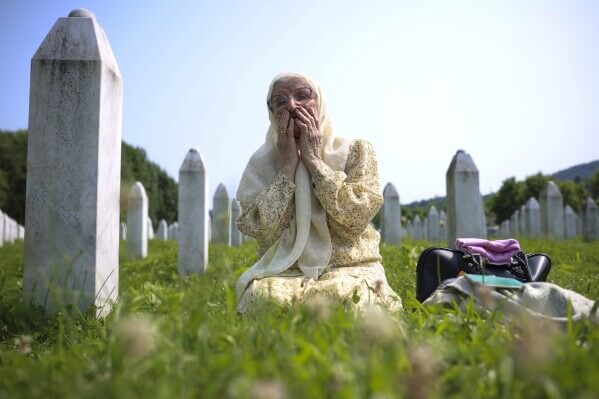
In July 1995, a horrific massacre took place in the small town of Srebrenica in Bosnia and Herzegovina. It has gone down in history as the largest genocide in Europe since World War II. In less than a week, at least 8,372 unarmed Muslim men and boys were systematically executed by Serbian forces.
This massacre occurred in what the United Nations had declared a “safe area,” right in front of UN peacekeepers, whose inaction and failure effectively enabled the tragedy.
This horrific event remains not only a deep scar for the Muslims of Bosnia but also a permanent stain on the conscience of humanity. July 11 marked the 30th anniversary of the Srebrenica genocide.
There are two main reasons why we must continue to remember it: first, because countless members of the Muslim Ummah were brutally killed at the hands of oppressors in 1995; and second, because Srebrenica remains alarmingly relevant even today.
The location may have changed, the scenery may look different, but the echoes of Srebrenica are still witnessed in other parts of the world under new names.
To understand the Srebrenica massacre, one must look back to the early 1990s and the collapse of the socialist state of Yugoslavia in Southeastern Europe. After the death of President Marshal Tito, Yugoslavia became politically, economically, and ethnically unstable. Between 1991 and 1992, Slovenia, Croatia, and Bosnia and Herzegovina declared independence one after another.
Bosnia’s independence was the bloodiest and most complex, as its three major ethnic groups—Bosniak Muslims, Croat Catholics, and Serb Orthodox Christians—engaged in conflict with divergent political goals. The Serbs aimed to ethnically cleanse Bosnia of Muslims and Croats in order to create a “Greater Serbia.”
To achieve this, they pursued a policy of ethnic cleansing. Today, Israel is following similar tactics in Gaza. In Bosnia, this campaign involved systematic killings, mass rapes, burning of homes, and forced displacements of Muslims.

Srebrenica was a small town in eastern Bosnia predominantly inhabited by Muslims. In 1993, the United Nations declared it a “safe area” and deployed a Dutch battalion of peacekeepers. By that time, Serbian forces had taken over much of the surrounding territory, prompting thousands of Muslim refugees to seek shelter in Srebrenica.
By July 1995, over 40,000 people had gathered in the enclave. Then came July 11, 1995—a terrifying day in history. On this day, the Bosnian Serb army under the command of Ratko Mladić entered Srebrenica.
They threatened the Dutch UN peacekeepers into submission and seized control of the town. The Serbian forces then separated men and boys from women. Women, children, and the elderly were transported by truck to the nearby town of Tuzla, while the men and boys were taken away and summarily executed.
The genocide was meticulously planned. The Bosnian Serb army had been surrounding Srebrenica for weeks, cutting off food, medicine, and humanitarian aid. Within just five to six days after capturing the town, they executed the genocide.
Victims were transported by truck to schools, garages, farms, and forests where they were shot. The bodies were secretly buried in mass graves. To erase the evidence, some of the remains were later dug up and scattered in different locations.
Now, 30 years later, Gaza appears to be reliving the horrors of Srebrenica. The Israeli administration is creating artificial shortages of food and medicine while bombing civilian populations in Gaza.
The atrocities were not limited to men; women were also subjected to horrific sexual violence. According to multiple UN reports, rape was used as a weapon of war to terrorize and psychologically damage the Muslim population, forcing them to flee permanently.
The Srebrenica massacre was a clear case of identity-based violence. All those who were killed were Muslims, and their only crime was being Muslim. Bosnian Serb nationalism was heavily influenced by Christian Serbian ethnocentrism and religious supremacy.
They viewed Islam as a “foreign religion” and despised Bosniak Muslims as descendants of the Ottoman era. Some Serbian leaders referred to the extermination of Bosniak Muslims as a form of “national rebirth.”
One of Ratko Mladić’s infamous statements during the massacre was, “We have finally liberated this town from the Muslims”—a chilling reflection of deep-rooted Islamophobia.
Srebrenica was designated as a UN “safe area,” and yet, the peacekeepers stationed there failed to offer any resistance. The Dutch battalion essentially surrendered and handed over the Muslim men to the Serb forces.
Despite repeated requests, NATO air support was delayed and ineffective. By the time NATO intervened militarily, the massacre had already concluded. This failure raised serious questions about the impartiality and effectiveness of the United Nations. Many analysts argue that Western apathy and intentional inaction played a role, as attacks on Muslims were not taken as seriously.
The world gradually became aware of the genocide through media coverage—mass graves, photos of murdered boys, their bloodied clothes. The US, EU, and UN condemned the massacre, but one cannot help but wonder: if they had acted in time, could the killings have been prevented?
The response from the Muslim world was also disappointing. Many countries in the Middle East remained silent. Only Turkey and a few Arab nations condemned the atrocities, but no significant diplomatic pressure followed. The primary perpetrators of the genocide were the Bosnian Serb army and its paramilitary forces.
The operation was led by Ratko Mladić, chief of the Bosnian Serb army, with political leadership from Radovan Karadžić, the wartime president of the Bosnian Serbs and chief architect of the ethnic cleansing policy. Slobodan Milošević, the President of Serbia, indirectly supported these atrocities.
In 1993, the UN established the International Criminal Tribunal for the former Yugoslavia (ICTY). Through lengthy trials, some top perpetrators were brought to justice.
In 2017, Ratko Mladić was sentenced to life imprisonment. In 2016, Radovan Karadžić was found guilty of genocide and crimes against humanity. Slobodan Milošević died in prison in 2006 before his trial concluded. However, many Serbian war criminals in Bosnia have still evaded justice.
Some are active in politics, while others hold high-ranking positions in security forces. This culture of impunity remains a source of deep anger and pain for Bosnia’s Muslims.

Following the genocide, the Dayton Peace Agreement was signed in December 1995. It effectively divided Bosnia into two parts: the Federation of Bosnia and Herzegovina (controlled by Muslims and Croats) and Republika Srpska (controlled by the Serbs).
This division created permanent segregation. In many cases, Muslims were expelled even from their own towns like Srebrenica. Today, Srebrenica is under Republika Srpska’s control, where Muslims face fear, discrimination, and oppression if they choose to live there. The local government often denies the genocide and obstructs memorial ceremonies.
Every year on July 11, an International Day of Remembrance is observed for the Srebrenica genocide. A memorial center has been established in Potočari, near Tuzla, where newly identified remains from mass graves are buried with state honors.
This remembrance is more than a day of mourning—it is a grim reminder of how the UN, the so-called defenders of human rights, and the developed world failed to protect people simply because they were Muslim.
As the 30th anniversary of the Srebrenica genocide is marked, the massacre in Gaza has rekindled urgent questions among conscientious people: when will the cycle of genocide against Muslims end?
Srebrenica teaches us that the promises of “safe zones” and peacekeepers may exist only on paper if the reality on the ground says otherwise. The soil of Bosnia still holds the blood of more than 8,000 Muslim men and boys whose only crime was their faith.
This massacre stands as a grim example of how a people were targeted for extermination based on religion and ethnicity. The silence and inaction of the UN, the EU, and NATO planted seeds of mistrust and disappointment in the Muslim world.
Thus, discussions about Srebrenica must continue. What happened there 30 years ago seems to be replaying in Gaza today. Srebrenica was a brutal symbol of Muslim genocide—where more than 8,000 unarmed Muslim men and boys were slaughtered in a UN-designated safe zone.
That same shameless silence, international inaction, and disregard for Muslim lives is being repeated in Gaza. So far, over 59,000 people—mostly women and children—have been killed in Gaza by Israeli forces.
At least 140,000 Gazans have been injured. Children are dying in their mothers’ arms, doctors are trapped in bombed hospitals, and civilians are struggling to survive without food, water, or shelter.
The global media plays a biased role, the UN remains silent and ineffective, and human rights rhetoric has become worthless in the games of powerful states. Even in the 21st century, Gaza throws a piercing question at the face of so-called civilization: how many more Srebrenicas will history silently mourn?
Will the Muslim world only mourn, or will it finally unite and act for justice? This remains the most urgent question of our time.




keep posting your articles
Thanks
latheef Farook Colombo
A good overall article bringing awareness to the atrocities that occured in Bosnia during the Balkan war’s in the 1990’s. Srebrenica was one of the worst with ~8,372 victims, there were mass executions of innocent civilians that occured in Prijedor (~5,200 victims), Zvornik (~2,000 victims), Višegrad (~3,000 victims) and Foča (~2,704 victims). Addirionally Bosnia there were thousands of innocent civilains who were targeted by mortar shelling, sniper fire and land-mines – many were killed during every day actions like: crossng a road, going to work/school, pouring water at a tap outside of the house and walking from one place to another place in a village.
It must be pointed out that the collapse of Yugoslavia and it’s institutional collapse were not triggers of the instability and the subsequent war. The hatred of Muslims in the Balkans is centuries old. Muslims had experienced multiple genocides in the Balkans over the past few hundred years – an example during the second world war thousands of Muslims were massacred in the Bihor region of Sandzak – (now Montenegro). The Četnik forces (Serbian Ultranationalist Guerilla forces) were commanded by Draže Mihajlović, who gave orders for such ethnic cleansing to take place. What many are not aware of is this War criminal is glorified to the present day, there are monuments celebrating of Draže Mihajlović in Melbourne, Victoria.
The events in Bosnia during the 1990’s were horrific to say the least however, such experiences are constantly being reminded to survivors who are taunted in present day Bosnia and in other countries. Tensions have not dissapeared, they are always there – even 30 years after. The Bosnian people are always cognizant that conflict can break out at any time, living on edge is part of their existence and it is all because others hatred for the Bosnian peoples belief in Islam.