


“Domestic Violence is no longer an unaddressed phenomenon. Controversy is never far away from this topic. Culture wars, gender wars and the far right with the far left is all of what we have to deal with.” The podcast hosted by Faraz Nomani intended to discuss Muslim men’s perspective: they were the unheard voices in the situation.
The podcast opened to feature a true life story of a sister whose husband had been regularly absent from home and the COVID-19 lockdown made a situation become unbearable until her husband revealed that he had a second wife and the situation with his first wife had become unbearable. He now wanted out.
The sister had to unpack and leave with her two children who appeared to be under the age of ten. She had nowhere to go. She called another sister who asked her to call National Zakat Foundation. They were able to assist.
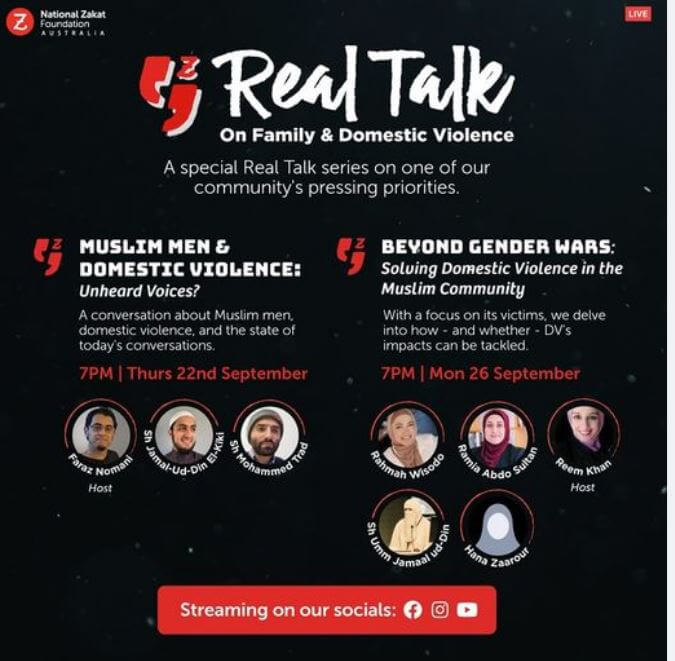
Shocking but also drawing the sisters in and showing a possible female perspective, it appeared to be a clip to highlight the work of the National Zakat Foundation.
Two young sheikhs in the community were able to join in and offer their viewpoints at this juncture. They were Sheikh Jamal-ud-din El-Kiki from the Lebanese Muslim Association who often deals with husband and wife reconciliation matters and Sheikh Mohammad Trad who is the Imam at Zetland Mosque and works for AFIC.
They both do not uniquely see domestic violence as a Muslim specific issue as it affects all communities. Coming out of lockdown has had residual effects and traumas especially within Muslim communities. Where there are cases of injustice, they normally involve some level of trauma which is why they recommends healing.
Sheikh Trad went on to talk about physical abuse and psychological abuse attributed to socioeconomic factors and he feels that branding of this issue as being associated with Islam is not right.
Faraz infers that a lot of brothers feel that they get labelled as an instigator.
Sheikh Jamal says that he deals with a lot of men who have the mentality that, “he has to teach her a lesson or she deserved it.”
Sheikh Trad went on to address, “toxic masculinity,” and how the times affect the understanding of this.
Toxic Masculinity is condemnable aggressive behaviour and it is not in line with Islamic teachings.
They quoted the hadith, “the best of you is the one who is best to his family (especially the wife).”
Sheikh Jamal also cautioned against throwing around of labels, “misogynist,”” narcissist.”
“The alpha male notion is not found in the Seerah,” said Sheikh Jamal.
Sheikh Trad warns of boasting in company, “my husband only does what I tell him, “or “she only ever has to listen to me” type mentality. No one knows behind closed doors.
We need to be quiet in community about personal matters and submit to Allah first. One of the tensions between men and women is the sense of individualism. Marriage is supposed to be about softness.
Questions from the audience included the showing of emotions for a male. Sheikh Jamal responded with the Prophet (s) being able to readily show his emotion.
“Bravery and courage is recommended in Islam with Haqq (truth),” said Sheikh Trad.
Though the topic was domestic violence, most of what was discussed was relationship dynamics between married couples. Gender roles, feminism, past traumas, narcissism and societal expectations.
Spiritual abuse was also touched upon. Issues of conflicts with religion and the need to prove oneself right for the court and fighting for the kids is where matters become more complex and where Muslim men feel unheard in marriage breakdown.
Men abusing to try to take advantage was when it was brave for a man to confront the issue head-on. Is this all about power dynamics?
The host’s conclusion: masculinity was set as an example by the Prophet Mohmmad (s). Who could argue with that? Where there is harm, there should be no further harm.
While some of this is difficult to apply, these are messages that are important for everyone. The overall tone was wanting relationships to thrive.
It was a positive message set forth by these brothers.
There are many takeaways from the topic which could apply to any relationship dynamic. The conversational dynamic and the diverse backgrounds of the panel were refreshing.
It was good to see young, informed Muslim men who are open to listening to all sides of a story.



No such thing as “toxic masculinity”, I don’t know how the term left academia trying to describe inmates in prison into a cheap throw away term that random people used on the internet and wider media against all men. It’s not helpful and harms men from doing what they’re meant to.