


According to the University of Canberra’s Digital News Report: Australia 2026, 77% of Australians are concerned about what is real and what is fake when it comes to online news. With information now reaching us within seconds, knowing what to believe is becoming increasingly difficult.
We sometimes assume that false or misleading information is shared by people who deliberately want to deceive others. Yet often, the person sharing it may have perfectly good intentions. They may want to warn their family, support a cause they care about, or simply share something they believe is important.
The problem is that the information we receive online does not always give us the complete picture.
A short video may be genuine but missing what happened before or after it. A quote may be accurate but poorly explained. Someone may simply struggle to articulate what they actually meant.
Once the information we receive is separated from its original context, it becomes very easy to form an opinion that may be incorrect, without understanding the full story.
As a teacher, I see a simpler version of this when students have disagreements. We may hear one student’s account and feel certain we understand what happened.
Then suddenly, another student explains the same event from a different perspective, and suddenly, the situation looks very different.
The digital world works in much the same way. The difference is speed. Information can now reach thousands of people before we have stopped to ask a simple question: is there more to this story?
An Islamic reflection
Prophet Mohammad (s) reminded us:
“It is enough falsehood for a person to relate everything he hears.”
(Hadith: Sahih Muslim)
This does not mean that we should question everything we read or become suspicious of everyone around us. Rather, it reminds us that we have a responsibility for the information we choose to pass on.
That responsibility becomes particularly important because what we share can elicit many emotions. Anger may cause us to react quickly. Excitement may make us overlook important details.
Islam encourages us to seek truth and act with wisdom. In a digital world, part of that wisdom is learning when to pause.
Tonight’s DigitalDeen action
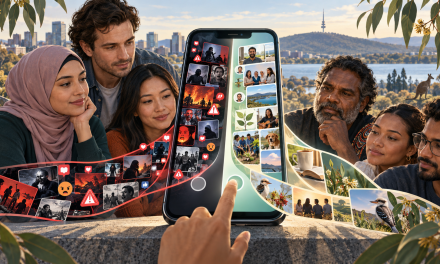
The next time something online makes you immediately angry, shocked or excited, take a moment before accepting or sharing it.
Ask yourself:
- Where did this information originally come from?
- Am I seeing the full context?
- Do I really need to share this?
You do not need to investigate everything you see online. Instead, start with one simple habit: when something creates a strong emotional reaction, give yourself time before responding and sharing.
Technology has made sharing information easier than ever. As an ummah, our responsibility is to ensure that ease does not remove our judgement.
May Allah grant us the wisdom to recognise truth, the patience to seek context, and the good character to be responsible with what we share.
Source: University of Canberra, Digital News Report: Australia 2026.





Comments