

The UN at 80: Shaping Our Future Together Conference, hosted by the United Nations Association of Australia (NSW Division) at the Sheraton Grand Hotel Sydney, brought together diplomats, academics, and thought leaders to reflect on the UN’s achievements and its role in an era of renewed global turbulence.
Across a full day of panels and keynotes, the themes of cooperation, accountability, and reform ran deep – reminding all that the UN’s founding ideals remain as urgent as ever.
Opening reflections: Renewal through reform
UNAA NSW President Dr Patricia Jenkings opened with a call to “rebuild cooperation through conviction, not convenience,” setting a tone of optimism and resolve.

Dr Patricia Jenkings, President UNAA NSW.
Miklos Gaspar, representing the United Nations Information Centre for Southeast Asia, reflected on the UN’s legacy as “a living promise spanning borders, bridging continents, inspiring generations.”

Miklos Gaspar, UN Information Centre.
Ambassador Gabriele Visentin, Head of the European Union Delegation to Australia, hailed the Charter as “one of humanity’s most remarkable acts of hope,” urging renewed multilateralism to confront disinformation, climate disruption, and the erosion of democratic norms.

His Excellency Gabriele Visentin, EU Ambassador to Australia.
Australia’s Foreign Minister Senator Penny Wong delivered the day’s most anticipated address, framing Australia as an “amplified middle power” committed to purposeful UN reform. “Reform,” she said, “must be driven by purpose, not process,” reaffirming Australia’s belief in rules-based cooperation and human dignity as the foundation of peace.

Senator The Honourable Penny Wong, Australia’s Minister for Foreign Affairs
Human rights and peace-building in a changing world
The conference’s next sessions examined the twin pillars of peace and human rights.
Leanne Smith, CEO of the Australian Human Rights Commission, warned that “only one per cent of total UN expenditure supports the human rights system,” a reality that places the integrity of the UN’s moral mission at risk. She urged renewed commitment to universality and accountability, reminding delegates that credibility depends on keeping people at the centre of decision-making.

Leanne Smith, CEO, Australian Human Rights Commission.
In the peacebuilding session, Major General Tim Ford AO, leader of the UNAA NSW Peace and Security Pillar, moderated a discussion featuring a video address from Lieutenant General Cheryl Pearce AM CSC, Acting UN Military Adviser, and Angela Robinson, First Assistant Secretary at DFAT.
General Pearce described peace operations as “a lifeline for millions of people living in fragile and conflict-affected settings,” calling for modular, technology-enabled approaches to future missions.
Robinson outlined Australia’s renewed peacebuilding strategy – elevating conflict prevention, expanding funding to the UN Peacebuilding Fund, and creating a practical toolkit for national prevention strategies. Her message was clear: “Every dollar spent on prevention saves one hundred on response.”

Angela Robinson,First Assistant Secretary, Multilateral Policy & Human Rights Division, DFAT.
Truth, media and global citizenship
The panel on truth and the media, featured Professors Peter Greste and Monica Attard, who examined the global erosion of trust in information. Greste cautioned that “truth and facts are being replaced by angertainment,” while Attard reminded that journalism “is defined by process, not platform” – its survival resting on transparency and verification.

Professor Peter Greste, Professor of Journalism Macquarie University, Executive Director, Alliance for Jounalists’ Freedom.
Universities were spotlighted in a parallel discussion on education’s role in building global citizens. Professor Attila Brungs (UNSW Vice-Chancellor and President) reframed artificial intelligence as a catalyst for deeper learning, and Professor Barney Glover AO (Jobs and Skills Australia) urged that “the future belongs to graduates who can learn to learn.”
Youth delegate Iris Brown of UN Youth Australia closed the session with a resonant message: “Global citizenship must be practised, not just taught.”

Prof Attila Brungs, Vice Chancellor and President UNSW.
Sustainability and Innovation
Sustainability sessions showcased Australian leadership in turning ambition into action.
Fiona Reynolds, CEO of the UN Global Compact Network Australia, reminded delegates that the Sustainable Development Goals remain “the world’s business plan,” but warned that progress “is off-track unless governments and business align ambition with delivery.”
Professor Veena Sahajwalla AO (UNSW) demonstrated how science and circular-economy innovation can drive both jobs and climate action through her pioneering “micro-factory” technologies.
Marine biologist Dr Vanessa Pirotta offered an emotional reminder of the planet’s interconnectedness: “When we protect whales, we protect the oceans – and when we protect the oceans, we protect ourselves.”
The session closed with consensus that sustainability and prosperity are inseparable, requiring partnerships between government, business, and civil society.

Andrew Petersen, Chief Executive Officer of Business Council for Sustainable Development.
Peace, rights, and positive change
Steve Killelea AM, founder of the Institute for Economics and Peace, presented sobering data: the global economic cost of violence now exceeds 11 per cent of world GDP – a 20 trillion-dollar burden. His Positive Peace Framework demonstrated that societies investing in governance, trust, and equitable opportunity are also the most resilient.

Steve Killelea AM, Founder and Executive Chairman, Institute of Economics and Peace.
A parallel panel discussion featuring Thomas Mayo, Hugh de Kretser, and Justine Nolan linked these global lessons back to Australia. “Human rights,” Nolan observed, “have never been a consensus project – they survive because we defend them, even when it’s uncomfortable.”
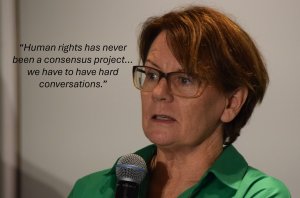
Justine Nolan, Director, Australian Human Rights Institute
The UN at a crossroads
The day’s final plenary, “The UN at a Crossroads: Leadership, Relevance and the Road Ahead”, drew together these threads.
Moderator Gary Quinlan AO, former Australian Ambassador to the UN, delivered an unflinching assessment: “Multilateral rules are being displaced by strategic opportunism.” Yet he insisted the UN’s universality and convening power remain irreplaceable. Quoting Dag Hammarskjöld, he reminded the audience, “The UN was not created to take us to heaven; it was created to save us from hell.”

Gary Quinlan AO, former Australian Ambassador to the UN.
Arthur Sinodinos AO argued that the UN’s imperfections are “a feature of an imperfect world,” urging pragmatic reform – especially a more representative Security Council and renewed US engagement through shared interest.
Leanne Smith called for visionary leadership in appointing the next Secretary-General and warned that budget cuts risk hollowing out the human-rights system.
Dr Courtney Fung cautioned that a “pared-down UN reduced to service delivery” would abdicate its moral authority, while Ryan Neelam (Lowy Institute) urged a revival of trust and transparency, including self-restraint on the veto.

Dr Courtney Fung, Associate Professor, Security Studies, Macquarie University.
In discussion, audience members pressed for Security Council expansion, stronger representation of women, and recognition that “Australia’s credibility abroad depends on progress at home.”
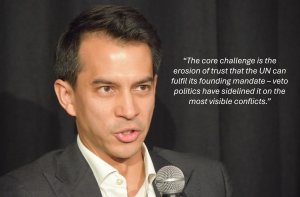
Ryan Neelam, Director Public Opinion & Foreign Policy Program at The Lowy Institute.
Quinlan’s closing words distilled the day’s purpose: “If the UN doesn’t tell its story, others will define it as failure. Action requires leadership – and leadership requires conviction.”
Looking ahead
The conference closed on a note of realism and resolve. Despite funding crises, fractured geopolitics, and waning trust, every session affirmed that reforming the UN is not an act of nostalgia but of necessity. As one delegate remarked, the Charter’s promise endures because “it remains the only institution capable of saving us from our worst instincts – and giving us the means to work together for our best.”



Comments