


Western Sydney University’s Vice-Chancellor shares his journey and vision at the Salaam Institute Sydney event
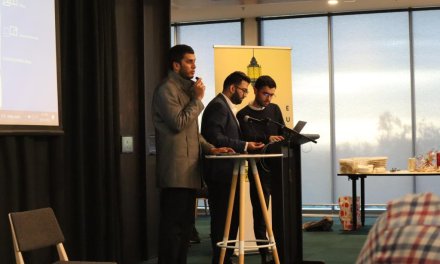
The Salaam Institute hosted a candid conversation between Professor Talal Yassine AM, Managing Director of Salaam, and Distinguished Professor George Williams AO, Vice-Chancellor of Western Sydney University on Wednesday 10 September 2025 at Gilbert + Tobin Offices in Sydney.

The evening, titled “Universities at a Crossroads: A Vice-Chancellor’s Take on Funding, Free Speech, and the Future of Higher Education”, drew academics, students, and community leaders to explore the timely topic with highly engaging discussions.
Talal Yassine opened the evening by introducing the Salaam Institute as “a platform of dialogue, leadership, and community empowerment through events like tonight’s”.

He thanked sponsors including City University, Tender Loving Care, the Raman Sharif Group, and Media Diversity Australia, whose support “makes our meaningful conversations possible”.
Yassine welcomed the guests, noting the “particular importance of course is the role of universities in Western Sydney, with its very large diverse community”.
He acknowledged that universities face “significant challenge from funding cuts, but also technology and AI and changing student populations”.

George Williams’ story
Yassine disclosed that it was his birthday today saying “it was too many years forward to actually celebrate”, before he started the interview by inviting Williams to share his personal journey.
Williams recounted a difficult childhood “from the wrong side of the tracks” in Tasmania and Sydney, where poverty and instability dominated his early years.
A turning point came at age nine when a teacher who gave him “permanent detention every Thursday lunchtime” instead used the time to teach him one-on-one, sparking “a love of learning”.
At 14, the Tasmanian Dams case ignited his fascination with law as “a tool for social justice for environmental activism to drive outcomes”.
Later, working on the High Court’s Mabo case “sealed the deal” in his commitment to “using law to drive an equal and fair society”.

The crisis in higher education
Williams described the current period as the toughest universities have faced: “There’s never been a more tumultuous and difficult time than right now.”
He pointed to government policy changes that “took billions out of the sector almost overnight”, leading to thousands of job losses, including “238 jobs at Western Sydney University”.
Since the 1980s, government funding has declined from 0.9% to 0.6% of GDP, forcing reliance on international students. At WSU, “24 cents in every dollar goes to food programs, devices or learning programs”.
While the government has allowed 25,000 additional international students, Williams admitted, “That’s not enough to reverse the fact that we just don’t have the dollars we needed to pay salaries.”

Free speech and global conflicts
Addressing free speech, Williams affirmed: “We respect freedom of speech, but we have no tolerance for hate speech at all — Islamophobia, anti-semitism, homophobia.”
He stressed that classrooms remain safe spaces: “Protests and megaphones are fine outside of class, but not in classes where political discussion is triggering and students just want to learn.”
On the war in Gaza, he explained the university’s “people fleeing conflict program”, which offers free education and full support for students from conflict zones.
“Thirty-five students so far” have joined the program, which sits outside the international student cap. “Our role is not to take a political stance, but to ask: what can we do? This is your home too. We’re going to wrap our arms around you.”

A strategic vision for western Sydney
Despite the turbulence, Williams expressed pride in WSU’s enduring mission: “Student success, impactful research and serving community.”
The university’s Strategic Plan 2030 includes AI literacy for all degrees, training the workforce for the new airport, and growth in advanced manufacturing and ag-tech.
Williams highlighted WSU’s multicultural strength: “One in two of our students still speak a language other than English at home. We’re arguably the most multicultural community in the globe.”
He also drew attention to social need: “One in two of our students has got food insecurity in Western Sydney. We provided 23,000 free breakfasts and dinners, and operate food pantries.”
The Q&A drew sharp questions from students and community members. On government control, Williams admitted: “The government has an increasing amount of influence… 331 different rules and regulations. Too many of my staff are spent doing compliance whereas I just want more staff in the classroom.”
Asked whether Gaza students were counted in the international cap, he clarified: “Outside the cap interestingly… the government’s been really accommodating with this special category.”
On criticism, Williams said: “I actually embrace disagreement and diversity. I’ve made better decisions where somebody’s disagreed and I’ve had to rethink something. Resilience and persistence are crucial qualities. If I’m wrong, I’ll change. If I’m right, I’ll stick to it.”
Looking ahead, Williams was optimistic: “Western Sydney is the epicenter, the hub of enormous opportunity. Find your passion, include AI in it, but don’t forget the humanities — creative thinking, philosophy, history, literature.”
The evening closed with a sense of urgency and hope: Australian universities stand at a crossroads, but leaders like Williams continue to steer their institutions with resilience, transparency, and an unshakable belief in education’s power to transform lives.



Comments