

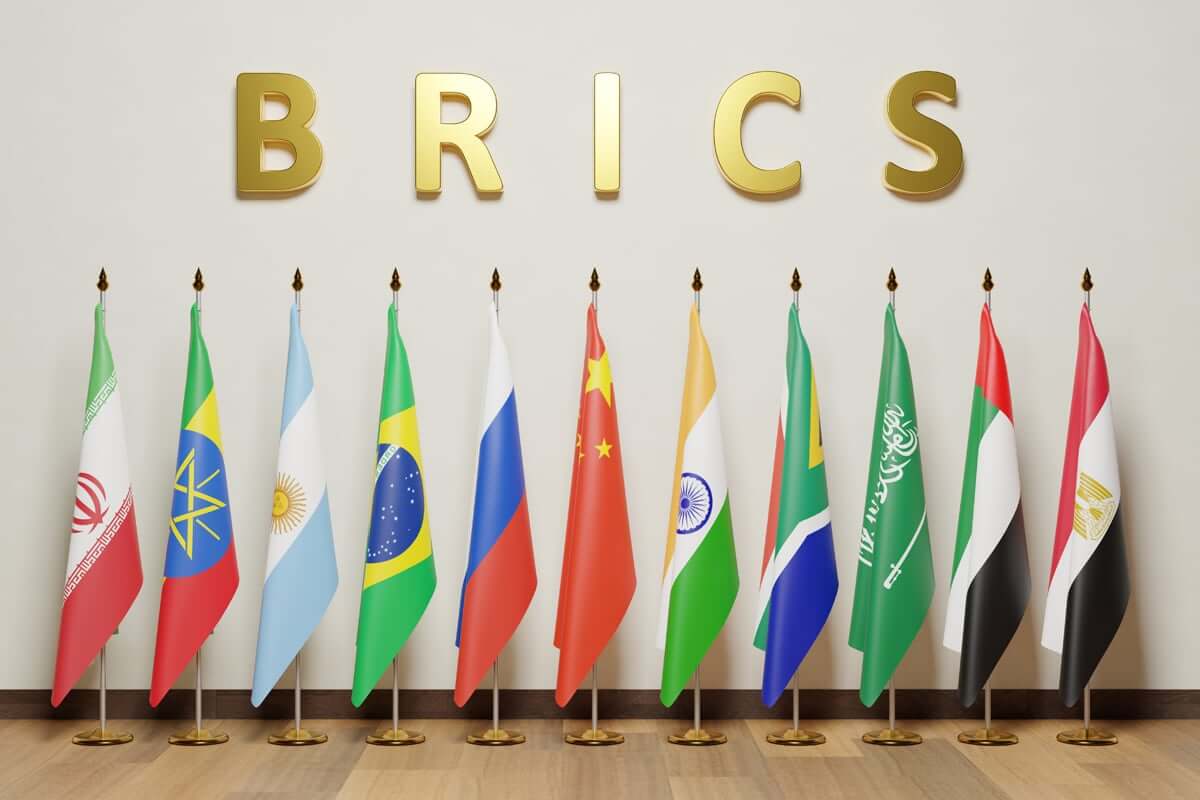
BRICS is Trump’s biggest global test since it poses a fundamental threat to US economic dominance. Having imposed 50% tariff on Brazil and India this aggressive move by Trump reveals a deep fear of the dollar’s decline.
The real question is, can BRICS survive and shift the world’s balance of power? Amid rising tariff tensions, India is walking a diplomatic tightrope, striving to balance its strategic ties with BRICS nations and its relationships with the West.
Yevgeny Primakov, the former Russian foreign minister and prime minister in the late 1990s, is to be credited for visualising the concept of a strategic trilateral grouping of Russia, India, and China (RIC) against US monopoly.
Possibly, Primakov envisioned a multipolar world that would balance U.S. dominance. Later, it transformed into today’s BRICS.
Founded in Russia in 2009, BRICS has evolved into a leading voice of Global South, now comprising 11 member nations and 10 partner countries. Together, they represent around 56% of the world’s population and 44% of the global economy in purchasing power parity (PPP) terms.
BRICS — an acronym for Brazil, Russia, India, China, and South Africa — expanded significantly after its 17th summit, held in Brazil in May 2025.
Egypt, Ethiopia, Indonesia, Iran, Saudi Arabia, and the United Arab Emirates joined as full members, while Belarus, Bolivia, Cuba, Kazakhstan, Malaysia, Nigeria, Thailand, Uganda, Vietnam, and Uzbekistan became partner nations.
The bloc’s rapid growth is undeniable. In contrast, Trump and Western outlets, such as Bloomberg have sought to undermine BRICS’ momentum, framing its success as a threat to degenerate US dollar.
However, every sovereign nation has the right to adopt whatever currency best serves its economic interests, free from imperial coercion.
Notably, BRICS currently comprises emerging economies, with no advanced industrialised nations among its members. This composition positions the bloc as a potential counterbalance to Western economic dominance, particularly challenging the US-led global financial order.
Of BRICS’ various initiatives, its development of alternative payment systems to bypass the US dollar has emerged as Washington’s primary concern – representing both a symbolic and substantive challenge to dollar hegemony.
The 17th BRICS Summit was held in Rio de Janeiro, Brazil, where Brazilian President Luiz Inácio Lula da Silva said, “The world has changed. We don’t want an emperor”.
His statement sent a strong message that drew significant attention in the West. During the summit, it was announced that India will host the 18th BRICS Leaders’ Summit in 2026, with Prime Minister Narendra Modi outlining plans to redefine the grouping’s direction.
Modi’s announcement raised eyebrows among BRICS members; as such, the biggest challenge BRICS may face is within. Modi unveiled a strategic vision for India’s presidency and desire to redefine BRICS as: “Building Resilience and Innovation for Cooperation and Sustainability” emphasising “humanity first” like global south empowerment, climate justice, technology & innovation.
India’s desire from BRICS is something quite different from the other two influential members; China and Russia may not agree with India’s proposal.
China’s vision appears to expand BRICS among BRI nations and the yuan as a payment system alternative to the US dollar, which India may not agree with.
Among other desires, Russia wants to use BRICS countries’ support against Western sanctions, trade of energy & defence technology within BRICS nations, non-dollar payment system. Russia’s vision appears to be political and security-oriented.
BRICS, as a platform for the Global South, is increasingly perceived as an alternative to Western-led alliances.
This is reflected in the contrasting positions within the group—China and Russia openly seek to challenge Western dominance, while India aims to ensure BRICS is not viewed as taking an anti-West stance.
Each of these three influential members appears to have its own distinct strategic interests to pursue within the bloc.
Despite decades of past hostilities, China and Russia have drawn closer in recent years, describing their ties as a “limitless friendship.” However, the third point of this strategic triangle—India—remains less cooperative.
In South Asia’s complex regional and geopolitical landscape, India shows little willingness to ease its rivalry with China. This persistent tension, particularly in the Bay of Bengal region, appears to be reinforced by India’s skewed foreign policy.
Even though India participates constructively in BRICS, its ambition to play a dominant role could ultimately undermine the bloc’s cohesion and success.
Compared to China and Russia, India’s foreign policy often leans more toward alignment with Western powers. This makes it unlikely that New Delhi would seek to position BRICS explicitly as an anti-Western bloc.
However, if BRICS advances its goal of establishing an alternative payment system to challenge the dominance of the US dollar, the United States will inevitably perceive the group as a strategic threat—regardless of the individual motives of its members.
The 17th BRICS Summit was held under the theme “Strengthening Global South Cooperation for More Inclusive and Sustainable Governance.”
Out of 126 commitments, the Key Outcomes from the Rio de Janeiro meeting included: Global South Cooperation and Multilateralism, Climate Action and Green Finance, Economic Sovereignty and Financial Integration, and Opposition to Trade Protectionism and Support for Global Security.
These commitments fundamentally clash with prevailing Western economic and strategic ideas. Consequently, India’s ambitious effort to reframe BRICS will encounter profound structural constraints.
The upcoming 2026 summit in New Delhi will demand masterful diplomacy—forging a common vision for the bloc’s image without alienating members China and Russia, whose geopolitical trajectories diverge sharply from Western alliances.
Navigating this East-West dichotomy amidst rising protectionism represents the central challenge of Indian foreign policy.







Comments