

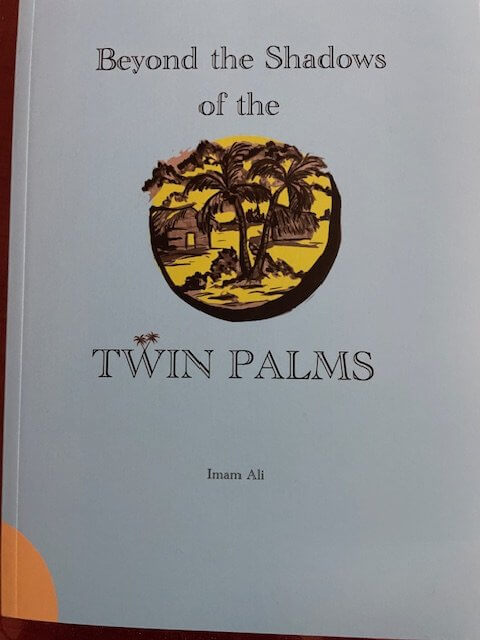
Beyond the Shadows of the Twin Palms, by Imam Ali, Melbourne: 2024, v+229 pp. ISBN: 978-1-7635213-1-5
The title under review here – an autobiography by a retired Muslim community leader – is a timely exposition and a first-rate piece of scholarship regarding the development of the Islam in Australia, Fiji and New Zealand over the past five decades.
Imam Ali from Fiji overcame several serious handicaps as a modern communal leader – the fact that his high level of education placed him firmly in the secular end of religious affairs for instance, and the fact that he grew up in a remote Pacific Island nation of limited means.
In fact, the first half of this book is dedicated to detailing his ancestry – how exactly his forefathers came to Fiji and the environment in which he himself grew up in.
This monograph is one of the first such publications to consider the various cultural and social conditions that have helped shape historic and modern expressions of the Muslim communities of the South Pacific, linking simultaneously South Asian, Arab, African and European Muslim identities, the impact of Western education, and the search for a common language with which to connect the distinctive elements of multiple philosophical suppositions.
It constitutes an important contribution to the field and contains multiple asides exploring oblique community issues and proclivities.
Chapter nine will be of great interest to historians as here Ali explains how he entered Muslim ‘politics’ and climbed up the social hierarchy in three countries through his carefully crafted negotiating skills and his command of details.
His private motto might as well have been the German phrase: wir schaffen das (‘we can do that’).
This book is only 229 pages of text, but it is as colourful and tightly woven as a Turkish carpet, demonstrating not just the many manner that men participate in community affairs, but how such proclivities make successful societies.
It is worth mentioning that the author does not focus or dwell on theology.
The stress here is on the experience of Islam in the south seas rather than an elucidation of the exact mechanical details of the faith; the text combines a surgically precise introduction to Islamic matters only within a broad critique of the mundane realities experienced by Muslims in this part of the world.
By and large, the personal analysis and recollections of Ali are very impressive, and I spotted few egregious mistakes (such as using the appellation ‘Aotearoa’ as a synonym for New Zealand!).
This is a book free from literary artifice and the tedious minutiae of community politics.
In the final analysis, the author of this tome must be applauded for his meticulous and valiant endeavours present a coherent and cogent account of his varied experiences as a Muslim community leader in three different lands.
In short, Beyond the Shadows of the Twin Palms is a charming autobiography, full of remarkable personal anecdotes that will raise many eyebrows and keep fingers turning pages.




Comments