


After becoming Prime Minister of India, Narendra Modi introduced several political slogans aimed at appealing to his supporters, such as “Act East,” “Neighbourhood First,” SAGAR, Make in India and people-to-people connectivity. However, in reality, these slogans seem to resonate more with the Indian media than with actual diplomatic achievements.
The main objectives of Act East policy are to engage Asia-Pacific in economic development, cultural exchange, and strategic and security cooperation through people-to-people connectivity. Modi converted the Act East policy in 2014 from an earlier version of the Look East Policy had no virtual progress.
After the fall of former Bangladeshi Prime Minister Sheikh Hasina, India’s media began portraying all its neighbouring countries as hostile. Consequentially, if India views Bangladesh and Myanmar as hostile, this makes land connectivity to the East nearly impossible, leaving only sea routes as a viable option.
How India’s “Act East” policy will succeed under these circumstances remains unclear. India’s overconfident diplomats and strategists have struggled to establish strong connections with its immediate eastern neighbours, raising doubts about its ability to connect with the broader East Asian region.
It is a fact that Myanmar is aligned with China. In the Maldives, President Mohamed Muizzu came to power with a campaign slogan of “India out.” In Nepal, China is gaining more influence than India. Now, according to India, Bangladesh is also moving away from its traditional alliance with India.
India’s contradictory actions—labelling Bangladeshis as “termites” and lately comment by Home Minister Amit Shah “hang every Bangladeshi infiltrator upside down to give them a lesson” while promoting a “Neighbourhood First” policy—do not seem to align. Given this reality, it is unclear how India plans to implement its “Neighbourhood First” and “Act East” policies effectively.
India’s “Make in India” policy, launched in 2014, aimed to transform India into a global manufacturing hub by encouraging both domestic and international companies to produce goods in India. It sought to reduce dependency on imports, particularly from China, by promoting local manufacturing and self-reliance. In fact, trade between India and China has increased over the years.
Imports from China have continued to grow, especially in sectors like electronics, pharmaceuticals, and machinery, highlighting the ongoing dependence on Chinese goods. This indicates that while the “Make in India” policy aimed to reduce reliance on China, in practice, economic ties have strengthened, reflecting the complexities and interdependencies in the global supply chain.

Courtesy: Export Gemius
Although India strongly supports the 79th UNGA Theme “leaving no one behind”, the reality is that India supported a dictator, Sheikh Hasina and her agendas ignoring the people’s demands of Bangladesh just to fulfil India’s regional hegemony.
The Indo-Pacific Strategy (IPS) has brought two superpowers, the United States and China, along with the regional power India, into a strategic convergence in the Bay of Bengal(BoB) region. Alternatively, one could argue that India’s ‘big brother’ attitude towards its neighbouring countries has pushed these countries to align themselves either with China or the United States. Unfortunately, India does not acknowledge that this shift is a result of its own self-centred diplomatic policies.
China has long sought access to the BoB as an alternative to the Malacca Strait to gain access into the Indian Ocean which is vital for China’s sea route connectivity. It has made significant progress in establishing a connection to the BoB through the China-Myanmar Economic Corridor (CMEC). Additionally, China has secured a lease on Sri Lanka’s Hambantota port, further strengthening its strategic foothold in the region.
Although India tried to connect its hinterland states through the Kaladan Multi-Modal Transit Transport Project it hung in limbo for more than a decade; India’s infrastructure projects like the India-Myanmar-Thailand Trilateral Highway have no significant progress. On the contrary, the Beijing to Bangkok train route is just a few links away. In the last decade, China has had significant engagements with East Asian countries.
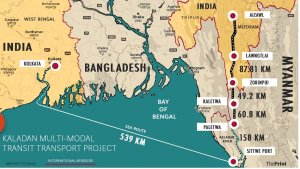
Courtesy: ThePrint
India continues to focus more on rhetoric than actual implementation regarding regional connectivity projects. As a result, the broader BoB region, including Bangladesh, Myanmar, and Thailand, is likely to align more with China than India in terms of connectivity. Additionally, with its control over the Hambantota Port in Sri Lanka, China is poised to exert even greater influence over this region, extending its strategic reach to the Malacca Strait.
How can India get fruitful results from the Act East policy where archrival China remain in the region to counter India in all respects? China seems to have subtly fulfilled the aims of Modi’s Security and Growth for All in the Region (SAGAR) policy, albeit to its own advantage.
India’s foreign policies have often been criticised for their inconsistencies since its independence. Although India maintained a stance of nonalignment, critics point out that it frequently sided with the Soviet Union during the Cold War. After the Soviet Union collapsed, India continued to foster strong ties with Russia.
Together with the United States, India invested over US$ 3 billion in Afghanistan, aiming to build goodwill with the Afghan people and counter Pakistan’s influence in the region. However, the abrupt withdrawal of U.S. forces from Afghanistan in 2021 left many of India’s projects either abandoned or in a state of uncertainty.
India aimed to develop Iran’s Chabahar Port to secure a strategic foothold in the region, but this effort faced obstacles due to China’s significant investments in the same port. Additionally, attempts by India’s Adani Group to invest in Myanmar Port construction and efforts by the Indian government to counter Chinese influence there have not been successful.
After Russia’s invasion of Ukraine, India continued to buy Russian oil at discounted rates, refining it and selling it to European Union countries. This approach has helped India keep its inflation under control, even as inflation has risen in many other parts of the world. However, India’s actions have faced significant criticism from the United States and other Western nations.
The White House has suggested that India could end up on the “wrong side of history” because of its decision. The long-term consequences of India’s choice to purchase cheap Russian oil are still emerging, and it remains uncertain how this will impact India’s position in the future.
In conclusion, the discussion suggests that since independence, India has pursued policies aimed at political gains and regional dominance. Its foreign policies have often not prioritised the well-being of the people in neighbouring countries, resulting in a lack of favourable public sentiment towards India.
As a result, despite being the world’s largest democracy, India has struggled to build strong, positive relationships with any of its neighbouring countries.






Comments