


Household and Inflation
Inflation, the rise in the prices of goods and services, is a pressing issue affecting economies worldwide.
Among the well-known inflation indicators is the Consumer Price Index (CPI), which measures the percentage change in the price of a basket of goods and services consumed by households.
The global inflation surge has been further exacerbated by the previous effect of the pandemic and ongoing conflict in Ukraine, impacting countries like Australia with soaring inflation rates.
As a result, essential commodities like food, housing, fuel, education, utilities, and internet services have witnessed significant price hikes, posing unexpected challenges to residents.
According to recently released ABS statistics, the monthly CPI indicator rose by 5.6% in the twelve months leading up to May 2023. Notably, the most substantial price increases were observed in the Housing (+8.4%), Food and non-alcoholic (+7.9%), and Furniture, household equipment, and services (+6.0%) groups, with house rental prices also showing an upward trend (+6.3%).
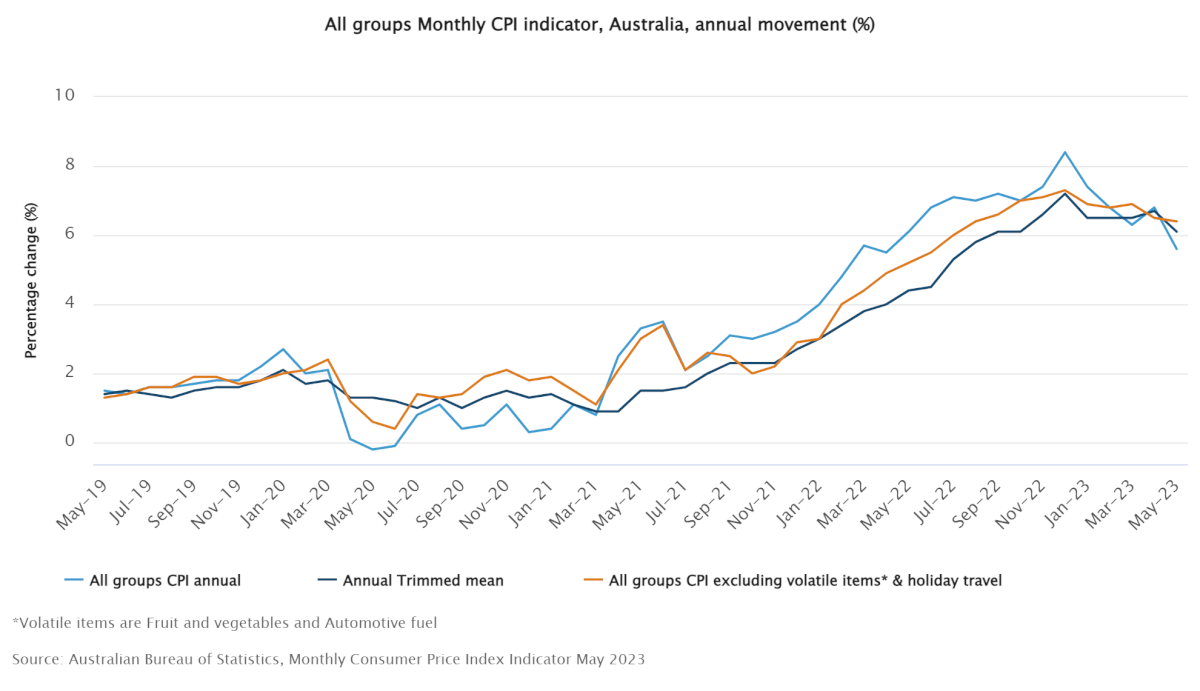
All groups CPI Indicator, Australia. Source: https://www.abs.gov.au/statistics/economy/price-indexes-and-inflation/monthly-consumer-price-index-indicator/may-2023
Strategies to deal with inflation
Being 3.2% of the Australian population, Australian Muslim families are also grappling with the impact of surging global inflation.
Nevertheless, they possess the option to seek guidance from Islamic economic principles to effectively tackle these inflation challenges. Here are some steps that Australian Muslim families can take to manage inflation:
1. Financial Education and Awareness: Raising financial awareness among family members is crucial. Understanding the impact of inflation and adopting sound financial management can help cope with rising prices. For instance, Muslim families can prepare by saving and establishing an emergency fund well in advance. As suggested in Surah Al-Hashr, 59:18 in the Qur’an, Islam encourages preparedness for the future.
2. Thrifty and Budget Planning: Careful budget planning is essential to control expenses. Identifying priority needs and minimizing unnecessary spending can aid in mitigating inflation’s effects. For example: by categorizing needs into Dharuriyyat (essential necessities like food and shelter), Hajjiyat (complementary needs like having a vehicle or cell phones), and Tahsiniyyat (embellishments or desirable like a branded outfit, luxury car, etc), a family can allocate their budgets wisely, reducing expenditure on the latter two categories.
3. Investment and Asset Management: Prudent investment can hedge against inflation. Adhering to Islamic economic principles, Muslim families can consider investing in Islamic stocks or land.
As suggested by in the Qur’an when asked about the interpretation of dreams. Yusuf replied, “You shall plant grain for seven consecutive years and leave the harvested ears, except for what you will eat”. (Quran 12:47)
This verse teaches us the significance of prudent investment. Smart investments can preserve the family’s wealth during times of inflation.
4. Debt Management: Managing debt wisely is vital. With regard to the prohibition of usury in Islam, Muslim families should avoid debt with interest and seek alternatives like interest-free loans or fair agreements with lenders.
As emphasized in the Quran “..Allah has permitted trading and forbidden interests”. (Quran2:75)
5. Sharing with Others: Islam encourages sharing with those in need through zakat and infaq. By extending assistance to the less fortunate, Muslim families can alleviate the impact of inflation on vulnerable communities.
This practice of giving back not only fosters unity but also attracts blessings, as indicated in a popular hadith “Alms do not reduce wealth.”
The outlined steps above are based on Islamic economic principles and can be tailored to each family’s unique financial situation and needs.
Embracing the spirit of sharing and caring for one another is essential in confronting economic challenges, including inflation, and hopefully, it will foster unity and solidarity among the Muslim community in Australia.
Ashabul Kahfi Islamic Centre
In response to the need to educate young people and Muslim families in Sydney about Islamic financial planning, the Ashabul Kahfi Islamic Centre started and offers short courses on family financial planning based on Islamic principles. These courses have been conducted several times in the past online or onsite.
Family financial management issues such as the Islamic view of wealth, emergency funds, Sharia investment, and inheritance are covered in-depth by well-trained speakers.
Email akic.office@gmail.com to further request information about the course.






Comments