


“inspiring”, “engaging”, “innovative”, “amazing”, “empowered”, “love the Islamic perspective”, “so glad I came to it”, “nothing like what I have attended before” are some of the reflections of Imams and Muslim leaders that attended the 2-day intensive Domestic and Family Violence Upskilling for Imams & Community Leaders 2022 event on 22 and 29 October 2022 in Adelaide, South Australia.
The event attracted Imams & Muslim Community Leaders in Adelaide and was collaboratively organised by Bosniaks Masjed Adelaide and the Muslim Women’s Association South Australia funded by the Department of Human Services, South Australian Government.
Dr Nada Ibrahim led and co-delivered this signature program with Aunty Debra Bennet (Relationships Australia Queensland) that has been successfully delivered in Brisbane (once) and Melbourne (3 times) since 2018.
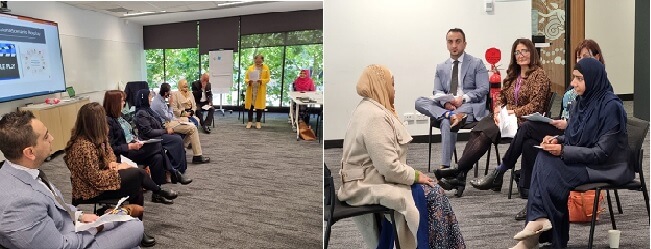
Professional Scenario Roleplay Panel: Imam, General Practitioners, SA Police, Lawyer & Victim Advocate
The Professional Scenario Roleplay Panel was particularly well received involving diverse perspectives of Imam Abdulsalam Alim (Wandana Mosque), two general practitioners (Dr Shakib Ur Rahman and Dr Suhana from Australian Islamic Medical Association), Detective Acting Senior Sergeant Carol Byrnes (South Australia Police), Sari Kheder (Port Adelaide Lawyers), and Namam Salih (Australian Refugee Association) where they illustrated best practices when working with DFV victims.

Group activities on collaboration and gender role origins.
Some creative activities have been introduced and fine-tuned over the years of presenting this signature program to engage learners through auditory, visual and experiential learning techniques. This facilitates a process of continuous active learning that synthesises and crystallises previous knowledge, skills and experiences with new learning.
Role plays identifying DFV in various settings of home, communities, and workplaces were a hit as participants enthusiastically put a show of their award-worthy acting performance skills in display, hammering home how easily harmful DFV behaviours are often accepted in society. By shifting the lens of perception, participants are able to see how they can intercept these harmful behaviours to foster safer families, homes, and responsive workplaces and communities.
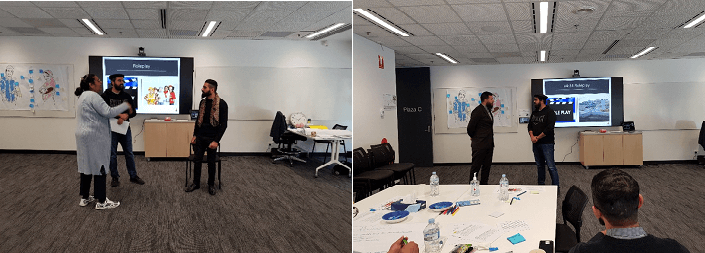
Roleplays to help identify DFV in families, communities & workplaces
Imams and Muslim Leaders enjoyed engaging in healthy discussions in pairs and grouped activities on various topics such as: identifying the multiple origins of gender roles, myths surrounding domestic and family violence (DFV), privilege when dealing with DFV victims, why it is not easy for DFV victims to leave DFV homes, DFV dynamics and statistics, identifying DFV in various social settings, DFV legislation and duty of care, the importance of multi-agency collaboration in addressing DFV, misrepresentation of Islamic scriptures in DFV situations, identifying faith-led strengths of Muslim communities, then creating a collective DFV rehearsed action plan that stems from the strengths of social justice values, community & diversity, and family & marriage.

Imams & Muslim Community leaders engaged in various topical discussions
Alhamdulillah the organisers especially Imam Rijad Jazvin and Sr Urika Ahmad did a fabulous job in helping make this a wonderfully successful event. We thank all the table facilitators and every Imam and Muslim leader that participated to make this a hugely successful event. No doubt the short, medium and long-term goals that the participants have committed themselves to will add leaps and bounds towards collaborative efforts in creating safer Muslim families and communities free of domestic and family violence.

Sharing reflections of the 2-day training and commitments to being DFV agent of change
If you would like this event to be run in your state or your organization, please reach out to Dr Nada Ibrahim on Nada.Ibrahim@unisa.edu.au






Comments